rheoMesh — an AMR-native octree mesher generating both body-fitted prism-layer meshes for FVM and block forests for LBM
English | Japanese
Navigation: design · results and comparisons · development log and detailed history · AMR literature survey · map
Summary: rheoMesh is the mesh generator of OpenRheo. It reads the snappyHexMeshDict and the geometry files as they are, builds a layered FVM mesh (an OpenFOAM
polyMesh) with threads, and also writes an LBM block forest from the same octree. Source: mesh/ (Apache-2.0). Status as of 2026-11-21; all DrivAer figures and numbers are provisional.
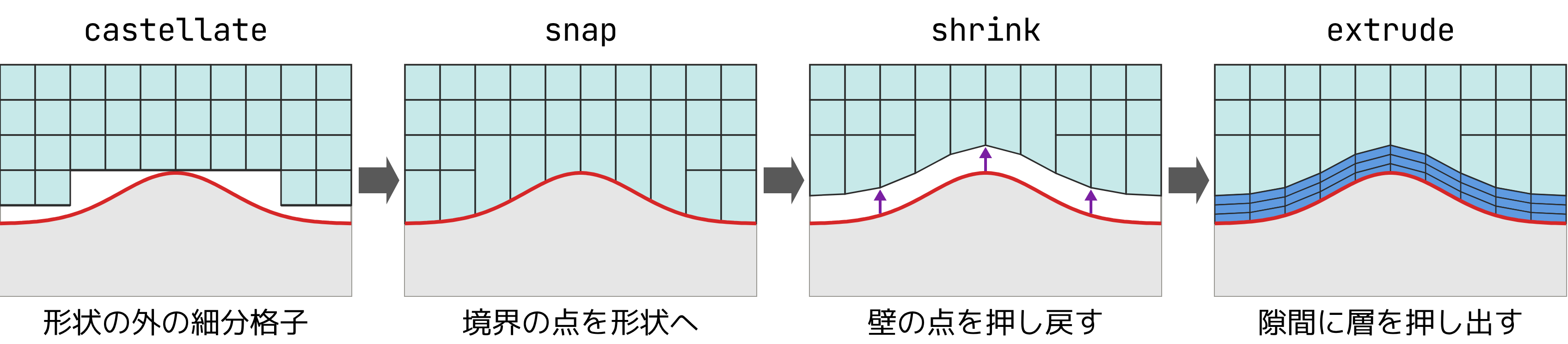
Procedure of the snappyHexMeshLike mode (castellate → snap → shrink → extrude)
- Hex-dominant octree, with conformal polyhedral transition cells and prism layers grown from the surface. No OpenFOAM library is linked.
- No domain decomposition. ISO C++ standard parallel algorithms, threads in one process; the same input gives the same mesh bit for bit at any thread count and on any machine.
- Clean-room development. Written only from the specification and the papers and public documents it cites; snappyHexMesh and cfMesh were used as black boxes whose output alone was examined.
The two modes
| snappyHexMeshLike mode (main line) | native method (layers in two passes) | |
|---|---|---|
| How to choose it | RHEOMESH_MODE=snappyHexMeshLike (alias shm) |
no RHEOMESH_MODE; settings in a recipe file |
| Procedure | as snappyHexMesh (castellate → snap → shrink → extrude) | remove cells near the surface from the core, close the space with the pillow and project it onto the wall |
| Status (2026-11-22) | default rule set shm-defaults-v2611.6 |
frozen (2026-11-20); only its layer field was ported to snappyHexMeshLike as S1 |
rheoMesh at a glance
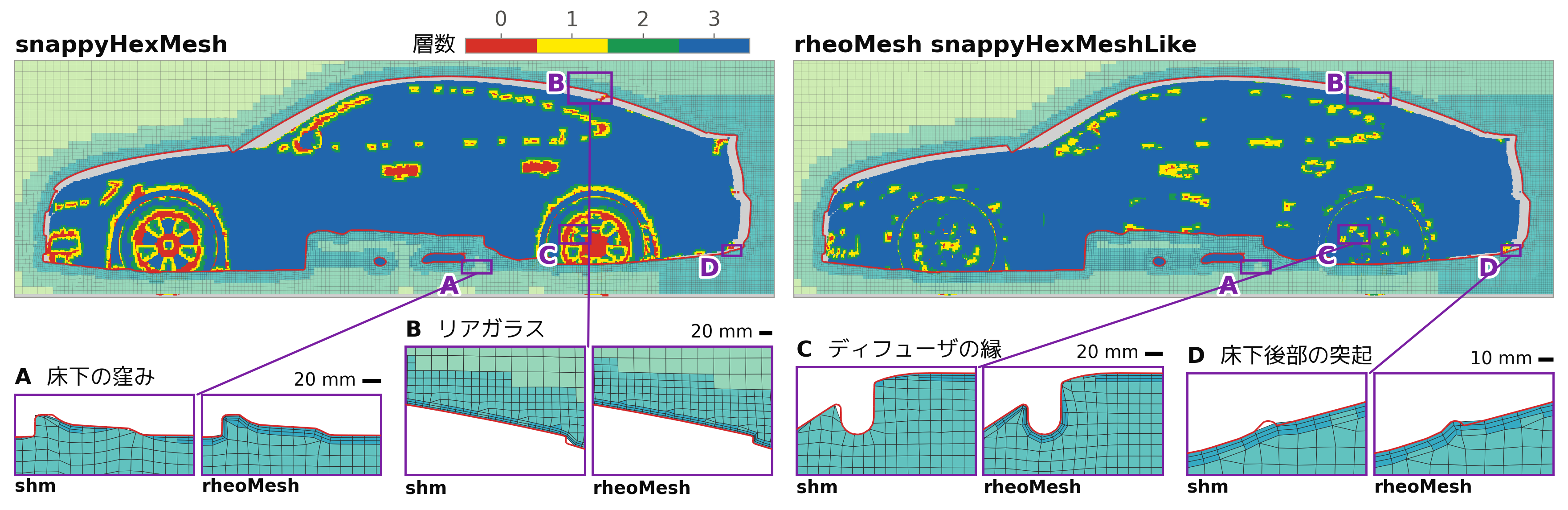
DrivAer centre-plane sections and wall layer counts (left: snappyHexMesh, right: rheoMesh). The layers stay continuous around the wheels.
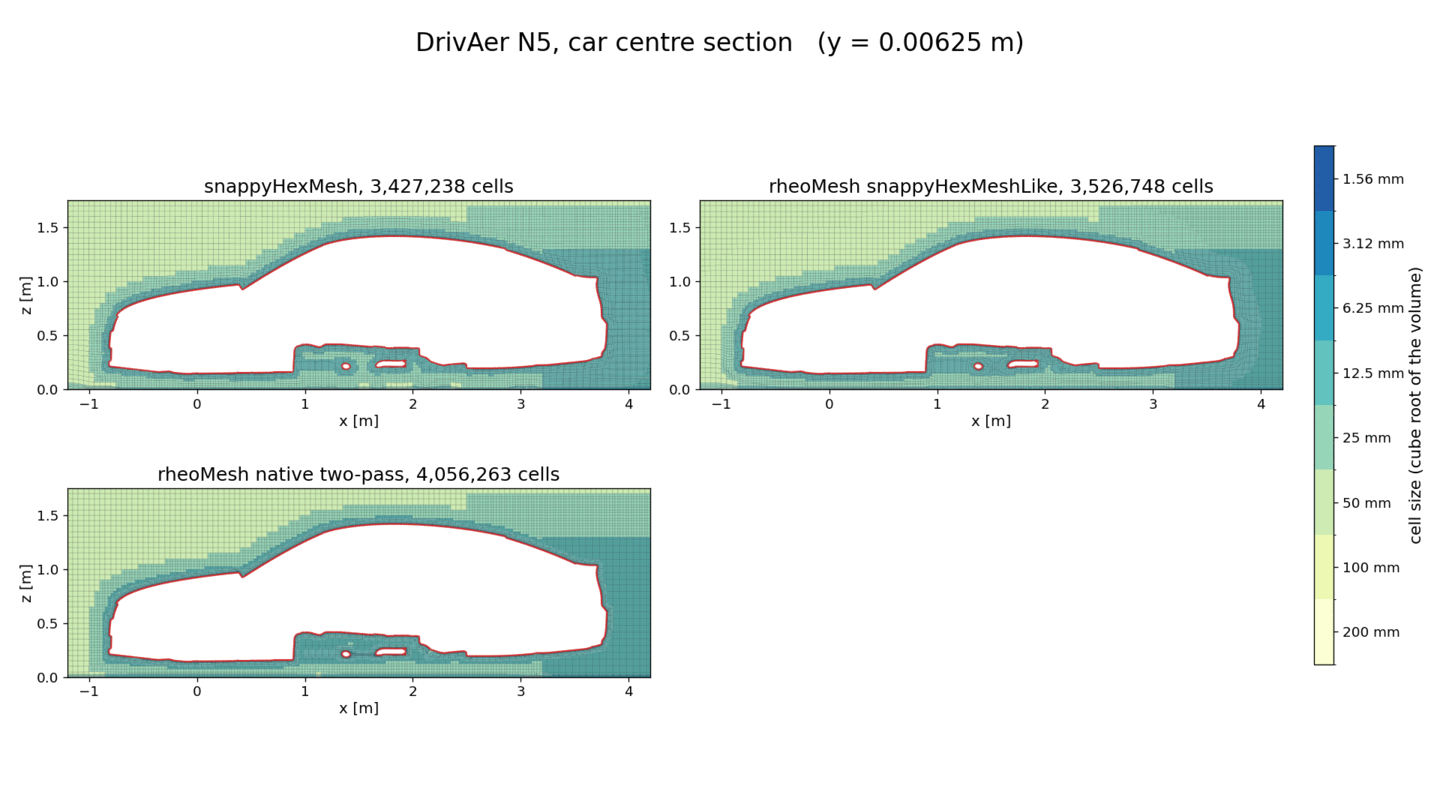 DrivAer centre plane |
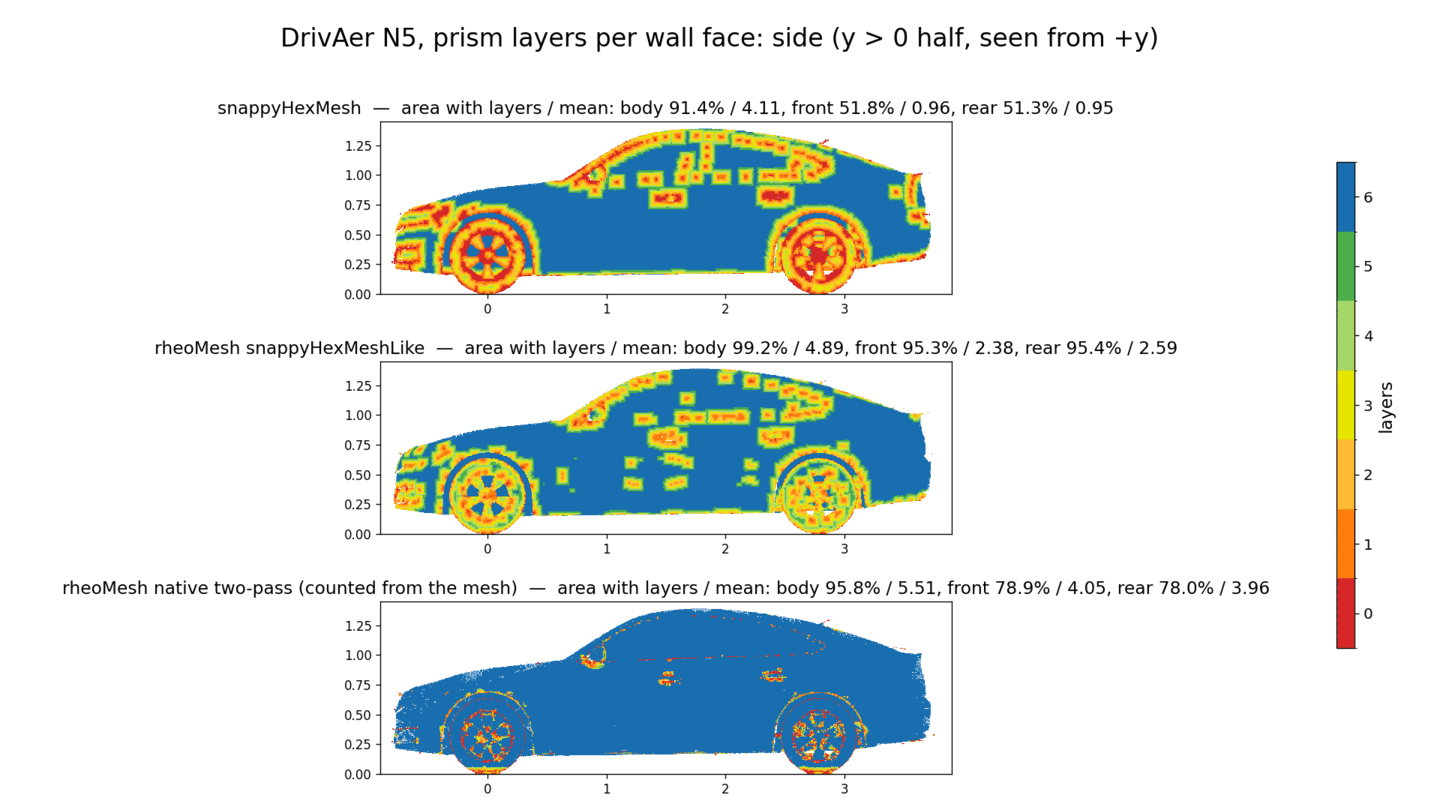 DrivAer boundary layers |
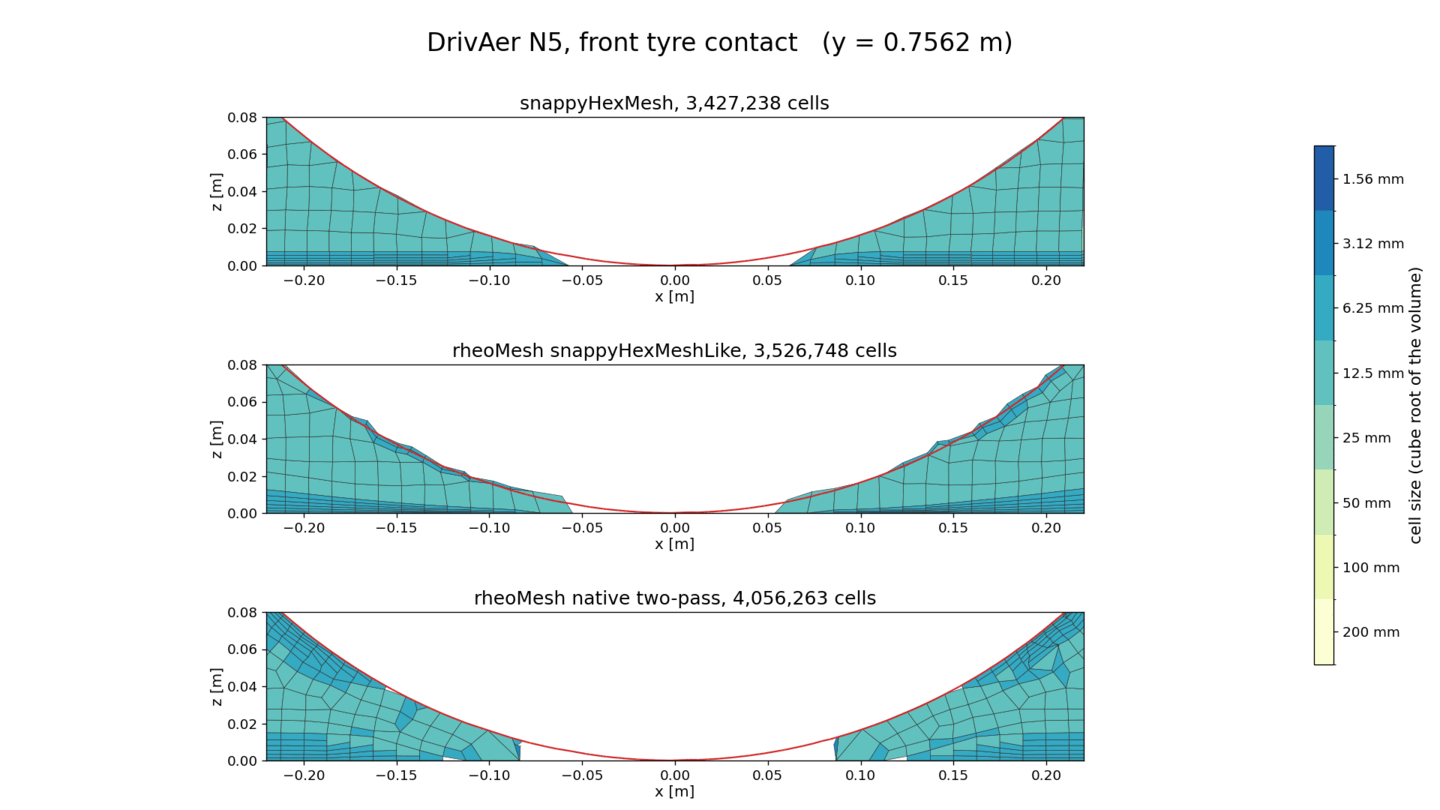 Tyre / wheel boundary layers |
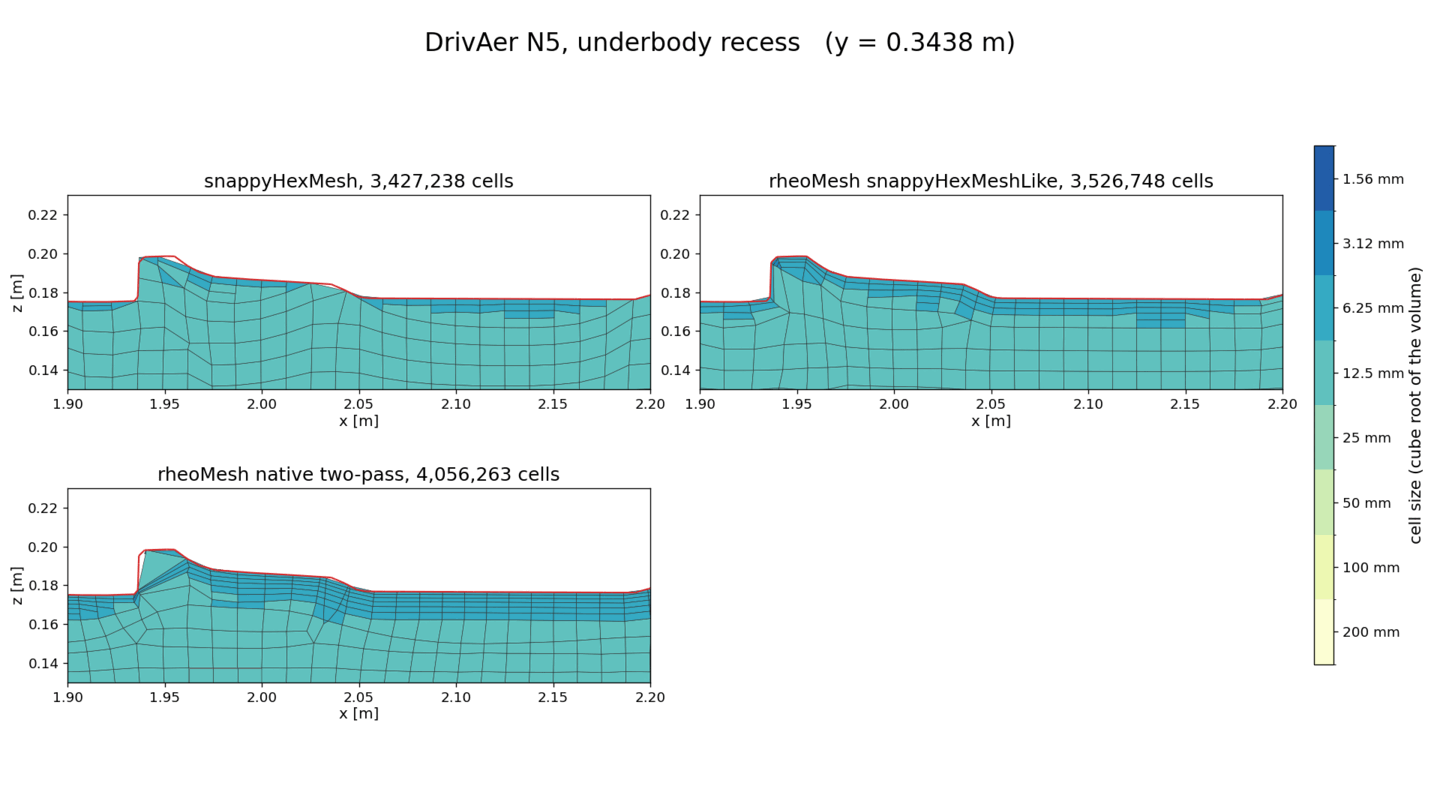 Underbody detail |
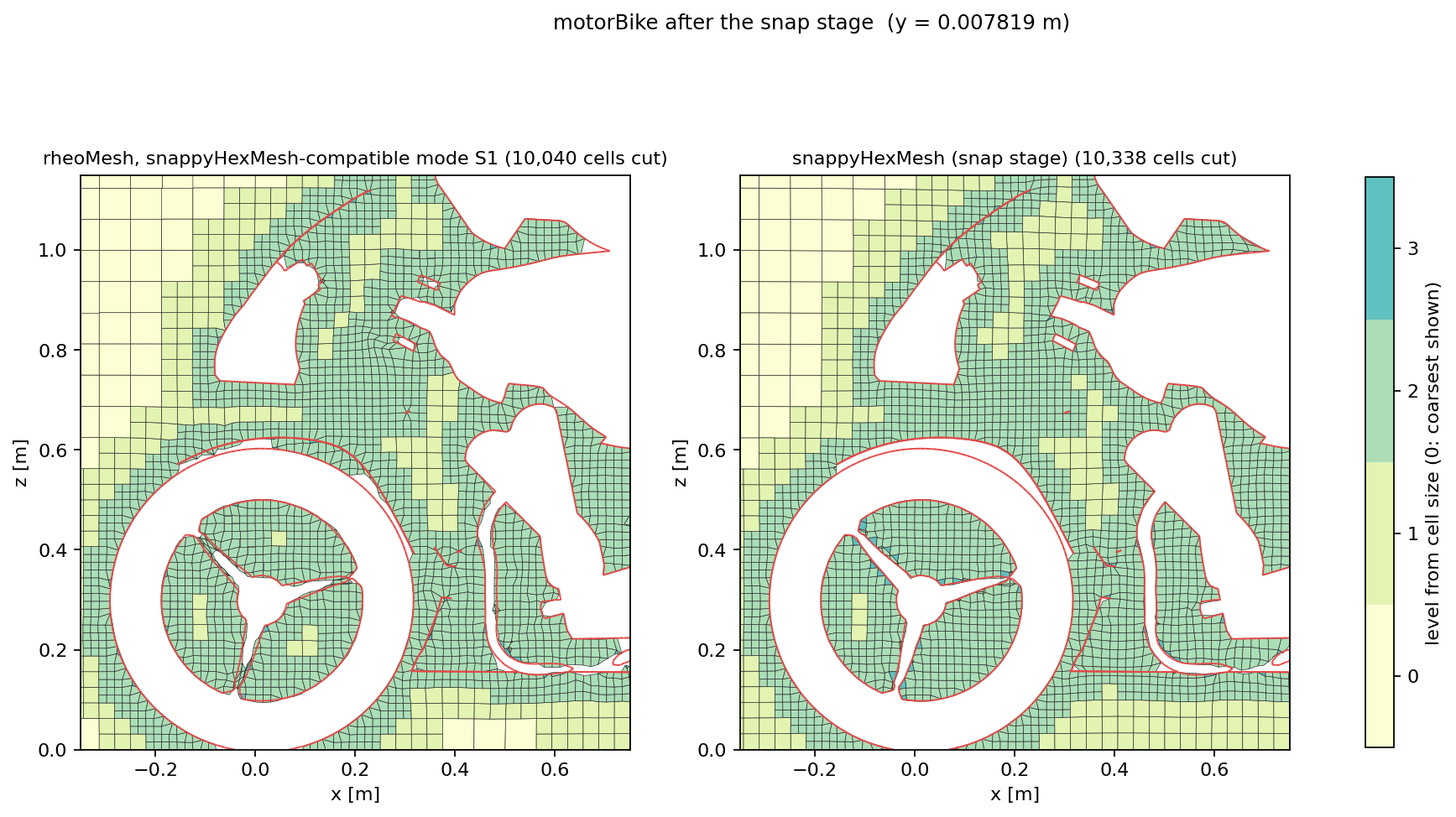 motorBike front |
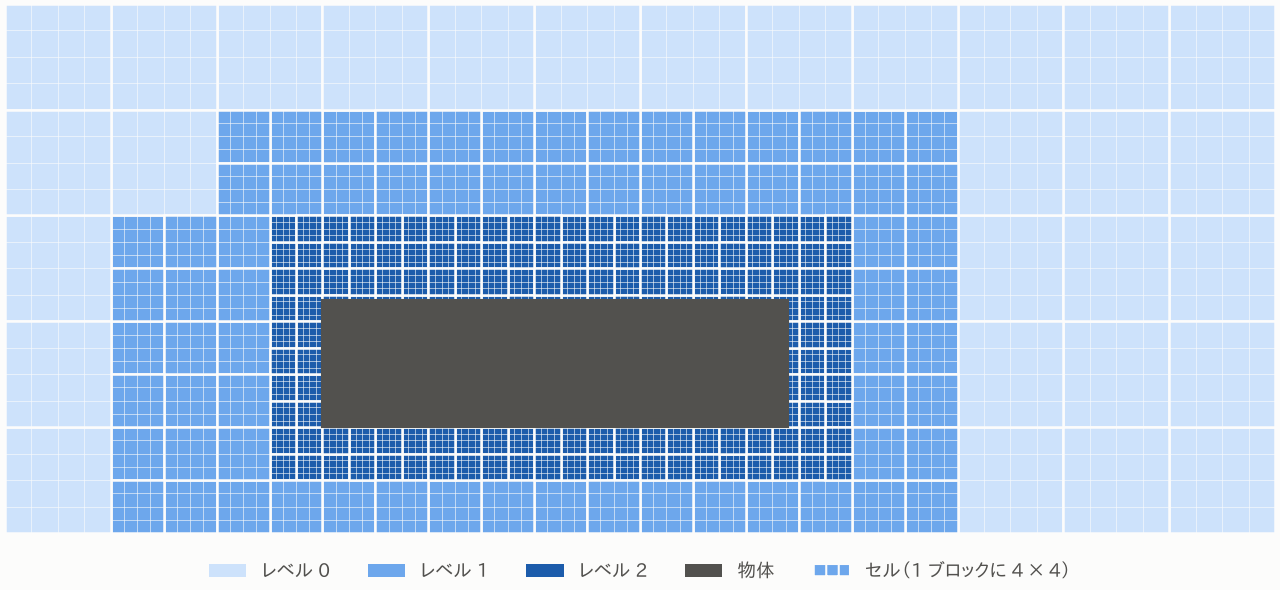 LBM block forest (same octree) |
Headlines
All 88 OpenFOAM tutorials (2026-11-21)
All tutorials with a snappyHexMeshDict in OpenFOAM v2606 (65) and OpenFOAM-13 (23) were run on Miyabi-C. 37 newly pass Mesh OK versus v2611.5, with 0 regressions.
| Mesher / version | Mesh OK (all 88) |
OpenFOAM-13 (23) | OpenFOAM v2606 (65) |
|---|---|---|---|
snappyHexMesh (2026-11-20) |
57 / 88 | 16 / 23 | 41 / 65 |
rheoMesh v2611.5 (2026-11-20) |
45 / 88 | 8 / 23 | 37 / 65 |
rheoMesh integration build v2611.6 (2026-11-21) |
82 / 88 (82/83 runnable = 98.8 %) | 23 / 23 (100 %) | 59 / 65 (90.8 %) |
rheoMesh latest (42f96bce, 2026-11-22) |
83 / 88 (83/83 runnable = 100 %) | 23 / 23 (100 %) | 60 / 65 (92.3 %) |
On the 45 cases both pass, rheoMesh is faster on 40 (median speedup 1.98×). With max_aspect = 950 enabled by default, the sole remaining runnable case airfoilWithLayers (20 layers, expansionRatio 1.5) now passes Mesh OK in 0.93 s (max aspect ratio 203.6), reaching 100 % across all 83 runnable tutorials (the other 5 reference an unreplaced placeholder stlName.stl and cannot be run by snappyHexMesh either). Full table in the detailed history.
Public GitHub snappyHexMeshDict cases (2026-11-22)
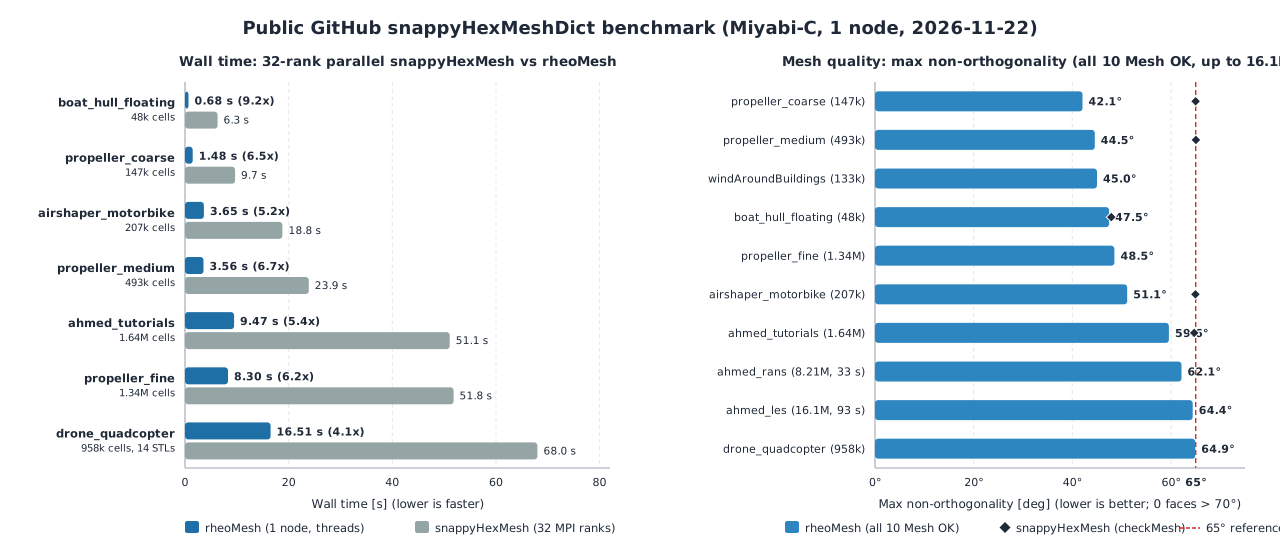
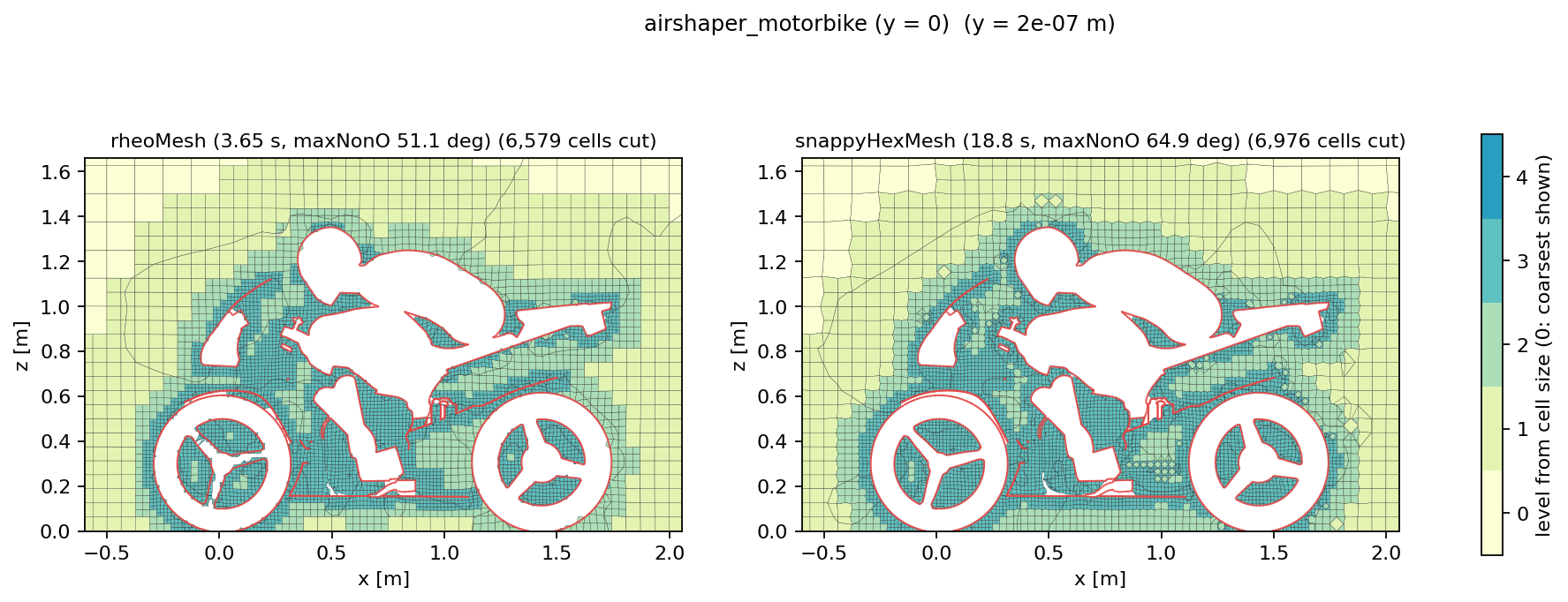
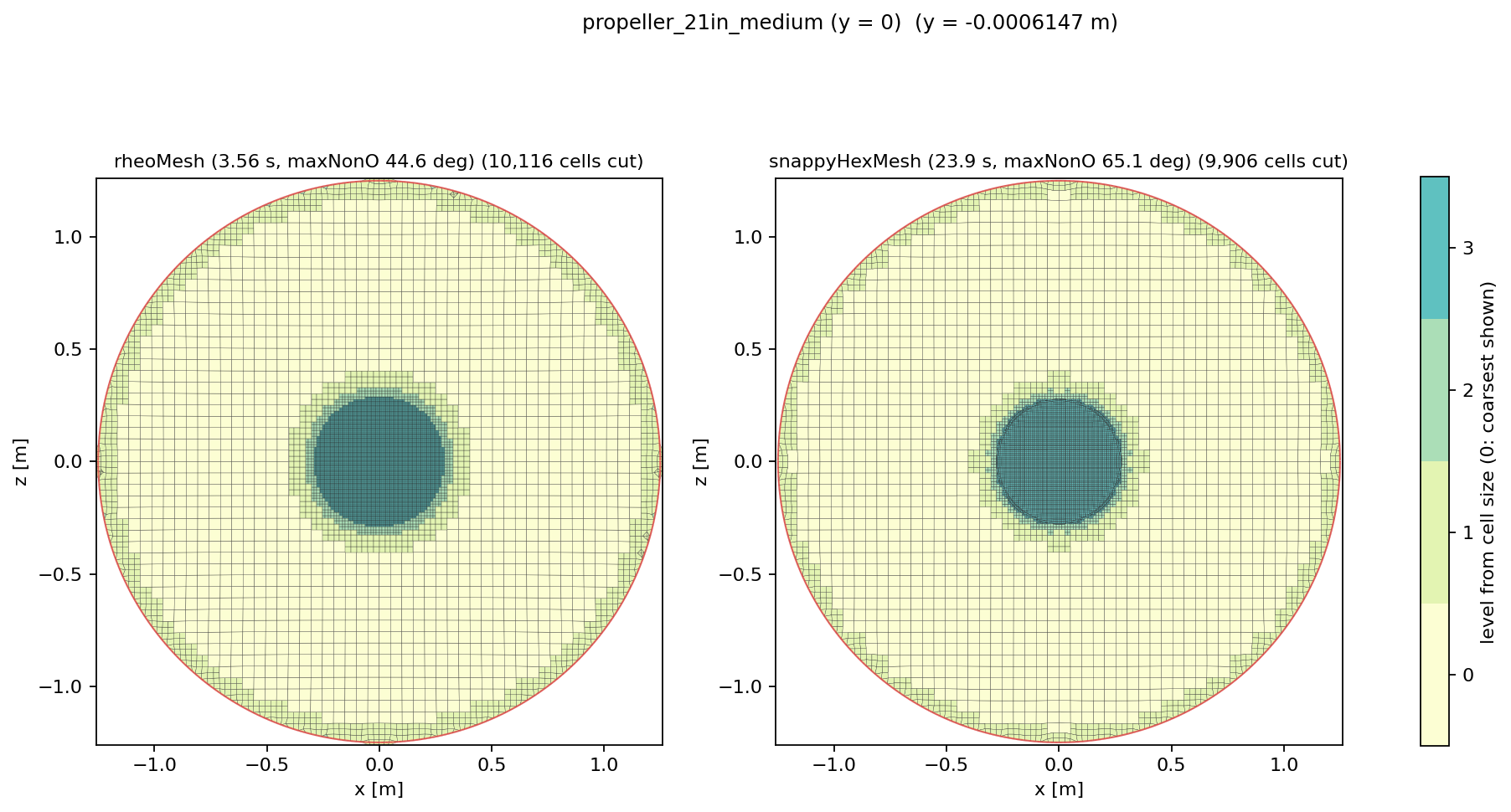
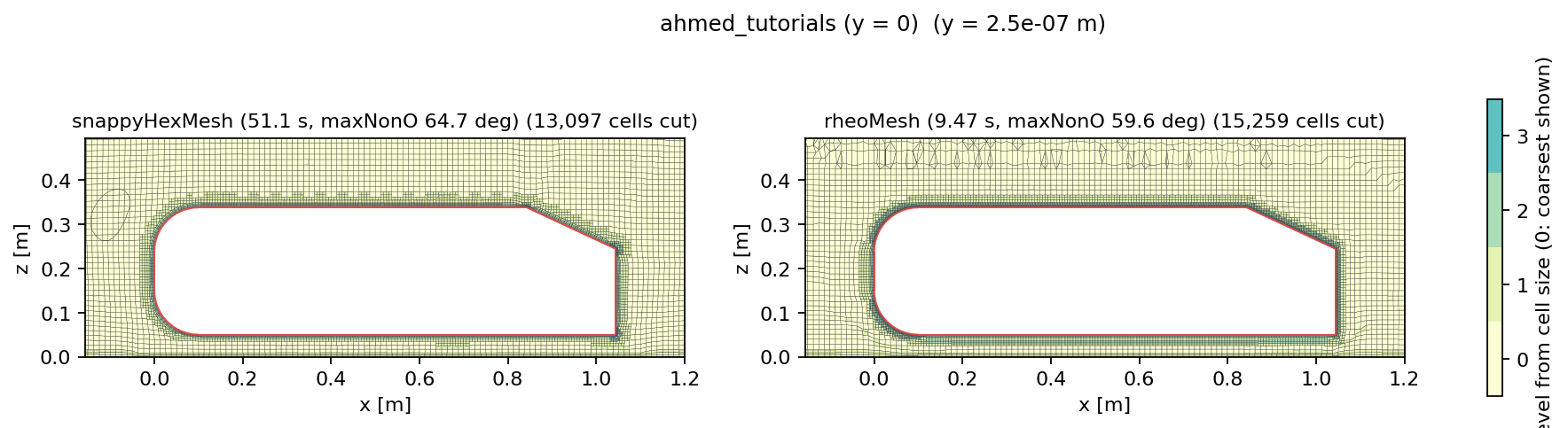
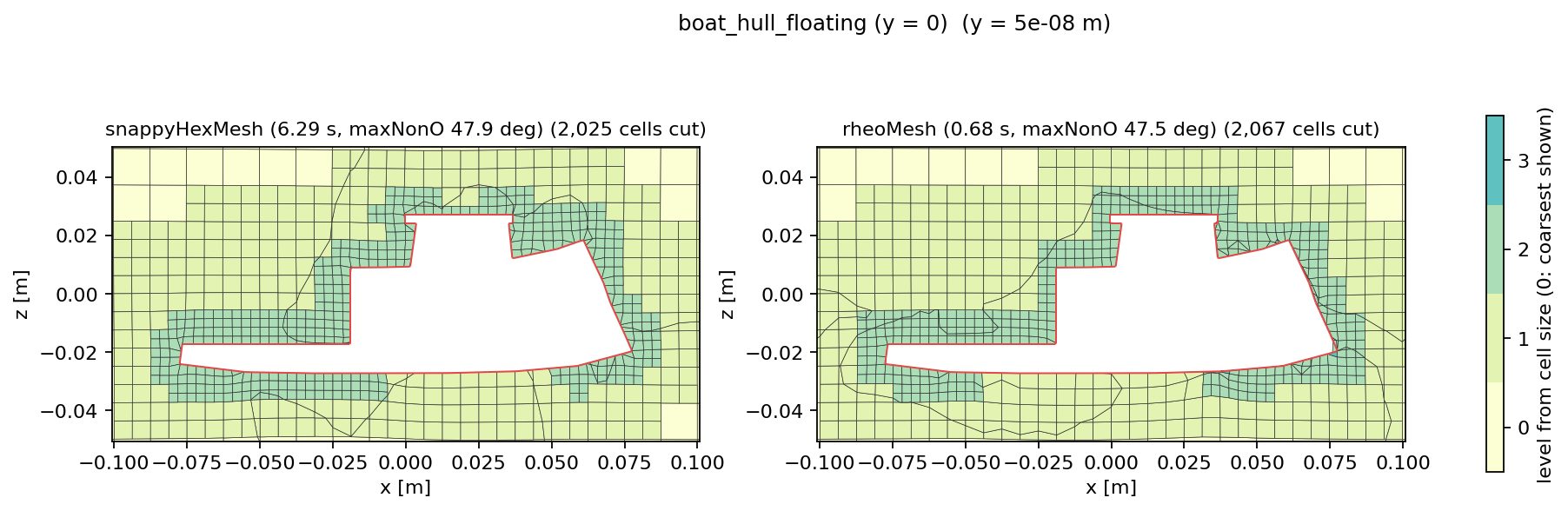
Beyond the official tutorials, public GitHub snappyHexMeshDict cases (external car aero, 21-inch UAV propeller at 3 resolutions, 4-blade quadcopter drone, floating boat hull, urban buildings, and Ahmed body RANS 8.21 M / LES 16.06 M cells) were compared on one Miyabi-C node. All 10 runnable cases pass Mesh OK (0 faces over 70°), run 4.1×–9.3× faster than 32-rank parallel snappyHexMesh, and reduce max non-orthogonality from ~65° to 42°–60°.
airshaper_motorbike (external aero, 5.2× faster) |
propeller_21in_medium (UAV propeller, 6.7× faster) |
|---|---|
 |
 |
ahmed_tutorials (Ahmed body 1.64 M cells, 5.4× faster) |
boat_hull_floating (ship hull, 9.3× faster) |
|---|---|
 |
 |
DrivAer 3 M cells: versus snappyHexMesh (3 layers, updated 2026-11-22)
| snappyHexMesh (3 layers, 11-10) | rheoMesh (3 layers, 11-10) | rheoMesh latest (3 layers, 11-22) | |
|---|---|---|---|
| Time with layers | 37.4 s | 24.0 s | 27.3 s |
| Time without layers | 30.7 s | 8.2 s | 11.6 s (maxNonO 50.3°) |
| Cells (with layers) | 3,068,471 | 3,122,614 | 3,241,521 |
| Faces with non-orthogonality over 60° | 52 | 39 | 37 (max 64.40°, 0 over 70°) |
| Faces with skewness over 3 | 172 | 53 | 27 (max 3.812) |
| Pocket volume between wall and geometry | 841 cm³ | 149 cm³ | — |
| Faces with layers: body | 92.6 % | 98.8 % | 98.9 % (99.4 % by area) |
| Faces with layers: wheels (front / rear) | 58.1 % / 54.9 % | 94.0 % / 94.4 % | 93.4 % / 93.5 % (96.3 % / 96.1 % by area) |
Times are the mesher process only on one node (snappyHexMesh: 384 MPI ranks; rheoMesh: one threaded process). On the same 3-layer setup, the latest build (f61a73b) completes in 27.3 s with Mesh OK, cutting faces with skewness > 3 from 53 → 27 (6.4× fewer than snappyHexMesh) and non-orthogonality > 60° from 39 → 37 (99.9 % ground, 98.6 % total wall faces / 99.9 % by area extruded). Measurement details are in the detailed history.
DrivAer 22.6 M cells: 2-node MPI performance (Miyabi-C, 2026-11-22)
| Item | Result |
|---|---|
| Total time (16 ranks × 14 threads) | 112.09 → 99.69 s (sub-100 s, bit-identical) |
| Layer stage (wall bands + sparse shrink / morph) | 45.67 → 30.94 s (−14.7 s, 1.48×, bit-identical) |
| MPI reproducibility | 0/1/2/4/8-rank comparison 37/37 PASS (RHEOMESH_MPI_LBAND=1, bit-identical to serial) |
| Direct solver-ready decomposition | --decompose N; 0.6 s for 6.3 M cells into 224 parts (19 s with decomposePar) |
| LBM export | rheomesh-lbm writes the octree block forest as .orl (2.03 M cells for the half car, --wall-distance supported) |
With the layer field (S1, opt-in), the 22.64 M-cell DrivAer is Mesh OK and gives Cd = 0.2431 with 448-rank simpleFoam (sting-free reference 0.244). Grid convergence (L1–L4), the v2611.4 / v2611.5 history and the assessment of the frozen method are in the detailed history.
Quick start
rheoMesh is a standalone CMake project in mesh/ of the OpenRheo repository (build and tests in mesh/README.md). Build and generate meshes in a compute-node job; on the login node only fetch sources.
git clone https://gitlab.com/masaz/openrheo.git
git clone -b Nagoya-University-Information-Technology-Center-20261218 \
    https://gitlab.com/OpenCAE/Supercomputer-OpenFOAM-Training.git
(cd Supercomputer-OpenFOAM-Training/Flow2/drivaerFastback/run && ./getGeometry)   # DrivAer geometry

# compute-node job (build + ctest + N5 mesh; give your own queue and group)
qsub -q <queue> -l select=1 -W group_list=$G \
    -v MESH=$PWD/openrheo/mesh,TRI=$PWD/Supercomputer-OpenFOAM-Training/Flow2/drivaerFastback/run/base/constant/triSurface,NS=5,WRITE=1,KEEP=1,OUT=$PWD/rheomesh_runs,RHEOMESH_SETTINGS=$PWD/openrheo/mesh/recipes/core.recipe \
    openrheo/mesh/tools/miyabi/job_castellate_c.sh
N5 gives about 2.86 M cells in about 12 s on Miyabi-C and passes Mesh OK. The GPU (GH200) build variants and job details are in "Building and running a sample on Miyabi" of the detailed history.
Related pages
Design (structure, design principles, quality gates) · Results and comparisons (dated comparisons and figures) · Development log and detailed history (chronological log, comparison tables of other mesh generators, grid convergence) · AMR literature survey · Map