Swinging jet (swing_jet3d) — the effect of swinging, and a check against mistaking turbulence for it¶
English | Japanese
The numbers on this page are taken from §19 of docs/design/ladder-cases-design-2026-08.md (below, "the design document") and from the run output (sw2_*/probe.csv). The numbers in the table were recomputed from the output and checked to agree.
What this case checks¶
When an air conditioner's louvre swings left and right, steady RANS room analyses solve 5 fixed orientations (−45, −22.5, 0, +22.5, +45°) as steady problems and average them with the trapezoidal rule (weights 1, 2, 2, 2, 1 / 8). This case checks what that quasi-steady treatment loses by comparing it with 1 unsteady computation in which the jet swings. It is also a common benchmark for comparing unsteady LBM with unsteady FVM (pimpleFoam) (header of swing_jet3d.cpp).
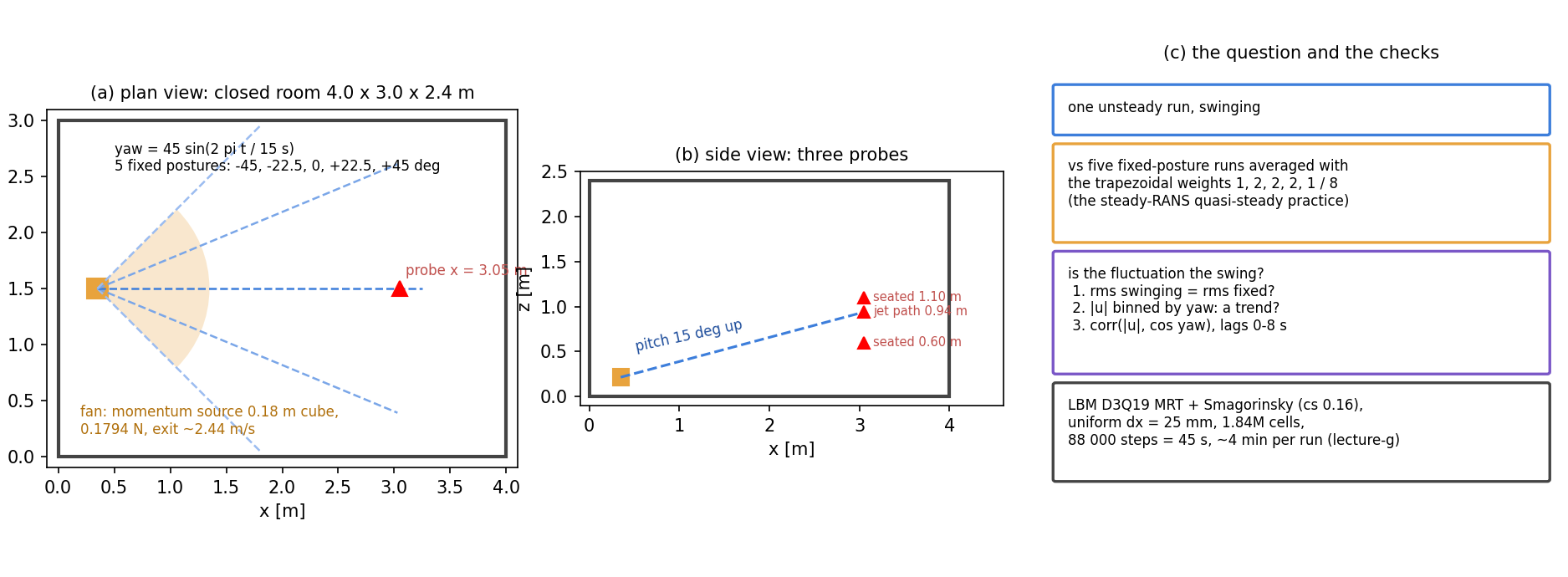
- Room: a closed box of 4.0 × 3.0 × 2.4 m (walls on all 6 faces). Not a real room, but a simple box that isolates only the question.
- Fan: a cubic momentum source with 0.18 m sides (total momentum 0.1794 N, outlet speed about 2.44 m/s). The blades are not resolved. Pointed upward by 15°.
- Swinging: yaw = 45° · sin(2πt / 15 s).
- Probes: 2.7 m from the fan (x = 3.05 m), at z = 0.94 m in the path of the jet, and at seated-person heights z = 0.60 and 1.10 m.
- Computation: D3Q19, MRT, Smagorinsky (cs = 0.16), uniform grid dx = 25 mm (160 × 120 × 96 = 1.84M cells), 88,000 steps = 45 seconds, about 4 minutes for 1 run (lecture-g, job_swing.pbs).
Results (design document §19)¶
| Probe | Swinging mean | Trapezoidal mean of 5 orientations | Difference | Swinging rms | Fixed-orientation rms |
|---|---|---|---|---|---|
| Jet path z = 0.94 | 0.4732 | 0.5131 | −8.4 % | 0.1975 | 0.2057 |
| Seated z = 0.60 | 0.4952 | 0.5500 | −11.1 % | 0.1956 | 0.2113 |
| Seated z = 1.10 | 0.4981 | 0.5281 | −6.0 % | 0.1992 | 0.2182 |
(Speeds in m/s. The swinging run is averaged over the last 2 periods, t ≥ 15 s; the fixed orientations over t ≥ 30 s. The difference is divided by the swinging mean; divided by the mean of the 5 orientations it is −7.8 / −10.0 / −5.7 %.)
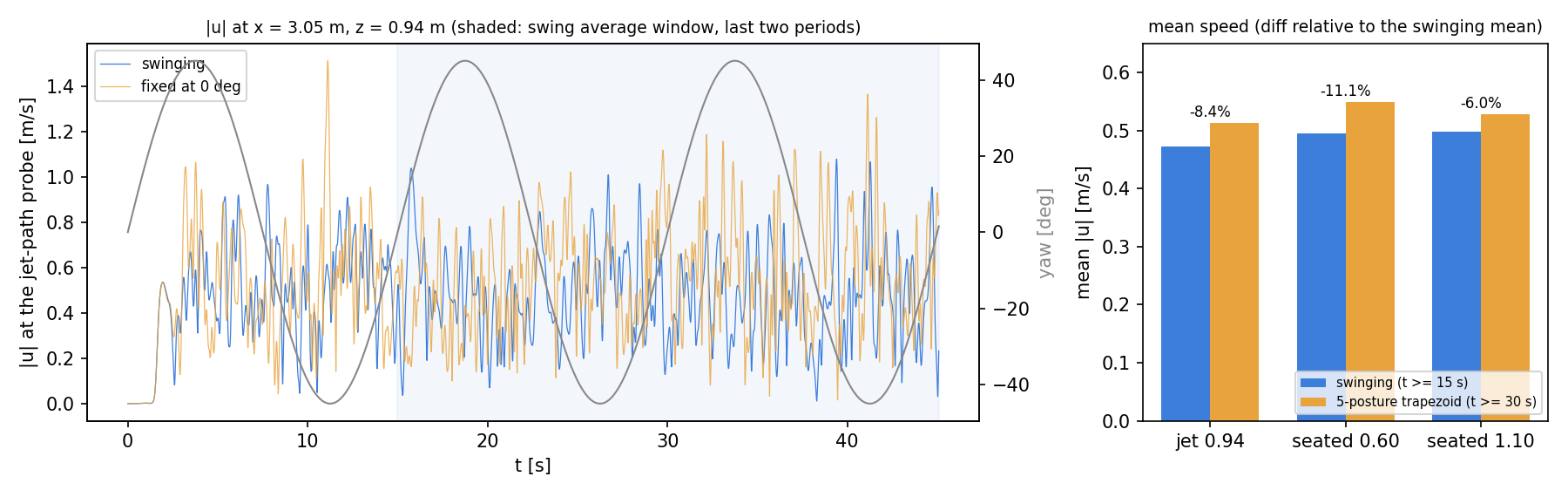
The quasi-steady average overestimates the mean speed by 6 to 11 %. On the other hand, the fluctuation that was thought to be lost in the quasi-steady approach appears with the same magnitude in every fixed orientation.
3 checks that the fluctuation is not being mistaken for the swinging¶
- Is the rms the same?: the swinging rms is 0.20 against a fixed-orientation rms of 0.21. The fluctuation is the turbulence of the jet itself.
- Does a trend appear when binned by angle?: binning the swinging signal by instantaneous angle shows no systematic trend. Meanwhile, the means of the 5 fixed orientations differ from each other by 15 to 26 %, so the probes are inside the jet and the direction does set the mean.
- Correlation: the maximum of the cross-correlation between |u| and cos(yaw) (lag 0 to 8 seconds) is |r| ≈ 0.20. The swinging explains about 4 % of the variance.
Conclusion (design document): in this configuration, the swinging moves the spatial distribution of the time average, and that is captured by the average over orientations. It adds almost nothing to the temporal fluctuation at a point. The ISO 7730 draught rate is determined by the mean speed and the turbulence intensity, so if the turbulence belongs to the jet itself, swinging does not change the draught rate much.
The first version (probes in the wrong place)¶
The first version released the jet horizontally from z = 0.215 m, and the probes were only at seated heights. All runs gave 0.46 to 0.56 m/s, mean differences of 0.6 to 3.1 %, and 42 % fluctuation; they were not measuring the jet. The current version points the jet upward by 15° (the outlet direction in the steady room model) and adds the jet-path probe.
Open points¶
- The 3 checks have no numerical thresholds; the judgement is made in prose. On re-examination, the trend binned by angle depends on how the binning is done (binning by absolute angle, it increases 0.41 → 0.50 m/s at the jet path), and the maximum correlation moves between 0.07 and 0.26 depending on the averaging interval. "No trend" and "4 %" depend on the interval and the binning.
- The averaging interval differs between the swinging run (last 30 seconds) and the fixed orientations (last 15 seconds); aligned to the same interval (t ≥ 15 s), the differences become −6.7 / −8.0 / −5.5 %.
- The FVM computation has not been done yet ("Still owed" in design document §19). These are LBM-only results at 1 resolution.
- It runs on the AMR machinery but uses no refinement; the grid is uniform.
- "2 probes" in the header is outdated; there are now 3.
Circulator swing in the apartment LDK¶
From the OpenCAE Symposium 2026 talk. Unlike the simple box above, this is a real LDK: the intermittency that a swinging circulator brings to the seat is evaluated with a buoyant unsteady LBM. The steady FVM velocity and temperature are mapped onto the LBM grid as a base state held by a force and a heat source, and the LBM solves the fluctuation (Multi-fidelity). Off, and swinging (±45°, 60 s period) at 1/9, 2/9 and 4/9 flow, compared 30–90 s after the swing starts.
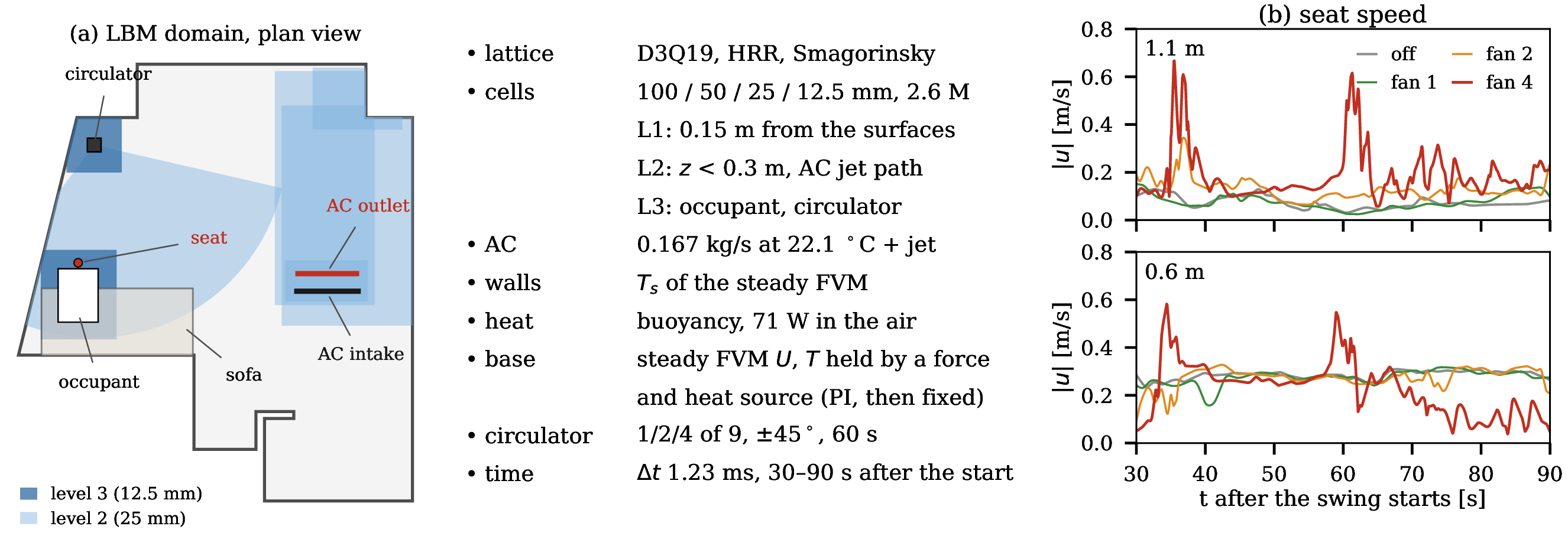
D3Q19, 100 mm base refined in 3 levels to 12.5 mm around the occupant and the circulator (2.6 M fluid cells); HRR collision with Smagorinsky, Spalding wall function, Boussinesq approximation.
The mean speed and turbulence intensity, MRT and SET*, and PMV and draught rate at the seat against the fan setting are the top row (a)–(c) of the results figure above.
| At the seat | Off | Swing, flow 4/9 |
|---|---|---|
| Speed at the head (1.1 m) | 0.07 m/s | 0.19 m/s (+0.12 m/s) |
| Turbulence intensity Tu at the head | 34 % | 58 % (+24) |
| SET* | 27.3 °C | 27.0 °C (−0.3 °C, cooler) |
| PMV (0 neutral, positive warm) | 0.64 | 0.55 (−0.09, cooler) |