Validation cases and the literature behind them
English | Japanese
This page covers the larger validation cases: the Ahmed body, the AIJ building, the ERCOFTAC wall-mounted cube, the heated cavity and the STL geometry path. For each it says what reference is used, what agrees, what does not, and what is open. The tier of every case is on Validation status; how tiers and gates work is on Validating against a reference.
Reference data. Data measured by others is not shipped when its licence is
non-commercial or unconfirmed: the Ahmed body (ERCOFTAC case 82,
CC BY-NC-SA 4.0) is fetched by scripts/fetch_reference_data.sh, the cube data
by hand. The AIJ Case A profiles are the one exception, redistributed for
validation.
Ahmed body (25° slant)
The drag to compare is the pressure drag: on the D3Q27 cumulant forest (nh 16, three levels) it is 0.317 against 0.285 measured, about 11 % high (2026-07-23). Friction is not trusted (see Turbulence and walls).
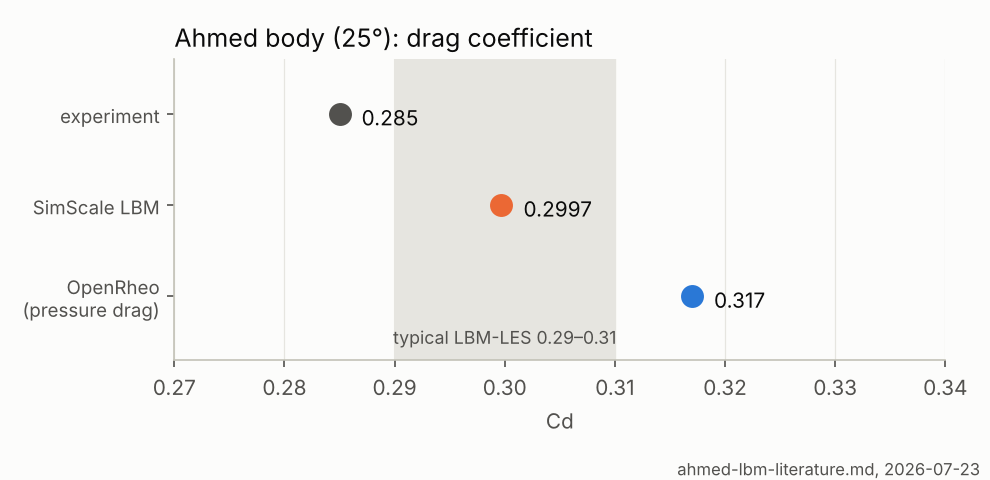
The pressure on the slant is the open point: Cp about −0.20 against −0.57 measured. A finer grid and other subgrid models (dynamic Smagorinsky, a lower constant, WALE) did not change it. The ctest of this driver is a smoke test only (a finite Cd between 0.2 and 5.0), not a validation.
AIJ Case A (a 1:1:2 building)
forest_building and forest_aij_d3q27 run the case with the measured inflow
profile (Meng & Hibi) and a digital-filter inflow turbulence. The quantities
are the mean field (roof reattachment, the cavity, velocity profiles); no
comparison number has been recorded yet.
ERCOFTAC case 41: the wall-mounted cube
D3Q27 cumulant with Smagorinsky, the Spalding wall model and a digital-filter inflow built from the measured profiles. The reattachment length behind the cube depends on resolution, not on the Smagorinsky constant (0.065 and 0.10 gave the same value at H/16):
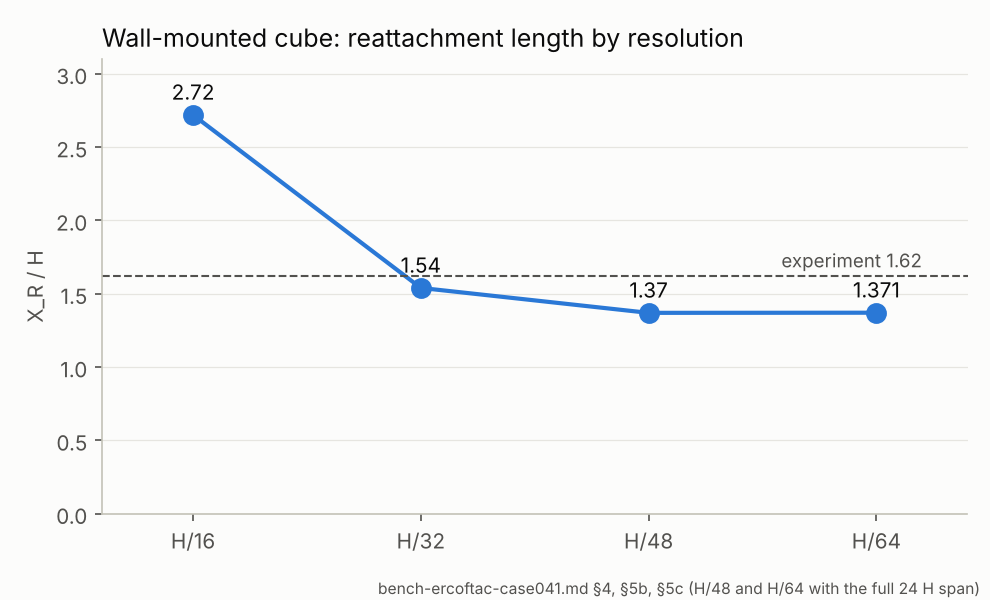
Runs with several seeds showed that the effect of the spanwise width lies inside the seed scatter, so the drop below the experiment comes from resolution. The production run (H/48, the full 24 H span) scaled from 631 to 4266 MLUPS on 1 to 8 GH200 (84 %); a CUDA path made the step 8.5 times (FP64) and 11.0 times (FP32 collision) faster than stdpar on one GB200. Figures and profiles are on the case page. The OpenFOAM RANS baseline was set up but not run.
Of the ERCOFTAC SIG15 cases in the OpenCAE V&V suite, only 6.3 (this cube) is run. The diffuser (8.2), the hill (4.2) and the hump (11.1) were ranked next and have not started.
The heated cavity (thermal LBM)
Double-distribution thermal LBM (D2Q9 flow, D2Q5 temperature) against de Vahl Davis:
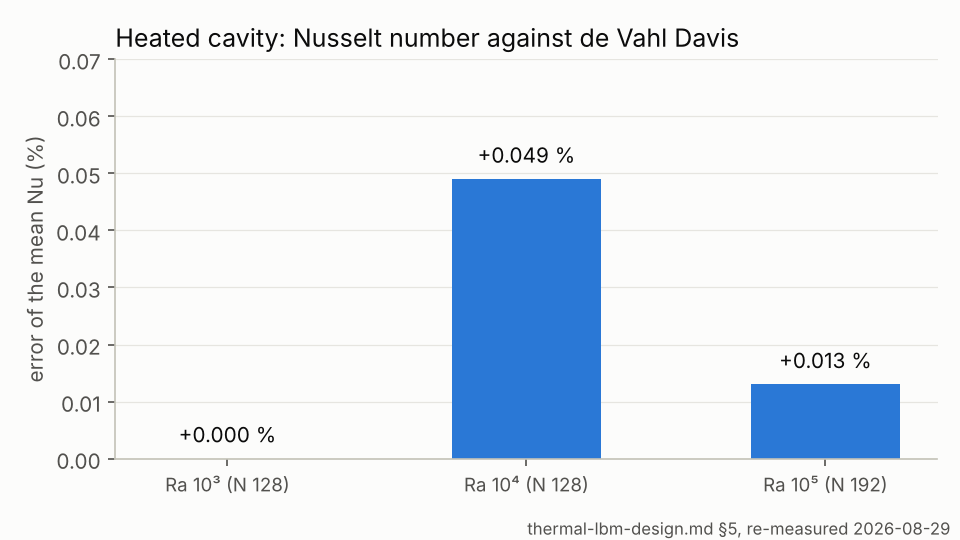
An earlier statement that the Nusselt number was "within a couple of percent" was wrong by two orders of magnitude and had spread into the catalogue, the roadmap and a manuscript; the check was re-run and corrected on 2026-08-29. In 3D the first two checks pass; the cubical cavity is not claimed because the reference data is missing.
STL geometry
stl_geom.hpp voxelizes an STL surface with a bounding-volume hierarchy and
a signed distance from angle-weighted pseudonormals, behind the same
solid/fluid predicate as the analytic shapes. Its ctest checks reading, an
open-surface audit, the sign and distance, and that the mask matches the
analytic sphere. The drag regressions planned for a sphere and an Ahmed STL
have no recorded result.
Still open
- The slant pressure of the Ahmed body, and the wall model behind it.
- A recorded AIJ Case A comparison.
- The OpenFOAM baseline of the cube, and the SIG15 cases after 6.3.
- The 3D heated cube (reference data).
- Drag checks for STL geometry.
Design records
Frozen; they are not updated and are not translated.
- ahmed-body-lbm-literature.md, ahmed-lbm-literature.md — the Ahmed body and LBM literature
- aij-case-a.md — AIJ Case A
- bench-ercoftac-case041.md — the wall-mounted cube
- ercoftac-sig15-coverage.md — SIG15 coverage
- thermal-lbm-design.md — thermal LBM
- stl-voxelization-design.md — STL voxelization