fda-nozzle3d
英語 | 日本語
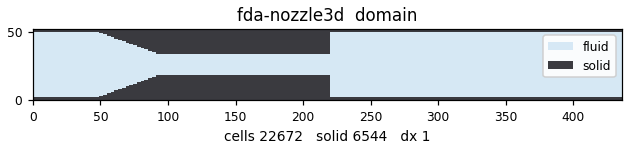
D3Q19 FDA benchmark nozzle -- laminar internal flow through the idealized medical-device / stenotic-tube model: a long inlet pipe, a 20-degree conical contraction, a narrow throat, then a SUDDEN axisymmetric expansion back to the inlet diameter (the "nozzle", flow-through direction). The throat jet accelerates by continuity, and downstream of the sudden expansion the static pressure PARTIALLY recovers (Borda-Carnot) as the jet decelerates and breaks up. This single case covers the OpenLB aorta3d / nozzle3d menu items.
概要: FDA が策定した医療機器評価用ノズル。急拡大部の圧力回復とスロート速度を見る。生体医療応用の検証対象として国際的に使われている形状。
Geometry
Animation
Fields
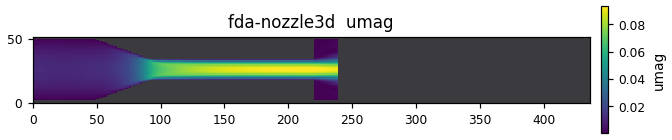
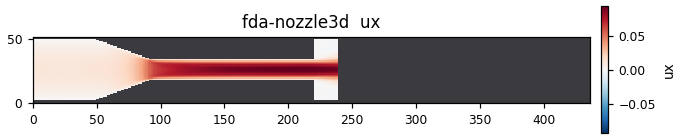
この計算が最後の出力ステップで書き出した場をそのまま描いたもの。3D ケースは中央断面。
Build & run
// fda_nozzle3d [rt] [Re] [steps] [umt] [THR_LD] [Cs] [center.csv] [plane.csv]
このページの図を作った計算のコスト(Miyabi-G Grace CPU (72 cores, -stdpar=multicore)): 50.1 s wall。
Validation
| Tier | T2 — 単点比較 |
| QoI | throat_velocity, pressure_recovery |
| Reference | FDA benchmark nozzle (Hariharan et al. 2011) |
| Gate | — ゲートなし |
Source & run details
| Item | Value |
|---|---|
| Target | orheo-fda-nozzle3d |
| Source | native/benchmarks/fda_nozzle3d.cpp |
| Lattice | D3Q19 |
| GPU twin | no |
| Modules | lbm_d3q19.hpp |
| Gallery run | 2026-07-27 @ 7628c0cf |
| Args | `` |
| Wall time | 50.08 s |
| CPU time | 1975.67 s |
| Device | Miyabi-G Grace CPU (72 cores, -stdpar=multicore) |
Computation log
この計算の実際の出力(先頭と末尾)。
FDA nozzle (Re_t=500, laminar): grid 436x52x52, throat d=16 cells (r_t=8), D_in=48
  layout x: inlet[0,48) cone[48,92) throat[92,220) outlet[220,436)  L/d_throat=8.0
  nu=1.6000e-03  tau=0.50480 (TRT Lambda=3/16 + Smagorinsky Cs=0.18)  U_in(bulk)=0.00556 peak=0.01111  umt=0.0500
  area ratio nominal=9.00  discrete A_in=1804 A_thr=208 (ratio=8.67)
  continuity: U_throat_pred = U_in*A_in/A_thr = 0.04818  (Ma_throat~0.08)
  solid frac=54.1%
  step      0/20000  u_throat_peak=0.04818  outlet_bulk=0.00536  drel_ob=1.00e+00  nsamp=0
  step    500/20000  u_throat_peak=0.05480  outlet_bulk=0.00453  drel_ob=1.54e-01  nsamp=0
  step   1000/20000  u_throat_peak=0.06975  outlet_bulk=0.00417  drel_ob=8.05e-02  nsamp=0
  step   1500/20000  u_throat_peak=0.08458  outlet_bulk=0.00511  drel_ob=2.25e-01  nsamp=0
  step   2000/20000  u_throat_peak=0.09642  outlet_bulk=0.00635  drel_ob=2.42e-01  nsamp=0
  step   2500/20000  u_throat_peak=0.10022  outlet_bulk=0.00644  drel_ob=1.42e-02  nsamp=0
  step   3000/20000  u_throat_peak=0.09957  outlet_bulk=0.00630  drel_ob=2.17e-02  nsamp=0
  step   3500/20000  u_throat_peak=0.09723  outlet_bulk=0.00586  drel_ob=6.86e-02  nsamp=0
...


=== RESULTS (Re_t nominal=500, realized=487; time-avg of 4 samples, stopped early at late-time collector divergence) ===
throat bulk velocity: measured=0.04873  continuity-pred=0.04818  (1.1%)
throat CENTERLINE peak=0.09349  (peak/bulk=1.92; parabolic->2.0)
mass flux Q: inlet=9.9583 throat=10.1360 outlet=10.1530  (conservation spread=1.9%)
pressure: p_inlet=4.362e-03  p_min=-3.432e-04 @x=219  drop(contract+throat)=4.705e-03
  post-expansion recovery = p_out - p_min = 3.432e-04 (7% of the drop)
jet breakup/recovery: centerline within 15% of outlet bulk at x=-1 (-1.0 d past the sudden expansion)
DONE