dkt2d¶
English | Japanese
« Home · « Particles and fluid-structure interaction
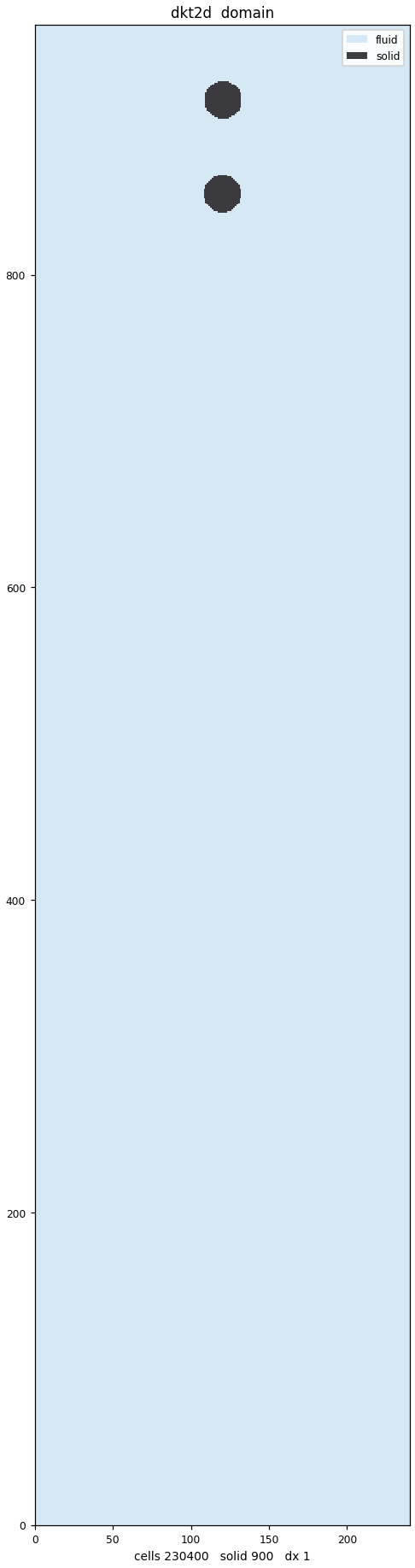
Two-disk drafting-kissing-tumbling (DKT): the classic 2D multi-particle FSI benchmark. Two identical, slightly-heavy circular disks are released from rest one directly above the other in a tall, quiescent, closed channel and settle under gravity. Both are TWO-WAY coupled to the fluid (moving bounce-back + momentum-exchange force AND torque; Newton translation + rotation each). The signature three-stage sequence: (1) DRAFTING -- the trailing (upper) disk falls into the leading (lower) disk's low-pressure wake, feels less drag, accelerates and closes the vertical gap; (2) KISSING -- the two disks touch and briefly settle as a vertical doublet (nose-to-tail); (3) TUMBLING -- the doublet is unstable: it rotates, the disks slide off one another, separate side-by-side and drift apart.
Geometry¶
Animation¶
Fields¶
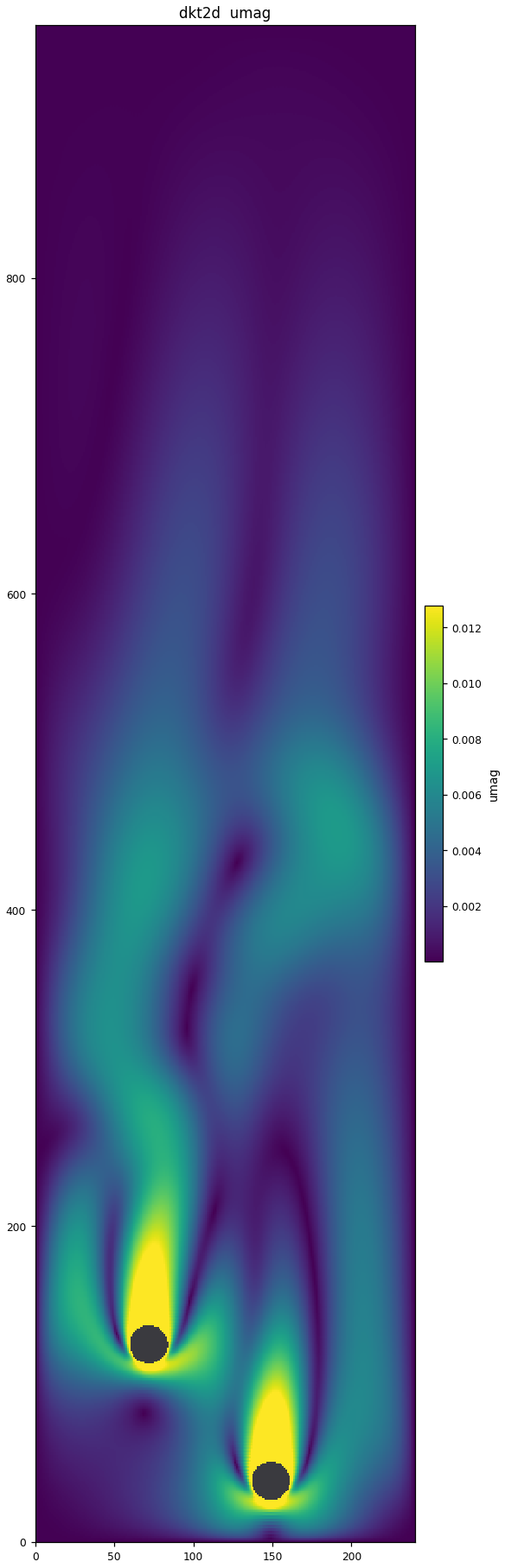
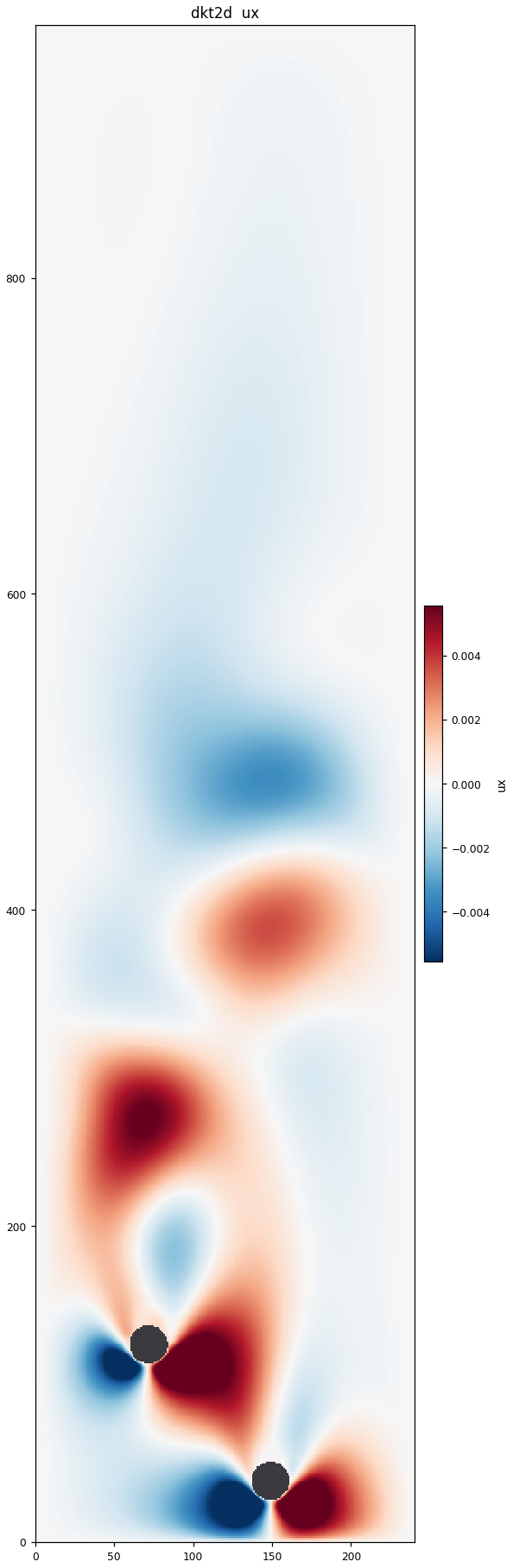
The fields this computation wrote at its last output step, plotted as they are. 3D cases show the mid-plane.
Results¶
2026-11-01: with the new defaults tau = 0.60 and krep_mult = 100 the three DKT stages appear. The figures and the animation on this page are from the 2026-11-02 gallery run with the new defaults (Grace CPU, 72 cores, 20.6 s wall). The 2026-07-27 run with the old defaults (tau = 0.55, krep_mult = 8) diverged (see below).
Results with the new defaults¶
The setting is a 240×960 = 0.23 M cell lattice, d = 24 cells (R = 12), TRT (τ = 0.60, ν = 3.333e-2, Λ = 3/16), density ratio 1.030, g_lat = 1.0e-3, repulsion range 1.5 cells, peak repulsion 100 times the net weight. Upper disk at (120.5, 912), lower disk at (120, 852), centre distance 2.5d, horizontal offset 0.5 cells. The run stops at step 41 800, when a disk nears the bottom wall. The trajectory of the gallery run agrees, to the printed digits, with a verification run made earlier on one CPU core.
| Steps | Surface gap | Horizontal separation | Stage |
|---|---|---|---|
| 0 → 12 000 | 1.50d → 0.06d | 0.02d → 0.09d | drafting: the trailing disk falls into the wake of the leading disk and catches up |
| 12 000 → 16 000 | about 0.06d | 0.09d → 0.64d | kissing: the disks touch and line up vertically |
| 18 000 → 20 000 | 0.16d → 0.96d | 1.15d → 1.83d | tumbling: the pair tips over and the disks change places (at step 20 000 the former upper disk is below) |
| after 20 000 | up to 4.6d | up to 5.0d | the disks separate sideways and settle |
The Reynolds number is about 21 during drafting and about 13 after the separation. With a peak repulsion of 400 times the net weight the trajectory is the same to four digits: the result does not depend on the strength of the repulsion.
What went wrong with the old defaults¶
- tau = 0.55: the rotation of the leading (lower) disk grows exponentially from about step 350 (1e-5 → 8e-3), and at step 570 its velocity jumps to O(1) and the run diverges. In the 2026-07-27 gallery run (status: ok in runs.json only means "the binary exited normally and wrote its artifacts") only the first three rows mean anything; every later row is the ballistic integration of rigid bodies that have lost their fluid links.
- Lowering g_lat to 2e-4 still diverges. A low-pass filter on the force (relax = 0.5, 0.7) only delays it, to steps 13 600 and 23 800.
- tau = 0.60, krep_mult = 8: no divergence, but after the kiss the disks sink into each other (surface gap −0.43d, centre distance 0.58d) and settle as one locked body. The repulsion is too weak.
Governing equations¶
Each disk is a rigid body two-way coupled to the fluid. The Newton equations for translation and rotation
\[
m\frac{d\boldsymbol{v}_p}{dt}=\boldsymbol{F}_h+(\rho_p-\rho_f)V\boldsymbol{g}
+\boldsymbol{F}_{\mathrm{rep}},\qquad
I\frac{d\omega}{dt}=T_h,\qquad V=\pi R^2,\quad I=\tfrac12 mR^2
\]
are advanced with semi-implicit Euler (dt = 1 lattice step). The fluid is D2Q9 TRT (with Λ = 3/16 the bounce-back wall position does not depend on viscosity). The disk surface is a moving-wall bounce-back that carries the local wall velocity \(\boldsymbol{u}_w=\boldsymbol{v}_p+\boldsymbol{\omega}\times(\boldsymbol{x}-\boldsymbol{X}_p)\):
\[
f_j(\boldsymbol{x}_f)=f^{*}_{\bar j}(\boldsymbol{x}_f)
+6\,w_j\,\rho_w\,(\boldsymbol{c}_j\cdot\boldsymbol{u}_w)
\]
Force and torque come from momentum exchange (MEM) on the boundary links:
\[
\boldsymbol{F}=\sum_{\mathrm{links}}\boldsymbol{c}_j\left(f^{*}_j+f_{\bar j}\right),\qquad
T=\sum_{\mathrm{links}}(\boldsymbol{x}_b-\boldsymbol{X}_p)\times
\left[\boldsymbol{c}_j\left(f^{*}_j+f_{\bar j}\right)\right]
\]
(the same convention as the one verified against Clift–Gauvin in sphere_drag.cpp). Cells uncovered by a disk are refilled with the equilibrium distribution at the neighbour-averaged density and the wall velocity (a known delicate step).
\(\boldsymbol{F}_{\mathrm{rep}}\) is a Glowinski/Wan-type short-range repulsion with a gap (xi = 1.5 cells, krep = 6.032e-1 = 100×net weight/xi²; until 2026-07-27 it was 8×, too weak). This is not a contact model but a numerical safeguard against lattice-scale overlap; it acts at positive gap and has neither damping nor friction. Physical soft-sphere contact (DEM) is a future item already designed as the two-layer structure in particles-dem-design.md §9.
Code walkthrough¶
Source (468 lines, single file).
%%{init: {'themeVariables': {'fontSize': '11px'}}}%%
flowchart TB
    subgraph BOX["Closed box 240×960<br/>halfway BB on all four walls / TRT inside"]
      D0["Upper disk d0<br/>moving-wall BB + MEM force/torque"]
      D1["Lower disk d1<br/>moving-wall BB + MEM force/torque"]
      D0 -. "Glowinski repulsion<br/>(gap < 1.5 cells)" .- D1
end- Mask — Each disk is a solid mask with an integer id, rebuilt from its position every step.
- collide/stream — TRT, pull scheme. A solid destination gets the opposite distribution plus the moving-wall momentum term.
- Force/torque — Accumulated for 2 disks in 1 parallel reduction (FT struct).
- Rigid-body update — Semi-implicit Euler with MEM force + buoyancy-corrected gravity + repulsion (around L339).
- Refill — Cells uncovered by a disk are filled with the equilibrium distribution.
- Output — CSV every 200 steps, vorticity snapshot every 4000 steps,
gallery frames only with
ORHEO_WIKI_DUMP.
Build & run¶
Cost of the computation that made the figures on this page (Miyabi-G Grace CPU (72 cores, -stdpar=multicore)): 20.6 s wall.
Things to try¶
- Pin down the divergence at tau = 0.55. Only the rotational degree of freedom grows unstably, so the added inertia of the rotation (at a density ratio of 1.03 the disk's inertia is comparable to the fluid's) or the refill step is the suspect. A run with the rotation held fixed (om = 0) tells the two apart.
- Replace the repulsion with DEM (dem.hpp). In dkt_spheres3d, dem.hpp handles contact and lubrication. See whether the same treatment in 2D removes the repulsion strength as a tuning knob.
- Compare with Feng–Hu–Joseph (1994). Put the sideways separation after the tumble and the time of the tumble next to reference values at the same Reynolds number (the reference values have not been checked yet).
Validation¶
| Tier | T2 — single-point comparison |
| QoI | dkt_timings |
| Reference | Feng, Hu & Joseph (1994) drafting-kissing-tumbling |
| Gate | 🧩 module gate (rigid_body) |
Source & run details¶
| Item | Value |
|---|---|
| Target | orheo-dkt2d |
| Source | native/benchmarks/dkt2d.cpp |
| Lattice | D2Q9 |
| GPU twin | no |
| Gallery run | 2026-11-02 @ 23e1e5f4 |
| Args | `` |
| Wall time | 20.57 s |
| CPU time | 701.57 s |
| Device | Miyabi-G Grace CPU (72 cores, -stdpar=multicore) |
Computation log¶
The actual output of this computation (head and tail).
DKT two-disk sedimentation (D2Q9 TRT, moving BB + MEM force/torque)
  grid 240x960 = 0.23M cells,  d=24 cells (R=12.0)
  tau=0.6000 nu_lat=3.3333e-02 (Lambda=3/16)  rho_p/rho_f=1.030  g_lat=1.00e-03
  net weight/disk=1.357e-02  repulsion: xi=1.5 cells krep=6.032e-01
  upper d0 @ (120.5,912.0)  lower d1 @ (120.0,852.0)  sep0=2.5 d  xoff=0.50
  maxsteps=76800  outevery=200  snapevery=4000
step       0  y0=912.0 y1=852.0  ygap=1.50d xsep=0.02d  vset=(0.0000,0.0000)  om=(-2.8e-20,-5.0e-21)  Re=0.0
step    2000  y0=896.9 y1=836.8  ygap=1.51d xsep=0.02d  vset=(0.0128,0.0129)  om=(-5.6e-06,3.5e-07)  Re=9.3
step    4000  y0=864.4 y1=804.8  ygap=1.48d xsep=0.02d  vset=(0.0193,0.0182)  om=(-1.0e-05,1.7e-06)  Re=13.9
step    6000  y0=820.1 y1=765.8  ygap=1.26d xsep=0.02d  vset=(0.0249,0.0205)  om=(-9.1e-06,4.5e-06)  Re=17.9
step    8000  y0=765.8 y1=723.4  ygap=0.77d xsep=0.02d  vset=(0.0291,0.0220)  om=(-1.9e-06,9.0e-06)  Re=21.0
step   10000  y0=705.3 y1=677.0  ygap=0.18d xsep=0.03d  vset=(0.0306,0.0248)  om=(1.1e-05,-9.6e-06)  Re=22.1
step   12000  y0=646.7 y1=621.4  ygap=0.06d xsep=0.09d  vset=(0.0292,0.0290)  om=(1.0e-05,-5.2e-05)  Re=21.0
step   14000  y0=587.8 y1=563.1  ygap=0.06d xsep=0.25d  vset=(0.0296,0.0289)  om=(5.3e-05,-1.2e-04)  Re=21.3
...

step   28000  y0=287.0 y1=353.4  ygap=4.59d xsep=4.85d  vset=(0.0178,0.0163)  om=(-3.8e-05,1.2e-04)  Re=12.8
step   30000  y0=251.4 y1=320.1  ygap=4.22d xsep=4.36d  vset=(0.0179,0.0168)  om=(-2.5e-05,7.0e-05)  Re=12.9
step   32000  y0=215.3 y1=286.6  ygap=3.84d xsep=3.81d  vset=(0.0182,0.0167)  om=(-2.0e-05,1.4e-05)  Re=13.1
step   34000  y0=178.6 y1=253.0  ygap=3.63d xsep=3.44d  vset=(0.0185,0.0169)  om=(-9.0e-06,-2.6e-05)  Re=13.3
step   36000  y0=141.3 y1=219.0  ygap=3.62d xsep=3.29d  vset=(0.0187,0.0171)  om=(-1.6e-05,-4.4e-05)  Re=13.5
step   38000  y0=103.7 y1=184.8  ygap=3.70d xsep=3.28d  vset=(0.0189,0.0172)  om=(-1.8e-05,-2.4e-05)  Re=13.6
step   40000  y0=66.1 y1=150.5  ygap=3.80d xsep=3.26d  vset=(0.0188,0.0172)  om=(-4.5e-06,-1.9e-05)  Re=13.5
a disk neared the bottom wall; stopping at step 41800.
wrote ./dkt2d.csv  (final Re~12.6)
References¶
- J. Feng, H. H. Hu & D. D. Joseph, "Direct simulation of initial value problems for the motion of solid bodies in a Newtonian fluid. Part 1. Sedimentation", J. Fluid Mech. 261 (1994) 95–134.
- L. Wang, Z. Guo & M. Krafczyk, LBM two-particle sedimentation (2013).
- A. J. C. Ladd, J. Fluid Mech. 271 (1994); C. K. Aidun, Y. Lu & E.-J. Ding, J. Fluid Mech. 373 (1998).
- R. Glowinski et al., J. Comput. Phys. 169 (2001).