bifurcation-deposition3d
English | Japanese
« Home · « Particles and fluid-structure interaction
Particle deposition in a symmetric Y-bifurcation tube -- inertial point- particle deposition efficiency DE(St), the classic inertial-impaction S-curve (the OpenLB bifurcation3d menu, reimplemented clean-room).
Geometry
Animation
Fields
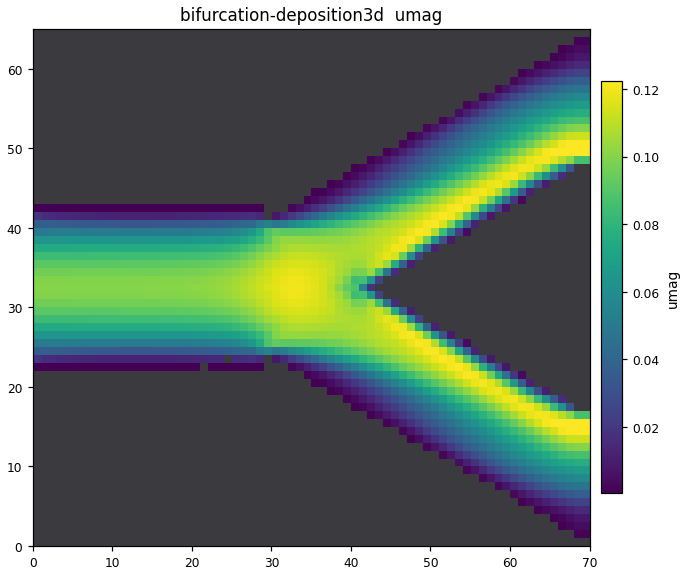
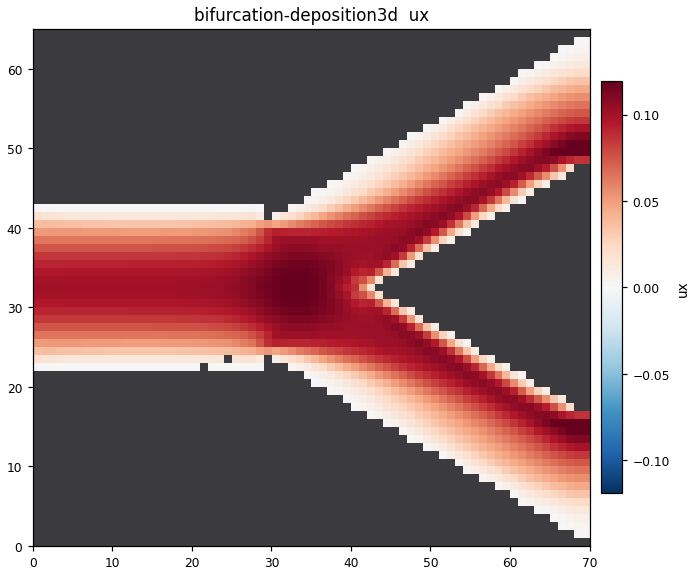
The fields this computation wrote at its last output step, plotted as they are. 3D cases show the mid-plane.
Results
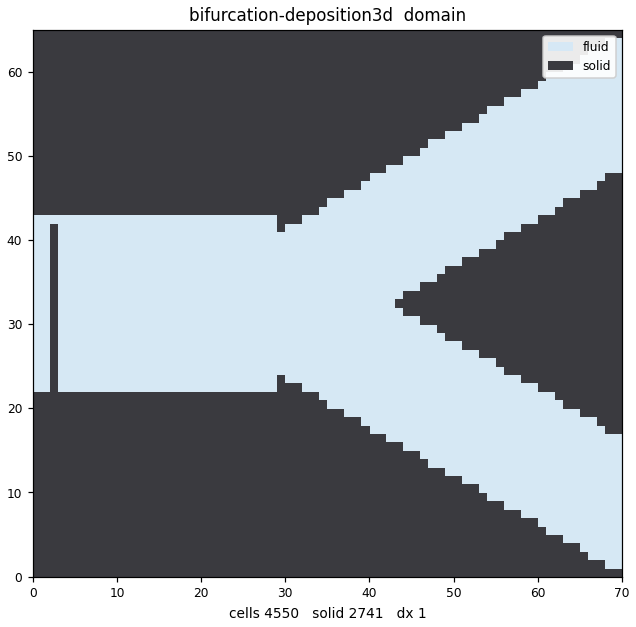
Deposition efficiency DE(St) of inertial point particles in a symmetric Y-shaped bifurcation — the classic S-shaped curve of inertial impaction. Parent-tube diameter nd = 20 cells (Rp = 10, daughter tubes Rd = 7, branching half-angle 30°), grid 70×65×27 = 0.12 M cells (fluid 22 503 / solid 100 347), Re = 200, U = 0.05 (peak Mach ~0.17), τ = 0.515, gravity off. Wall-clock 1.65 s on 72 Grace CPU cores.
First the carrier flow is brought to steady state over 15 000 steps. The centreline velocity converges to u_axis = 0.10086 (residual 1.2e-11) — against the ideal parabolic-inflow peak 2U = 0.100 this is (0.10086−0.100)/0.100 = +0.9%. The outflow fluxes into the left and right daughter tubes are 7.8890 / 7.8890 (asymmetry −0.0%), so the symmetry of the geometry and of the solver shows through directly.
DE(St) sweep with 4 000 particles injected per St into the frozen flow field
(bifur_de.csv):
| St | 0.02 | 0.05 | 0.1 | 0.2 | 0.35 | 0.5 | 0.75 | 1.0 | 1.5 | 2.0 |
|---|---|---|---|---|---|---|---|---|---|---|
| DE | 0.116 | 0.190 | 0.354 | 0.601 | 0.783 | 0.850 | 0.908 | 0.942 | 0.971 | 0.985 |
The steep rise through St ~ 0.1–0.3 (impaction on the carina, the apex of the bifurcation) and saturation at high St — the shape of the S-curve is as expected from Zhang–Kleinstreuer for a single bifurcation. On the other hand, DE = 0.116 at the low-St end is clearly higher than the "a few %" in the literature. As the VALIDATION section of the log itself admits, under the idealisations of one-way coupling, point particles, Stokes drag only, staircase walls and planar symmetry, this is a check of trend and threshold, not a calibrated agreement. In particular, the rule "deposited if the nearest cell is solid" adds 1 cell of staircase-wall roughness to the capture cross-section, which systematically pushes up deposition at low St. Trapped particles (caught in recirculation and never leaving) number 3 or fewer out of 4 000 at every St. The gallery video shows 699 mid-plane particles at St = 0.50, 120 frames.
Governing equations
The carrier flow solves the incompressible Navier–Stokes equations with D3Q19 regularized BGK and is frozen once steady. The particles follow the heavy-particle, low-Re_p limit of the Maxey–Riley (1983) equation with the added-mass, pressure-gradient, Basset and Faxén terms dropped:
\[
\frac{d\boldsymbol{v}}{dt}=\frac{\boldsymbol{u}_f-\boldsymbol{v}}{\tau_p}
+\boldsymbol{g},\qquad
\tau_p=\frac{\rho_p d^2}{18\mu},\qquad
\mathrm{St}=\frac{\rho_p d^2 U}{18\mu D}=\frac{\tau_p U}{D}
\]
Because the coupling is one-way (particles do not write back into f_i), the flow field is independent of St, and 1 fluid solution can be reused for the whole sweep — this is why a sweep of 10 points × 4 000 particles takes only 1.65 s wall-clock. Integration uses an exponential (analytic) integrator, unconditionally stable; u_f is trilinearly interpolated to the particle position. Deposition rule: nearest cell solid or outside the domain → deposited; reaching a daughter-tube outlet plane → escaped; DE = N_dep/N_inj.
Honest caveats from the header: one-way (no particle–particle collisions, no back-reaction on the flow), point particles (no finite-size lift, interception, Basset or added mass), Stokes drag only (Re_p ≲ 1), staircase walls (errors of a few % in radius and roughness at this resolution), and an idealised planar-symmetric geometry rather than a physiological airway. Module design: particle-tracking-design.md.
Code walkthrough
Source (548 lines).
%%{init: {'themeVariables': {'fontSize': '11px'}}}%%
flowchart LR
    IN["Parent inlet<br/>Guo non-equilibrium extrapolation<br/>parabolic inflow"] --> P["Parent tube Rp=10"]
    P --> C{"carina (apex_x=28)<br/>half-angle 30°"}
    C --> DU["Upper daughter Rd=7 → outlet fixed pressure"]
    C --> DL["Lower daughter Rd=7 → outlet fixed pressure"]
P -.-> W["Tube wall: staircase mask<br/>halfway BB<br/>particles deposit at nearest solid"]- Geometry — the Y-tube is rasterised analytically into a solid mask (staircase).
- Carrier flow — regularized BGK is run until the u_axis residual drops (15 000 steps, final residual 1.2e-11). The left/right symmetry of the outflow fluxes is checked in the log.
- Freeze and seed — the macroscopic velocity field is frozen. 4 000 particles are placed on the inlet cross-section with parabolic flux weighting.
- Sweep — 10 points St = 0.02..2.0. Each particle is tracked with the exponential integrator, and deposited / escaped / trapped are counted and DE written to CSV.
- Gallery — only the mid-plane particles at St = 0.50 are output, 120 frames, for rendering.
Build & run
cmake -S native -B native/build && cmake --build native/build -j
./native/build/orheo-bifurcation-deposition3d
bifurcation_deposition3d [nd] [steps] [Npart] [de_csv] [field_csv]
Cost of the computation that made the figures on this page (Miyabi-G Grace CPU (72 cores, -stdpar=multicore)): 1.6 s wall.
Things to try
- Npart from 4 000 → 16 000. The binomial statistical error of DE ~ sqrt(DE(1−DE)/N) halves. This confirms that the 0.116 at the low-St end is a systematic error, not statistics.
- nd from 20 → 40. The capture cross-section bias from the staircase wall and the "nearest-cell rule" shrinks; how close does low-St DE get to the "a few %" in the literature — the most meaningful sensitivity test for this case.
- Turn gravity on (9th argument). Gravitational settling is superimposed on inertial impaction and lifts DE on the low-St side. This mimics the regime where both mechanisms compete for aerosols in airways.
- Re from 200 → 500. Separation downstream of the carina changes; see how the number of trapped particles moves.
Validation
| Tier | T2 — single-point comparison |
| QoI | deposition_efficiency |
| Reference | Comer, Kleinstreuer & Zhong (2001) bifurcation deposition efficiency |
| Gate | — no gate |
Source & run details
| Item | Value |
|---|---|
| Target | orheo-bifurcation-deposition3d |
| Source | native/benchmarks/bifurcation_deposition3d.cpp |
| Lattice | D3Q19 |
| GPU twin | no |
| Modules | lbm_d3q19.hpp |
| Gallery run | 2026-07-27 @ 7628c0cf |
| Args | `` |
| Wall time | 1.65 s |
| CPU time | 88.46 s |
| Device | Miyabi-G Grace CPU (72 cores, -stdpar=multicore) |
Computation log
The actual output of this computation (head and tail).
=== bifurcation_deposition3d -- Y-tube inertial deposition ===
nd=20  grid 70x65x27 (0.12 Mcell)  Rp=10.0 Rd=7.0 apex_x=28
half-angle=30 deg  U=0.0500 (peakMach~0.17)  Re=200 nu=0.00500 tau=0.5150  g=0.00e+00
solid cells=100347  fluid cells=22503
step      0/15000  u_axis=0.04967  d=4.97e-02
step    500/15000  u_axis=0.09794  d=4.83e-02
step   1000/15000  u_axis=0.10298  d=5.03e-03
step   1500/15000  u_axis=0.10327  d=2.92e-04
step   2000/15000  u_axis=0.10197  d=1.30e-03
step   2500/15000  u_axis=0.10083  d=1.14e-03
step   3000/15000  u_axis=0.10060  d=2.36e-04
step   3500/15000  u_axis=0.10072  d=1.23e-04
step   4000/15000  u_axis=0.10084  d=1.22e-04
step   4500/15000  u_axis=0.10089  d=4.29e-05
...


wrote DE(St) -> bifur_de.csv
wiki: 120 gallery frames (699 mid-plane particles, St=0.50)

=== VALIDATION (DE vs St S-curve) ===
Expected (Zhang-Kleinstreuer single bifurcation): DE a few % for
St<0.05, sharp rise through St~0.1-0.3 (carina impaction), saturating.
CAVEATS: one-way point-particle, Stokes drag only, staircased wall,
planar symmetric idealisation -- trend+threshold, not a calibrated match.
References
- M. R. Maxey & J. J. Riley, "Equation of motion for a small rigid sphere in a nonuniform flow", Phys. Fluids 26 (1983) 883.
- Z. Zhang & C. Kleinstreuer, J. Aerosol Sci. 32 (2001); 33 (2002).
- S. Comer, C. Kleinstreuer & Z. Zhang, J. Fluid Mech. 435 (2001) 25.
- Z. Guo, C. Zheng & B. Shi, Phys. Rev. E 65 (2002) 046308.