Showcase¶
English | Japanese
A gallery of computed animations and figures, grouped by topic. Each section ends with a link to the detailed page.
GPU liquid cold-plate three-level multi-objective optimization (1D → FVM → LBM)¶
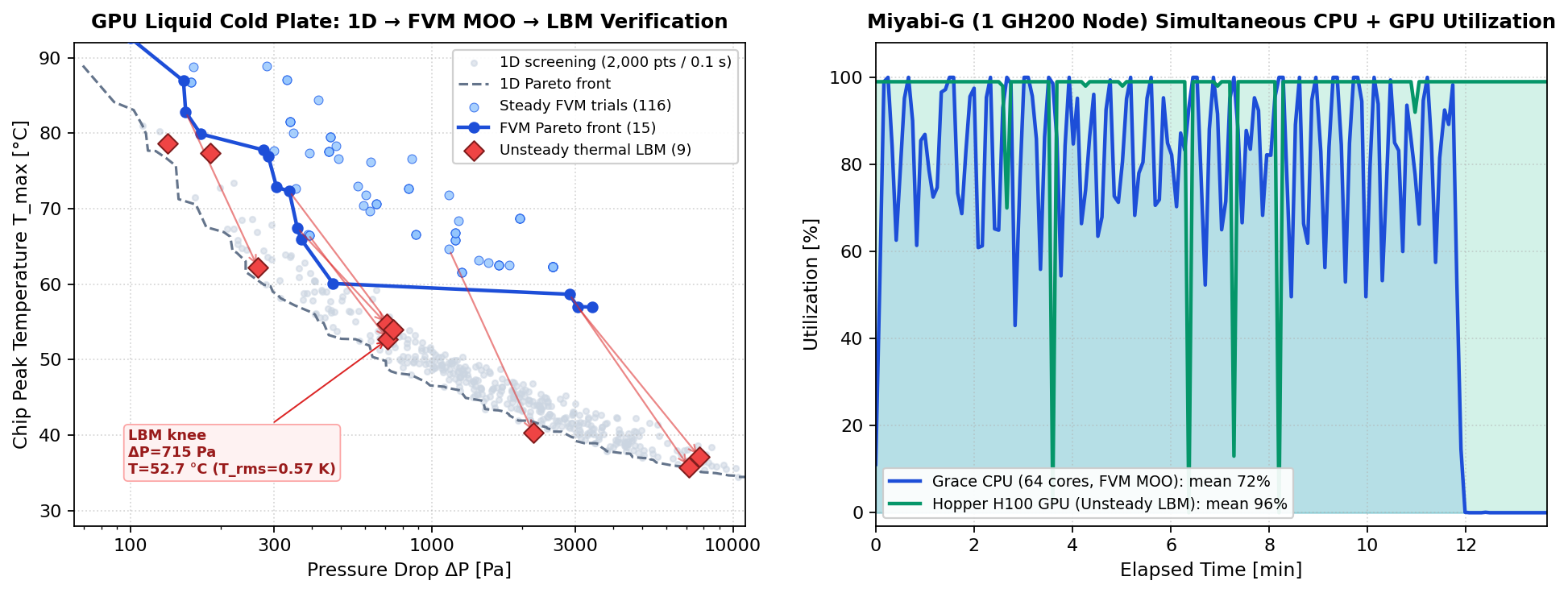
Simultaneous CPU + GPU multi-objective optimization of a 700 W-class staggered pin-fin liquid cold plate on one Miyabi-G node (1 GH200, 13.7 min). The 1D model screens 2,000 candidates in 0.1 s to seed Optuna NSGA-II; 64 Grace CPU cores (72% mean utilization) run 116 steady FVM evaluations (snappyHexMesh + buoyantBoussinesqSimpleFoam), while the Hopper H100 GPU (96% mean utilization, 3,933 MLUPS) continuously verifies 15 emerging Pareto designs with 3.07 M-cell unsteady 3D thermal LBM (D3Q19 TRT+Smagorinsky + D3Q7). The knee design (D = 1.02 mm, U = 0.25 m/s) achieves ΔP = 715 Pa, T_max = 52.7 °C, and unsteady hotspot fluctuation T_rms = 0.57 K.
Automotive aero three-level multi-objective optimization (1D → FVM → D3Q27 Cumulant LBM)¶
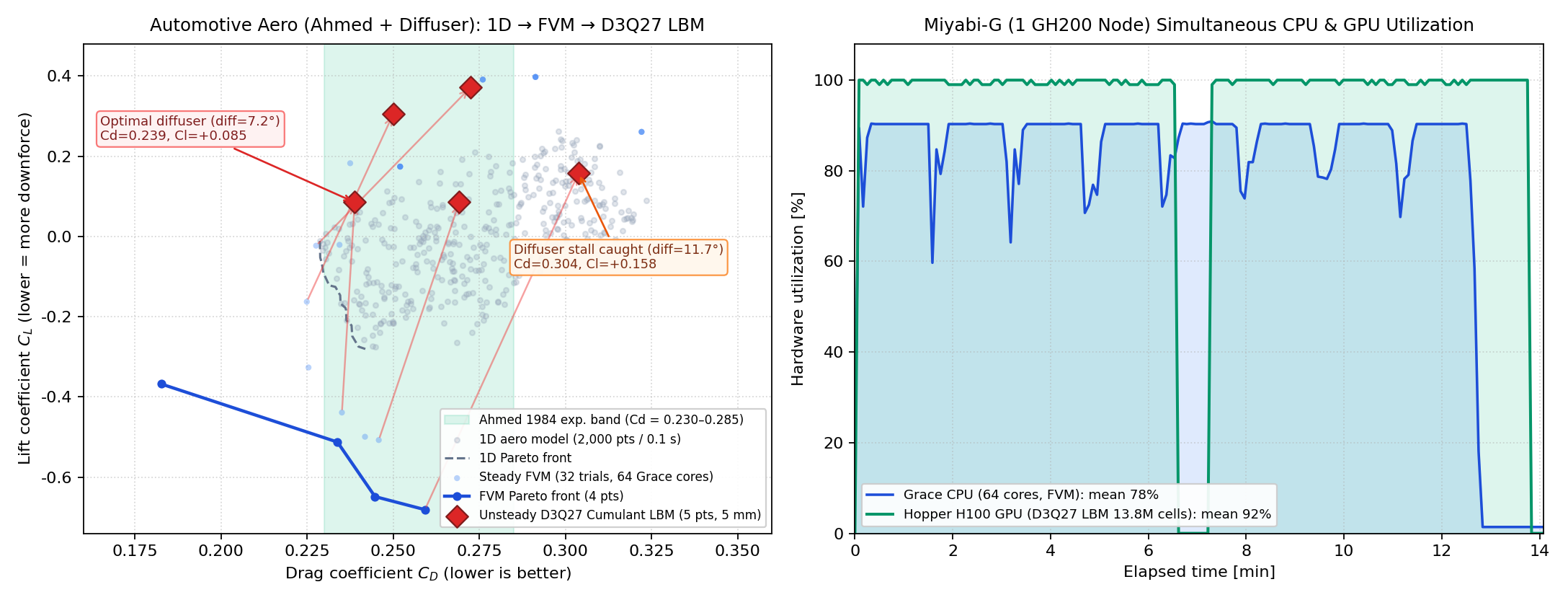
Simultaneous three-level optimization of rear slant, underbody diffuser angle, and ride height on the canonical Ahmed body (\(U_\infty = 40\text{ m/s},\; Re_H = 7.68\times 10^5\)) on Miyabi-G (1 GH200 node): 1D aero screening (2,000 designs / 0.1 s) → 64 Grace CPU cores running 32 high-fidelity 440k-cell steady FVM evaluations (5 mm surface + 3 prism layers, \(C_D = 0.183\text{–}0.322\), 78% mean / 91% peak utilization) → Hopper H100 GPU verifying 5 Pareto vehicles with OpenRheo's production D3Q27 Cumulant + WALE + 4-level Octree AMR (5 mm, 13.8 M cells) + Bouzidi + Spalding + Kawai–Larsson friction solver (92% mean utilization, 331 MLUPS). All three fidelities align inside the Ahmed 1984 experimental band (\(C_D = 0.230\text{–}0.285\); optimal 7.2° diffuser: FVM \(C_D = 0.235\) / LBM \(C_D = 0.239,\; C_L = +0.085\)) while catching 3D diffuser stall at 11.7° (\(C_D = 0.304\)).
Vehicle aerodynamics — DrivAer (LBM fed by an FVM solution)¶
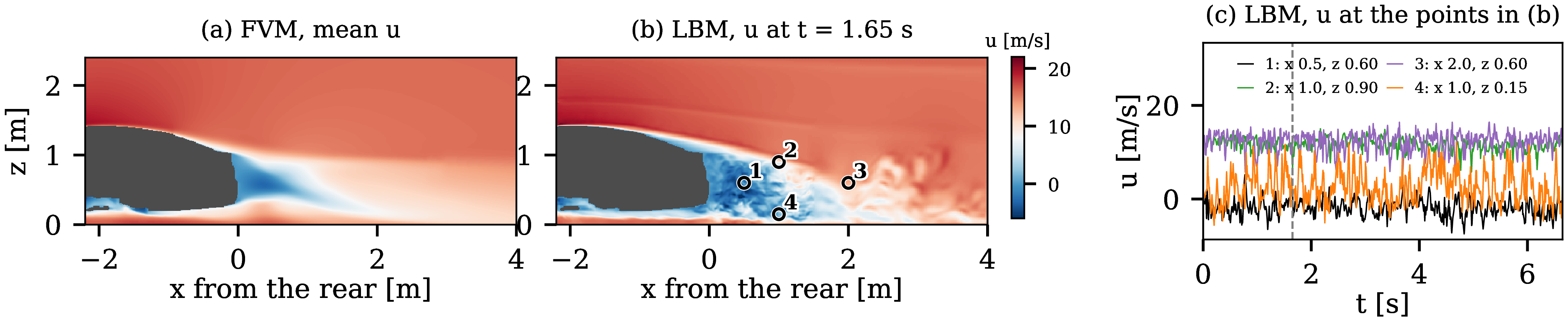
Steady FVM (3.43 M cells) gives Cd 0.257 (experiment 0.252). That velocity field becomes the inflow and the wake is solved with LBM (19.82 M cells). → DrivAer fastback
Thermal environment of an apartment living room¶
| Unsteady LBM (wind speed on a vertical section through the seat) | Steady FVM temperature and wind speed |
|---|---|
 |
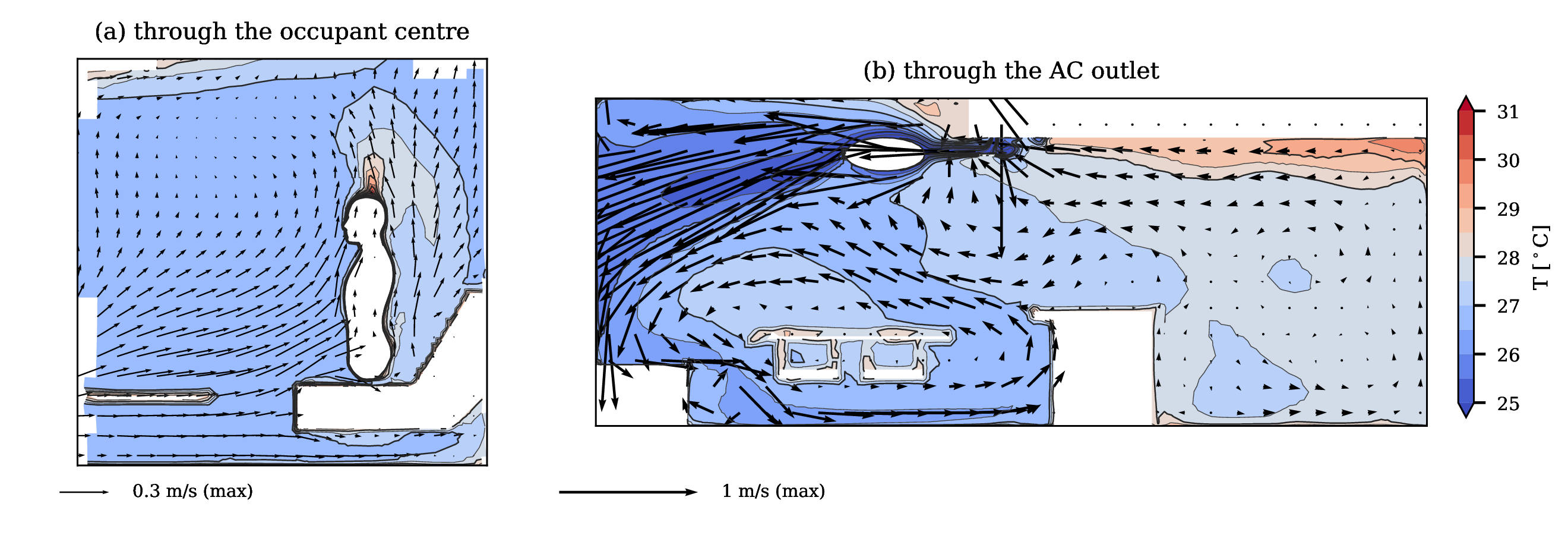 |
Matches 56 measured surface and air temperatures to RMS 0.63 K. Swinging the circulator raises the turbulence intensity from 34 % to 58 % and lowers SET* from 27.3 to 27.0 °C. → OpenCAE Symposium 2026 talk
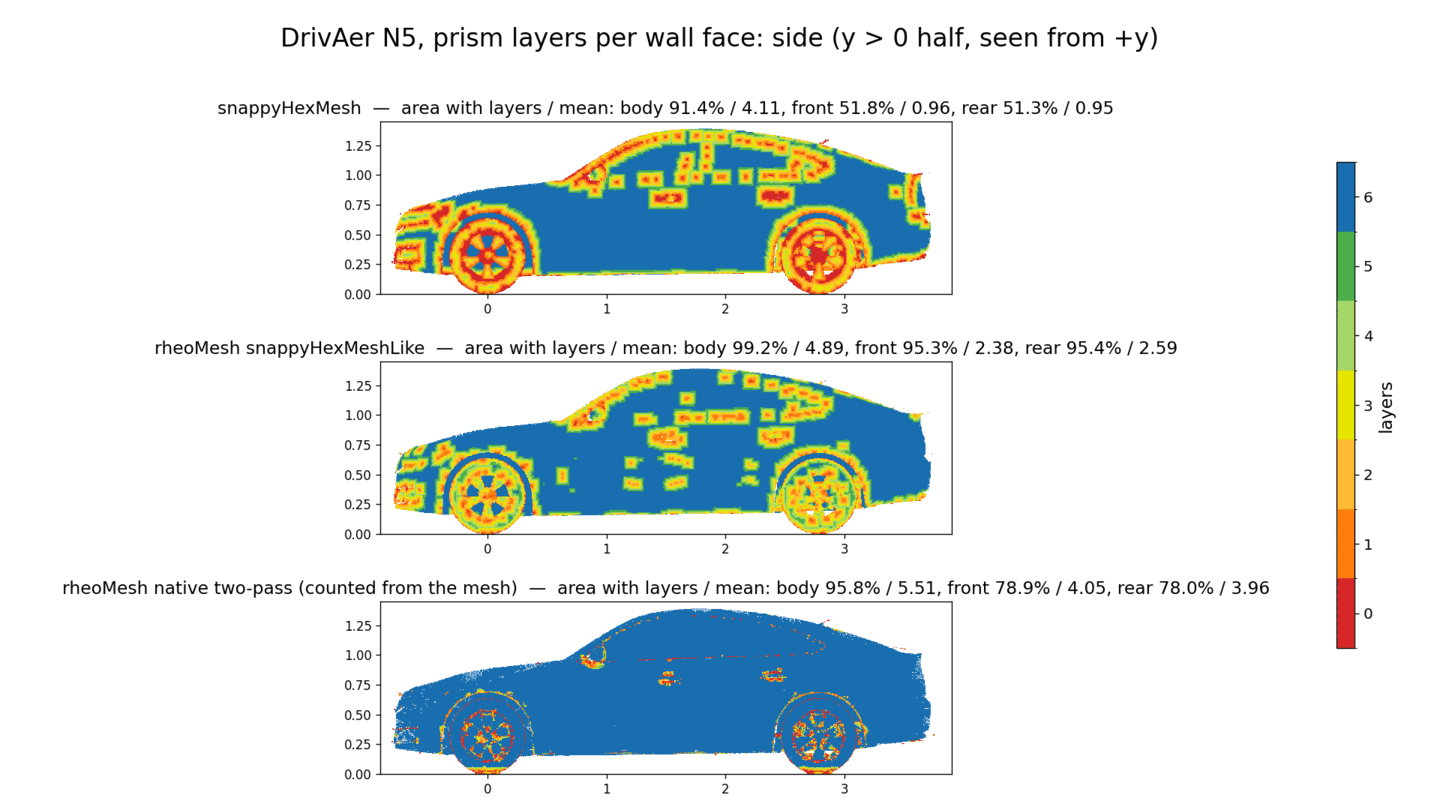
rheoMesh boundary-layer meshes¶
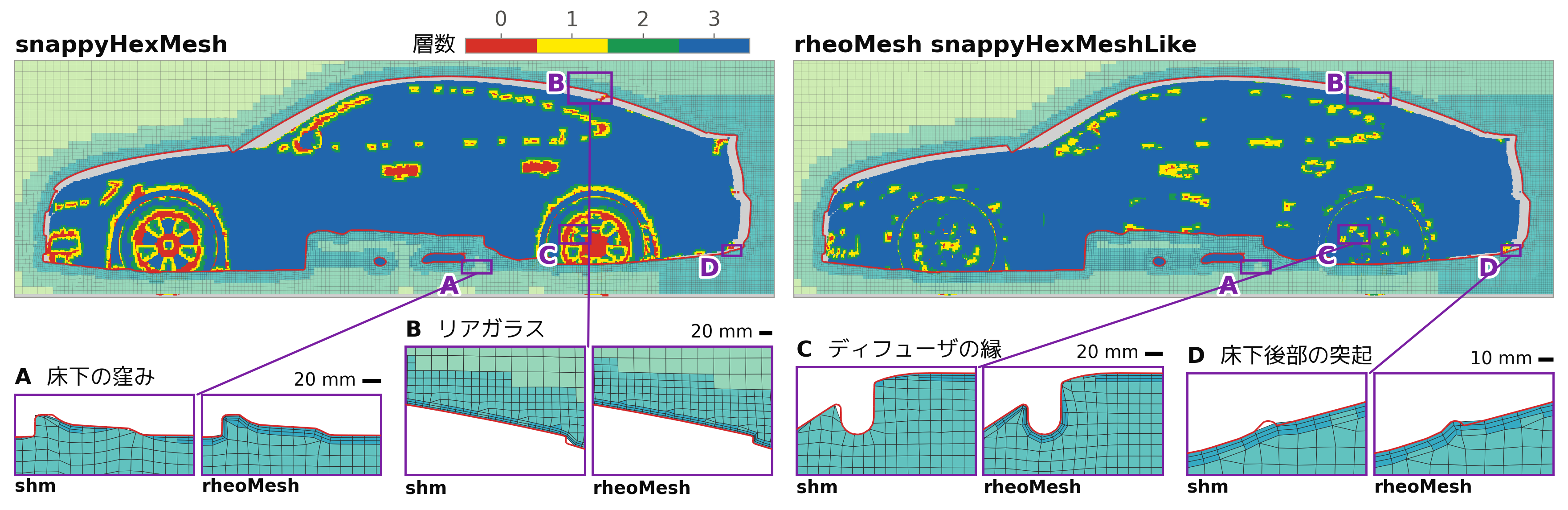
| DrivAer boundary layers | Tyre / wheel boundary layers |
|---|---|
 |
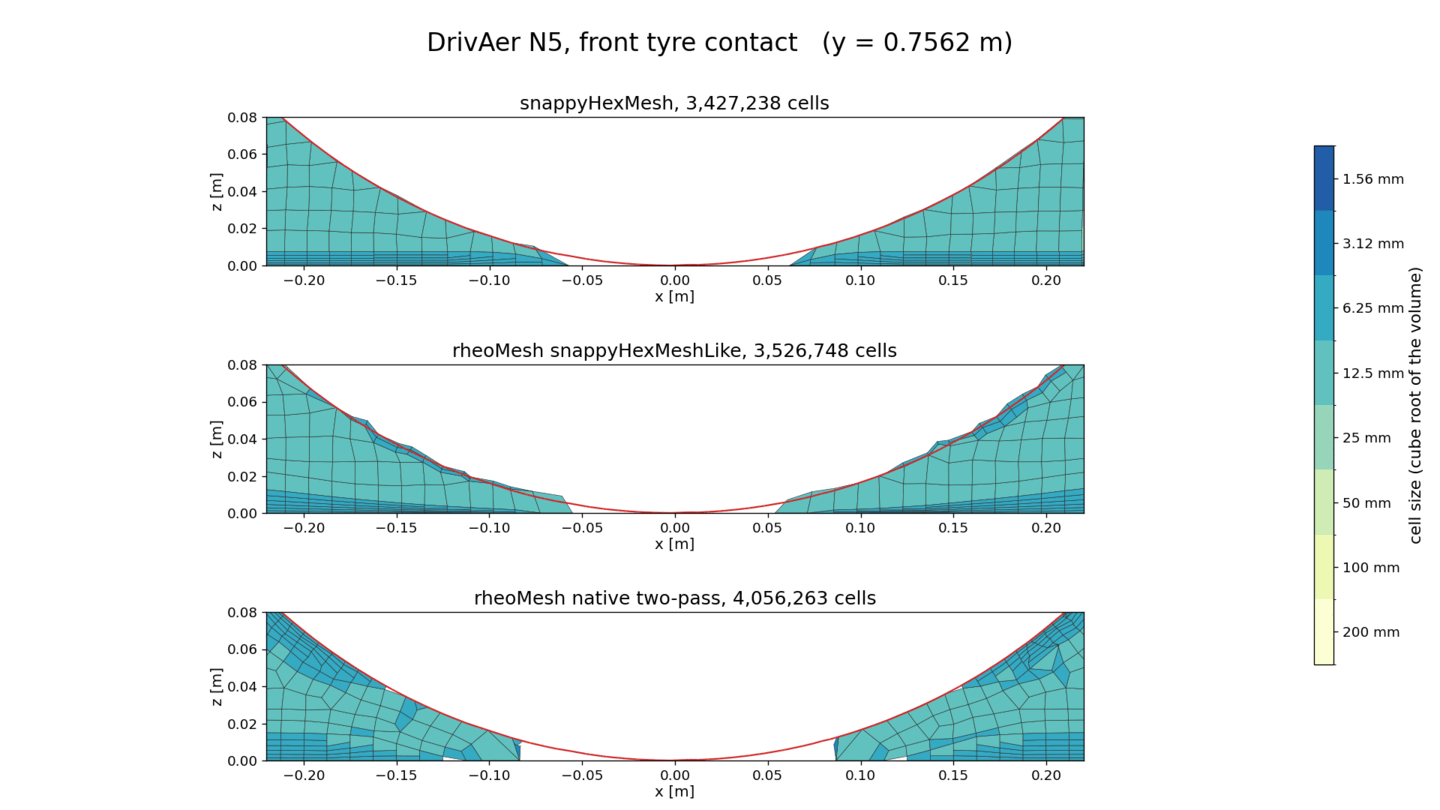 |
→ rheoMesh
Turbulence — wall-mounted cube (ERCOFTAC case 41)¶
Unsteady flow around a duct and grille (an example of multi-level coupling)¶
An air-conditioning circuit of fan → duct → diffuser → grille, solved part by part with different methods. Parts that do not need spatial distribution use 1D, the diffuser, where a steady solution suffices, uses FVM, and only the grille section, where vortices matter, is solved with unsteady LBM (with AMR).
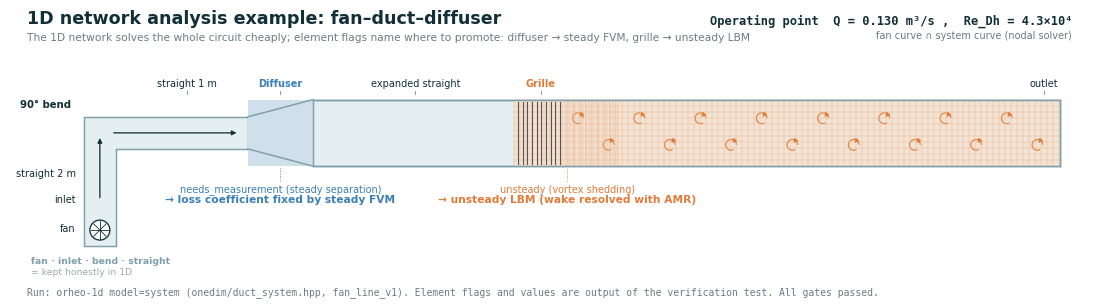
Unsteady LBM of the grille section¶
Velocity magnitude:
Vorticity — vortex shedding in the grille wake is visible:
Pressure:
Division of roles across the three tiers¶
| Tier | Target | Compute resource |
|---|---|---|
| 1D model | Fan characteristic, pressure loss of straight ducts | CPU 1 core |
| Steady FVM | Diffuser (separates but is steady) | CPU, a few cores |
| Unsteady LBM | Grille wake (vortex shedding is the main feature) | GPU |
On GH200 the Grace CPU and the Hopper GPU can be used at the same time, so this division fits as is in 1 node. → Design philosophy §6 · Multi-fidelity (1D ⇄ FVM ⇄ LBM)
Free surface — dam break¶
Evolution of the water surface for the SPHERIC dam break with an obstacle (MARIN experiment).
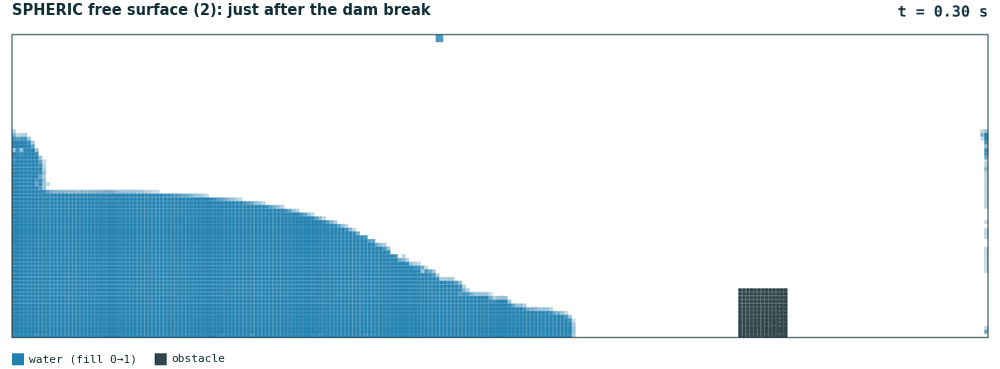
Dam-break animation:
Time series of pressure and water level are compared with the experiment → Free surface
Heat and phase change — melting and natural convection¶
| Gallium melting (2D) | Natural convection (Boussinesq) |
|---|---|
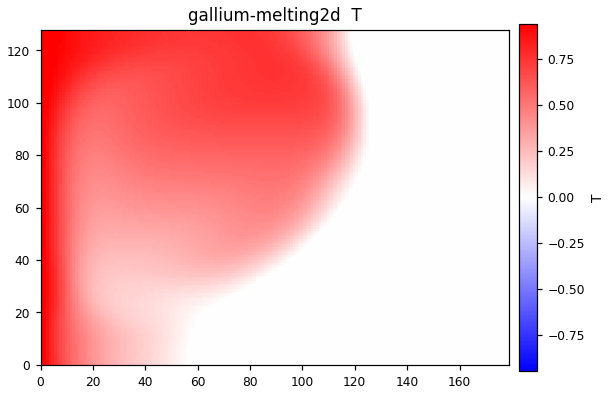 |
 |
Double-distribution-function (DDF) thermal LBM. → Heat transfer and phase change
Multiphase — phase field¶
A rising bubble solved with a high-density-ratio Allen-Cahn phase field.
→ Two-phase flow (phase field)
Particles and fluid-structure interaction — 3D bifurcation¶
Particle deposition in a bifurcation, solved with two-way coupling through momentum exchange.
→ Particles and fluid-structure interaction
Overview of validation coverage¶
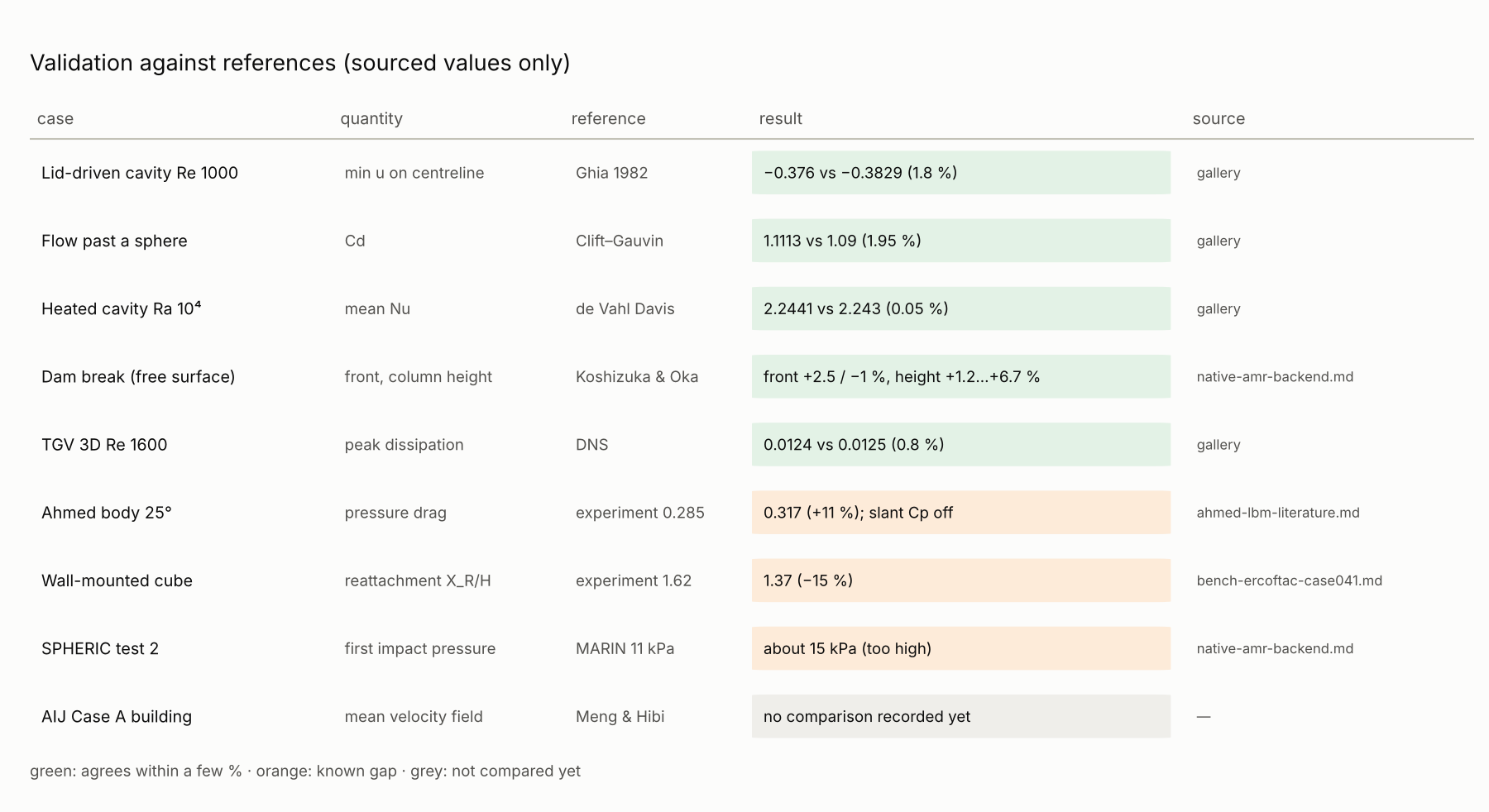

All cases are under Categories on Home; validation tiers are in Validation status.