sediment-shields2d
English | Japanese
« Home · « Particles and fluid-structure interaction
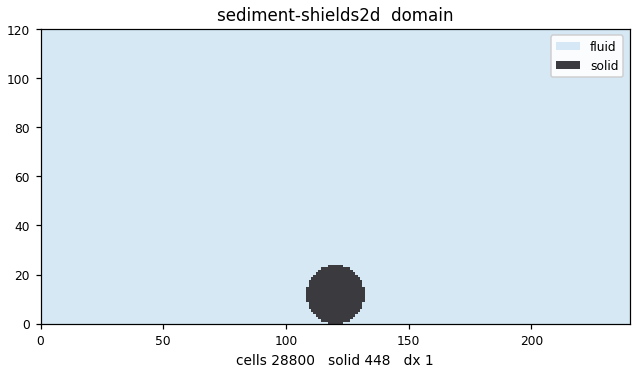
Sediment incipient motion -- the Shields threshold for a resolved bed grain. A single sediment grain (a 2D disk, d = nd cells) rests on a flat bed at the bottom of a plane Couette shear channel. The fluid exerts a hydrodynamic drag F_D, lift F_L and moment T on the grain (momentum exchange); the grain begins to move once that load overcomes its submerged weight and bed friction. The dimensionless mobility group is the Shields number theta = tau_b / ((rho_s - rho) g d) (bed shear stress over the submerged specific weight of a grain of diameter d), and motion sets in above a critical theta_cr, given classically by the Shields (1936) curve as a function of the grain Reynolds number Re_* = u_* d / nu. In the relevant range theta_cr ~ 0.03-0.06.
Geometry
Animation
Fields
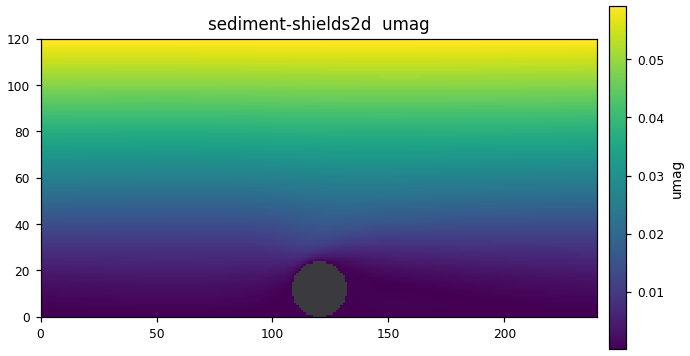
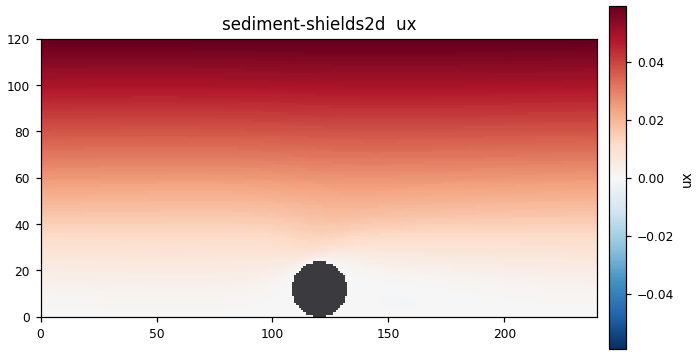
The fields this computation wrote at its last output step, plotted as they are. 3D cases show the mid-plane.
Results
Plane Couette shear is applied to 1 bed grain (a 2D disk, d = 24 cells) resting on a flat bed, with the grain held fixed (a static incipient-motion test that "asks whether it should move rather than moving it"), and the drag, lift and moment are measured by momentum exchange to obtain the critical Shields number. Grid 240×120 = 0.029 M cells, TRT (τ = 0.5667, ν = 2.2233e-2, Λ = 3/16), top-wall velocity U_w = 0.06, H = 120, friction coefficient μ_s = 0.6. Wall-clock time 11.2 s on 72 Grace CPU cores.
The bed shear is analytic: \(\tau_b=\rho\nu U_w/H = 2.2233\times10^{-2}\times0.06/120 = 1.1117\times10^{-5}\), \(u_*=\sqrt{\tau_b}=3.3342\times10^{-3}\), \(\mathrm{Re}_*=u_*d/\nu=3.599\). The baseline forces in quiescent fluid (Fy0 = -2.0 etc.) are measured first and subtracted.
In the time series, theta_cr tightens monotonically from 0.0296 (step 20000) to 0.0339 (step 200000) — a long tail as the grain's wake relaxes diffusively; the final value over an averaging window of 20 000 steps is
\[
\theta_{cr}=\frac{\tau_b\,\pi R}{2\,(F_D/\mu_s+F_L)}
=\frac{1.1117\times10^{-5}\times\pi\times12}
{2\,(2.95381\times10^{-3}/0.6+1.27479\times10^{-3})}=0.0338
\]
(⟨F_D⟩ = 2.95381e-3 and ⟨F_L⟩ = 1.27479e-3 are the averages in the log). The measured theta_cr = 0.0338 falls at the lower end of the classical Shields band 0.03–0.06. However, as the source header states up front, this is a verification that "brackets the band" under the idealizations of (i) a 2D disk rather than a 3D sphere (the O(1) geometric factors of frontal area and volume differ), (ii) an isolated grain rather than a packed bed (no hiding/exposure), and (iii) a sliding (Coulomb) threshold; it does not pin down 1 point.
A movable=1 variant that actually moves the grain is designed as a future item in particles-dem-design.md (the core of the design is that static-friction slide/stick needs a contact history) and sediment-morphodynamics-design.md.
Governing equations
The dimensionless mobility is the Shields number
\[
\theta=\frac{\tau_b}{(\rho_s-\rho)\,g\,d}
\]
and its critical value θ_cr is given by the Shields (1936) curve as a function of the particle Reynolds number Re_* = u_* d/ν (θ_cr ~ 0.03–0.06 in this range). For a fixed grain the flow (and hence F_D, F_L) is independent of the grain's weight, so 1 solve closes the critical submerged weight: from the onset-of-sliding condition \(F_D=\mu_s(W_{\mathrm{sub}}-F_L)\), \(W_{\mathrm{sub,cr}}=F_D/\mu_s+F_L\); substituting this into the submerged weight of a 2D disk, \(W_{\mathrm{sub}}=(\rho_s-\rho)g\,\pi R^2\), gives the θ_cr formula above.
The TRT magic Λ = 3/16 is essential for making the effective position of the bounce-back wall independent of viscosity — when ν is swept along the Re_* axis of the Shields curve, the forces cannot be compared if the grain's effective radius moves along with it.
An honest note on scope: this is incipient motion only, not bedload transport (Meyer-Peter–Müller), bed evolution (Exner), or antidunes. Those are the roadmap on the design-note side.
Code walkthrough
Source (421 lines).
%%{init: {'themeVariables': {'fontSize': '11px'}}}%%
flowchart TB
    T["Top wall y=H: translating at U_w=0.06<br/>(moving-wall bounce-back)"]
    subgraph CH["Interior TRT / periodic in x"]
      G(("Grain d=24<br/>fixed; F_D, F_L, T by MEM"))
    end
    B["Bed y=0: halfway BB<br/>grain rests on the bed"]
T --- CH --- B- Initialization — start from a linear Couette profile. Only the grain's local wake has to relax, so this is fast.
- Baseline — measure the forces on the grain in quiescent fluid (closed-pressure contribution Fy0 = -2.0 etc.) and subtract them from the main computation.
- collide/stream — TRT; bounce-back on the grain and the bed, moving-wall BB on the top wall, x periodic.
- Measurement — F_D, F_L, T by MEM on the grain's boundary links. Averaged over the last avgwin = 20 000
steps; θ_cr is computed and appended to the CSV (
sediment_shields2d.csv, history insediment_hist_run.csv).
Build & run
cmake -S native -B native/build && cmake --build native/build -j
./native/build/orheo-sediment-shields2d
Cost of the computation that made the figures on this page (Miyabi-G Grace CPU (72 cores, -stdpar=multicore)): 11.2 s wall.
Things to try
- Sweep Uw and draw the θ_cr(Re_) curve*. Since τ_b ∝ U_w, you can move along the Re_ axis. Can you follow the shape of the Shields curve (rising at low Re_, minimum around Re_* ~ 10)?
- Vary μ_s over 0.4–0.8. Look at the sensitivity θ_cr ∝ 1/(F_D/μ_s+F_L). You will see that the uncertainty in the friction coefficient explains part of the width of the classical band.
- Set maxsteps to 400 000. Check where the monotonic drift of theta_cr, 0.0296 → 0.0339, fully saturates (in this run the change over the final 20 000 steps is already about 0.0002).
- Change nd from 24 → 48. The staircase grain surface becomes finer; look at how the lift (the near-wall quantity, the most sensitive) changes.
Validation
| Tier | T2 — single-point comparison |
| QoI | Critical Shields number theta |
| Reference | Shields (1936) threshold-of-motion curve |
| Gate | 🧩 module gate (rigid_body) |
Source & run details
| Item | Value |
|---|---|
| Target | orheo-sediment-shields2d |
| Source | native/benchmarks/sediment_shields2d.cpp |
| Lattice | D2Q9 |
| GPU twin | no |
| Gallery run | 2026-07-27 @ 7628c0cf |
| Args | `` |
| Wall time | 11.16 s |
| CPU time | 631.75 s |
| Device | Miyabi-G Grace CPU (72 cores, -stdpar=multicore) |
Computation log
The actual output of this computation (head and tail).
sediment_shields2d [run]  (D2Q9 TRT, resolved bed grain, MEM force)
  grid 240x120 = 0.029M cells,  d=24 cells (R=12.0)
  tau=0.5667 nu=2.2233e-02 (Lambda=3/16)  U_w=0.0600  H=120
  tau_b=1.1117e-05 u_*=3.3342e-03 Re_*=3.599  mu_s=0.600
  grain @ (120.0,12.0) resting on bed;  maxsteps=200000 avgwin=20000
  quiescent baseline (subtracted): Fx0=1.3878e-16 Fy0=-2.0000e+00 T0=4.4409e-16
step       0  Fx=3.2450e-01 Fy=-1.8000e-05 T=-1.2596e+00  theta_cr=0.0004
step   20000  Fx=3.2531e-03 Fy=1.6583e-03 T=-1.4169e-02  theta_cr=0.0296
step   40000  Fx=3.2604e-03 Fy=1.4110e-03 T=-1.3361e-02  theta_cr=0.0306
step   60000  Fx=3.1470e-03 Fy=1.4077e-03 T=-1.2732e-02  theta_cr=0.0315
step   80000  Fx=3.1252e-03 Fy=1.3596e-03 T=-1.2463e-02  theta_cr=0.0319
step  100000  Fx=3.0534e-03 Fy=1.3204e-03 T=-1.2275e-02  theta_cr=0.0327
step  120000  Fx=3.0079e-03 Fy=1.3030e-03 T=-1.2141e-02  theta_cr=0.0332
step  140000  Fx=2.9856e-03 Fy=1.2913e-03 T=-1.2057e-02  theta_cr=0.0334
References
- A. Shields, "Anwendung der Aehnlichkeitsmechanik und der Turbulenzforschung auf die Geschiebebewegung", Preuss. Versuchsanstalt f. Wasserbau u. Schiffbau, Heft 26 (1936).
- P. L. Wiberg & J. D. Smith, Water Resour. Res. 23(8) (1987) 1471.
- E. Meyer-Peter & R. Müller, Proc. 2nd IAHR Congress (1948) (roadmap); F. M. Exner, Sitzungsber. Akad. Wiss. Wien (1925) (roadmap).
- A. J. C. Ladd, J. Fluid Mech. 271 (1994); C. K. Aidun, Y. Lu & E.-J. Ding, J. Fluid Mech. 373 (1998).