Particles, DEM, transport and electrochemistry
English | Japanese
This page covers what moves through the flow or is carried by it: solid particles resolved by the lattice, particle contact (DEM), point particles tracked along the flow, scalars such as heat or concentration, and ions in an electric field. Most of it is two-dimensional and validated against one canonical case each; several parts are designed further than they are built.
Resolved particles
A particle is a moving solid boundary: the lattice links that cross its
surface bounce back with the wall velocity, the force and torque come from the
momentum exchange, and Newton's equations move the particle
(rigid_body.hpp). The first case (2026-07-16) was a sphere settling onto a
wall, against the experiment of Ten Cate et al. (2002): the terminal velocity
is 5–9 % low and rises with resolution, and the sphere slows near the wall as
in the experiment.
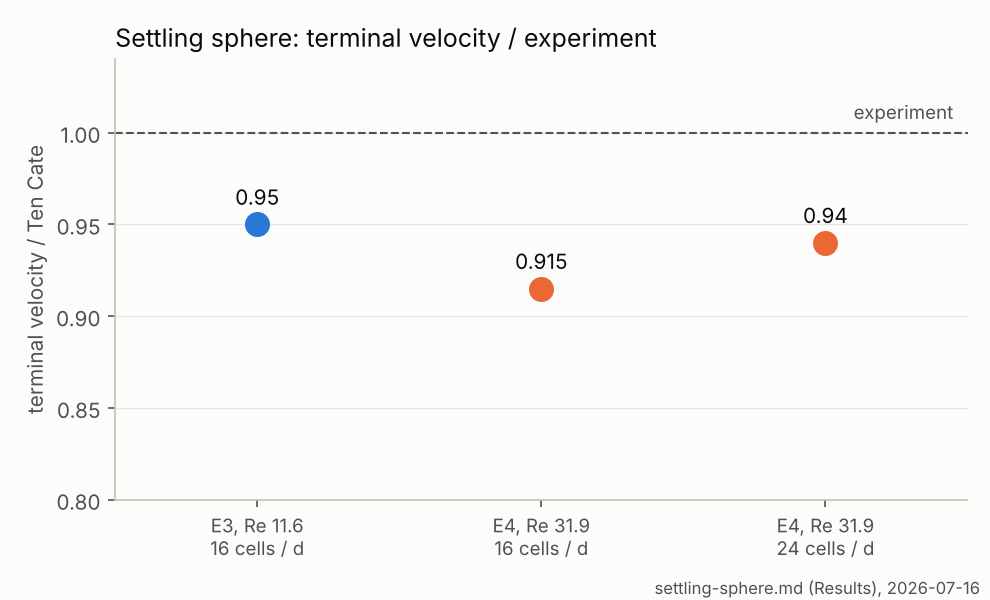
The same case took about 76 s on CPU cores and about 10 s on a GH200 (case E4, 16 cells per diameter, about 7,700 steps).
Two disks (dkt2d). Two disks settling one above the other show drafting, kissing and tumbling. The defaults changed on 2026-11-01: at τ = 0.55 the rotation of the leading disk grew until the run blew up near step 570, and with the old repulsion strength the disks sank into each other. With τ = 0.60 and a stronger repulsion the disks draft to a gap of 0.06 d by step 12,000, touch until about step 16,000, and the trailing disk passes the leading one by step 20,000.
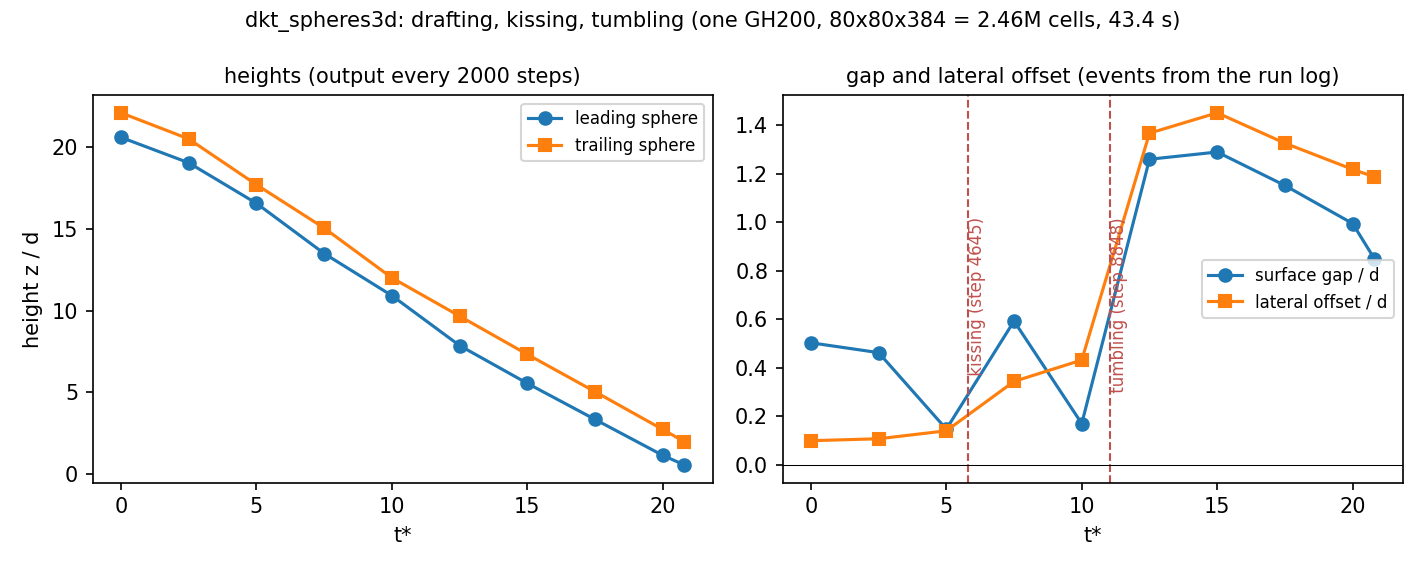
Two spheres with DEM (3D). The same sequence in 3D, with the contact solved by DEM, is described on its own page, Particle (DEM)–fluid coupling:
DEM contact
dem.hpp is a 3D contact model: a linear spring (default) or Hertz in the
normal direction with damping, a tangential dashpot limited by Coulomb
friction, a lubrication force when the gap is small (only when a fluid
viscosity is given), and a grid of bins to find neighbours. Its ctest checks
restitution, contact time, momentum, energy, the Hertz scaling, the
lubrication cut-off and the neighbour search.
It was built differently from its design record (2026-07-27), which planned a 2D model with a tangential spring that keeps its history and no lubrication. The tangential history is still missing, and the 2D drivers (dkt2d, hindered settling, sediment) do not use DEM yet.
Point particles, magnetic particles and sediment
- Tracking (
bifurcation_deposition3d): point particles follow the flow one way with Stokes drag and an exponential integrator; lift, the Schiller–Naumann correction and two-way coupling are not in. - Magnetic particles (
magnetic_particles2d): a point dipole in a field gradient with Stokes drag; one way by default. Chains of dipoles were designed, not built. - Sediment (
sediment_shields2d): a fixed grain and the Shields threshold for sliding. Bedload transport and a moving bed (Exner) were designed, not built.
Scalar transport
advection_diffusion.hpp carries a scalar on its own lattice with the velocity
given from outside. Since 2026-07-27 each face can be periodic, fixed value,
zero gradient, inflow or outflow, with a source term; this opened the Graetz,
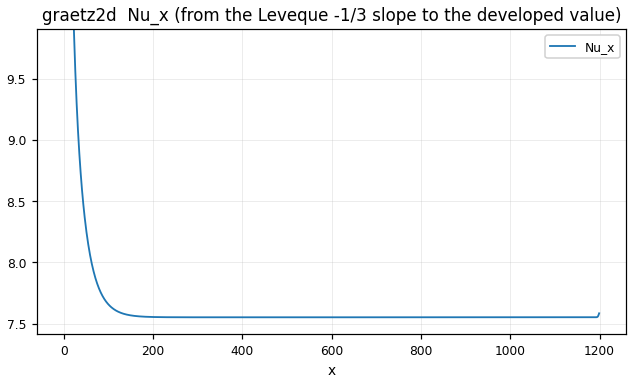
Taylor–Aris and adsorption cases (each a ctest). The Graetz case shows the
Nusselt number falling from the entrance to the developed value:
Radiative transfer (radiative.hpp) uses eight discrete directions.
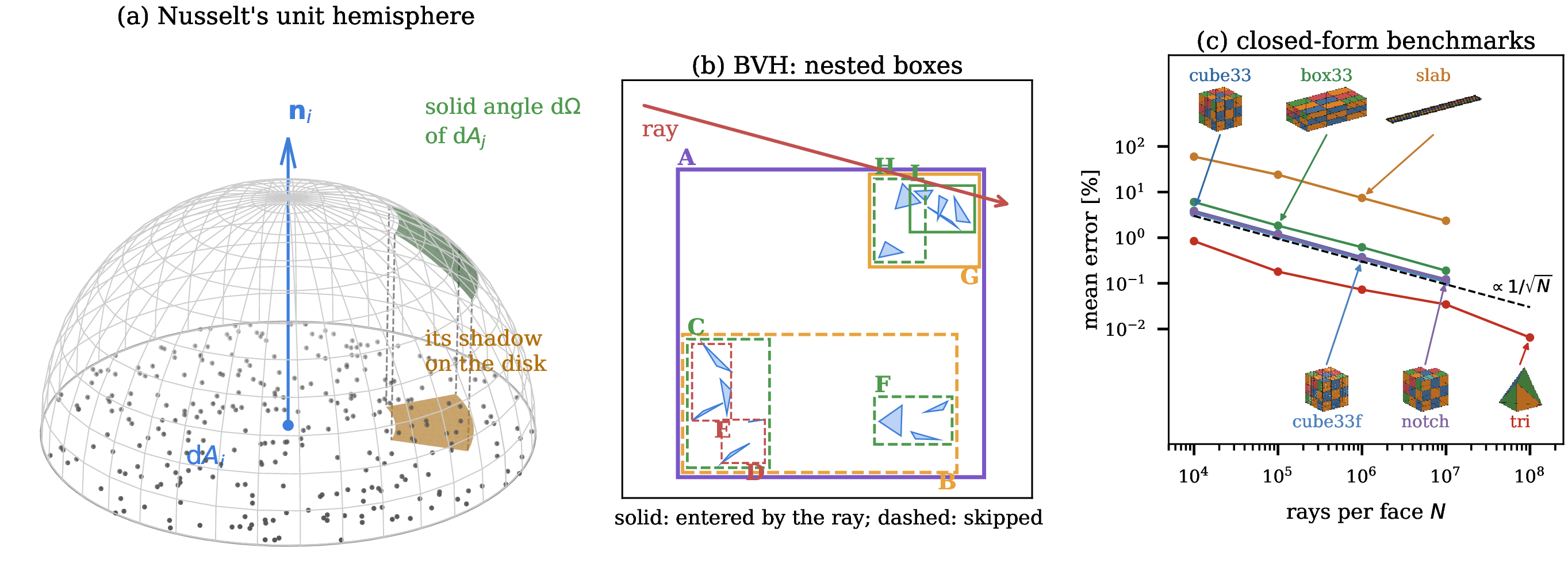
View factors for room radiation (from the OpenCAE Symposium 2026 talk): radiation matters in the thermal environment of a house, and the steady FVM (OpenFOAM) usually solves it with the viewFactor model. OpenFOAM's standard view factors are inaccurate and break the summation rule, so they are replaced by Monte Carlo: the view factor is the hit probability of cosine-weighted rays, which meets the summation rule by construction. A BVH (bounding volume hierarchy) speeds up the ray tracing, which is most of the cost; the method was verified on shapes with closed-form solutions; and symmetrising the product of area and view factor makes the reciprocity rule hold accurately too. The code is viewFactorsGenMC (GPLv3).
Electrochemistry
electrokinetics.hpp holds the analytic relations (Debye length,
Debye–Hückel, Gouy–Chapman, Helmholtz–Smoluchowski). pnp_full2d solves the
full Poisson–Nernst–Planck system: one lattice per ion for Nernst–Planck and a
pseudo-transient lattice for Poisson; it was validated on the Gouy–Chapman
double layer on 2026-07-17. electroosmosis2d drives a channel flow with a
fixed Debye–Hückel potential.
Measured
| what | result | source |
|---|---|---|
| Settling sphere, Ten Cate E3 / E4 | terminal velocity 0.95 / 0.915 (16 cells per diameter), 0.94 (E4, 24 cells) of the experiment | settling-sphere.md, 2026-07-16 |
| Two disks, dkt2d, τ = 0.60 | drafting, kissing and tumbling in that order; repulsion 100 and 400 give the same path to four digits | comment in dkt2d.cpp, 2026-11-01 |
| Two spheres with DEM, one GH200 | 2.46 M cells, 43.4 s | DEM-fluid-coupling page |
| Advection–diffusion, N = 128 | relative error 0.001813924 | gallery |
| Reaction–diffusion | relative error 0.0002566304 at Nx = 256, 6.42e-05 at Nx = 512 (second order) | gallery |
Still open
- DEM: the tangential history, and DEM in the 2D drivers.
- Rotation of the settling sphere (the two-sphere and two-disk cases have it).
- Two-way coupling and lift for point particles; chains of magnetic dipoles.
- Bedload transport and a moving bed.
- Faradaic reactions at electrodes and an implicit flux for PNP.
- The Thomas breakthrough curve for adsorption is reported, not gated.
Design records
Frozen; they are not updated and are not translated.
- settling-sphere.md — the settling sphere
- particles-dem-design.md — DEM
- particle-tracking-design.md — point particles
- magnetic-particles-design.md — magnetic particles
- sediment-morphodynamics-design.md — sediment
- advdiff2-design.md — scalar transport with walls, inflow and sources
- pnp-full-design.md — Poisson–Nernst–Planck