Particle (DEM)–fluid coupling — 2 spheres drafting, kissing and separating
English | Japanese
What was done
Contact between particles (DEM) and the flow around the particles (LBM) are solved within the same computation. The first coupled case is the phenomenon (DKT) in which 2 settling spheres catch up (drafting), touch (kissing), and tip over sideways and separate (tumbling).
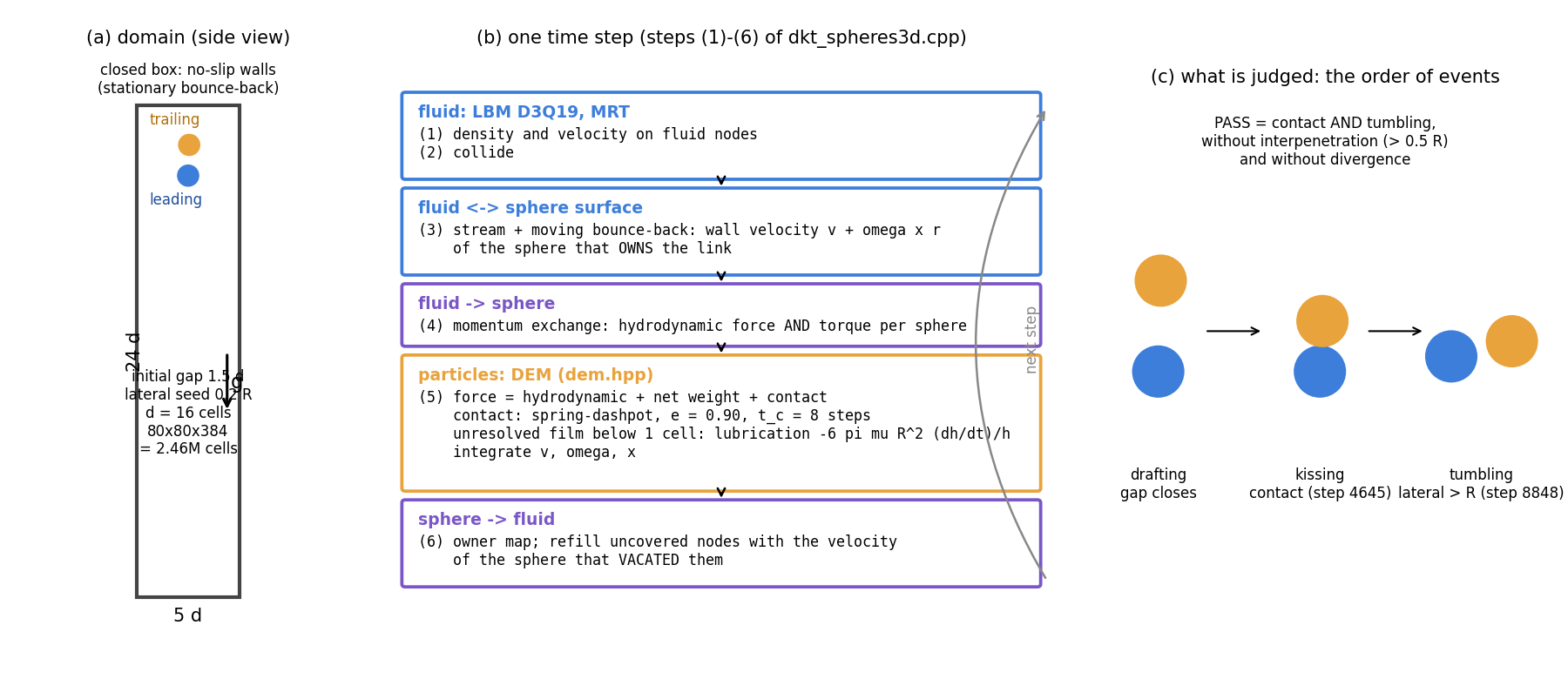
- Fluid side: D3Q19, MRT. The spheres are treated as moving walls (bounce-back), and force and torque are obtained by momentum exchange. Which lattice node belongs to which sphere is recorded, and the wall velocity v + ω × r is taken from that sphere. Nodes that a sphere has left are refilled using the velocity of the sphere that left (dkt_spheres3d.cpp). It builds on settling-sphere3d, where single-sphere settling is validated against Ten Cate (2002).
- Particle side (dem.hpp): linear spring–dashpot (Hertz is also selectable), lubrication force F = −6πμR²(dh/dt)/h, a tangential dashpot capped by Coulomb friction (no contact history is kept), and grid-binned neighbour search.
- Per-component tests (test_dem.cpp): coefficient of restitution, contact time, momentum conservation, the Hertz exponent, lubrication force and neighbour search are compared with exact solutions.
Results
On 1 GH200 on Miyabi-G, 43 s with 2.46M cells: the catch-up is monotonic, contact at step 4645, tipping over at 8848, and the lateral separation reaches 2.96 R, giving PASS (commit f55ed49).
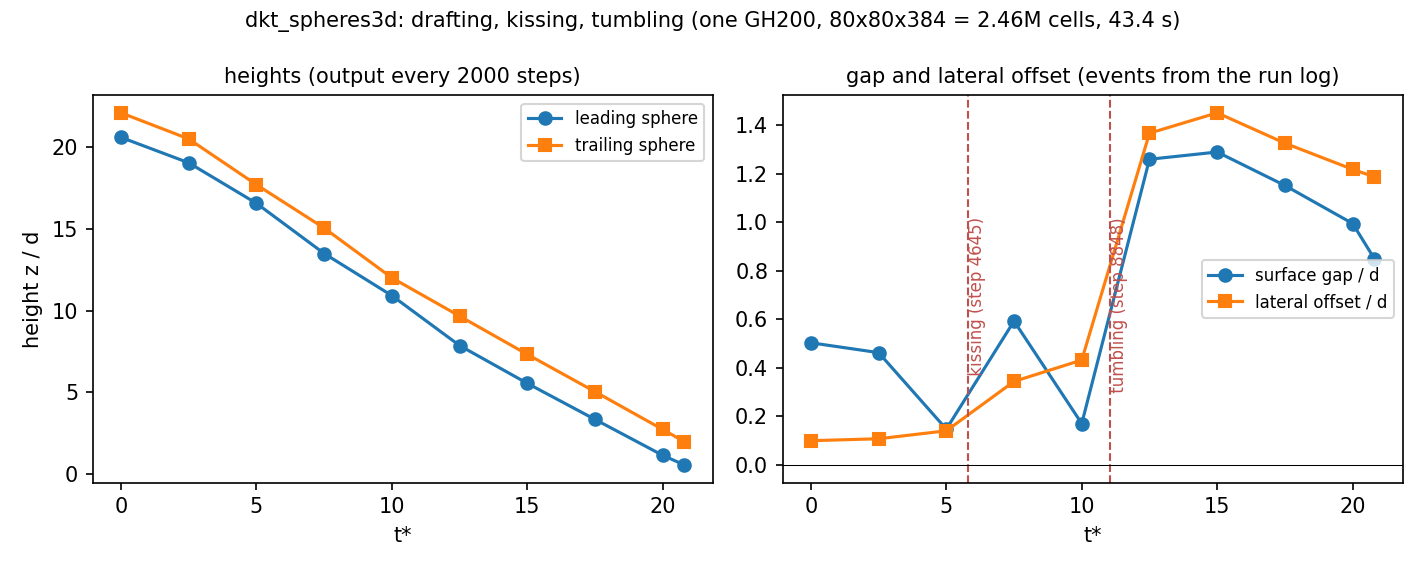
What is checked is the order in which events happen, not their times. DKT times shift with box width, density ratio and release height, so comparing with the times from papers using a different box would give a false sense of precision. The references are Fortes, Joseph & Lundgren (1987) and Glowinski et al. (2001). There is no numerical comparison with data from the papers.
What running it revealed (same commit)
- At first it diverged at 256 steps with velocity 3860. The cause was the default fluid condition (E4, τ = 0.53), not the treatment of torque. The default was changed to E3.
- On contact, the spheres overlapped by 0.55 R. The contact spring was too soft (contact time 40 steps); with 8 steps the overlap stayed within 0.15 cells.
- Without lubrication, the 2 spheres stick together through a spurious attraction 16 times their weight. With lubrication, the gap opens up to 0.5 d.
Open points
- The 43 s, 2.46M-cell run used the settings
dkt_out/dkt.conf(box 5 × 5 × 24 d, nd = 16 giving 80 × 80 × 384 = 2.46M cells, release spacing 1.5 d). The log and output are outside the repository (not under git). This is a different setting from the source defaults (6 × 6 × 16 d, spacing 2.0 d). - Only contact and tipping are included in the check; monotonic catch-up and the swap of order are only displayed.
- The design document particles-dem-design.md (2D, with contact history, no lubrication) has not been updated to match the implementation (3D, no history, with lubrication).
- There is no gallery page for this case yet.