drivaer
English | Japanese
« Home · « External flow and wind engineering
Summary: the wake of the DrivAer fastback (a realistic car shape) on the D3Q27 cumulant block-forest AMR-LBM. The inflow is a section cut from a steady OpenFOAM solution (simpleFoam, k-omega SST). The velocity field at y = 0 and the wake fluctuations are compared with the FVM. This is the case of the OpenRheo part 2 talk at the OpenCAE Symposium 2026 (section 7.4).
Setup
The LBM domain (8.3 x 8.2 x 5.1 m) holds the rear of the car and sits inside the FVM domain (half model, 40 x 5 x 8 m). The LBM inflow is the FVM section at x = 1.6 m, 2.2 m ahead of the rear: its mean velocity plus digital-filter fluctuations built from k.
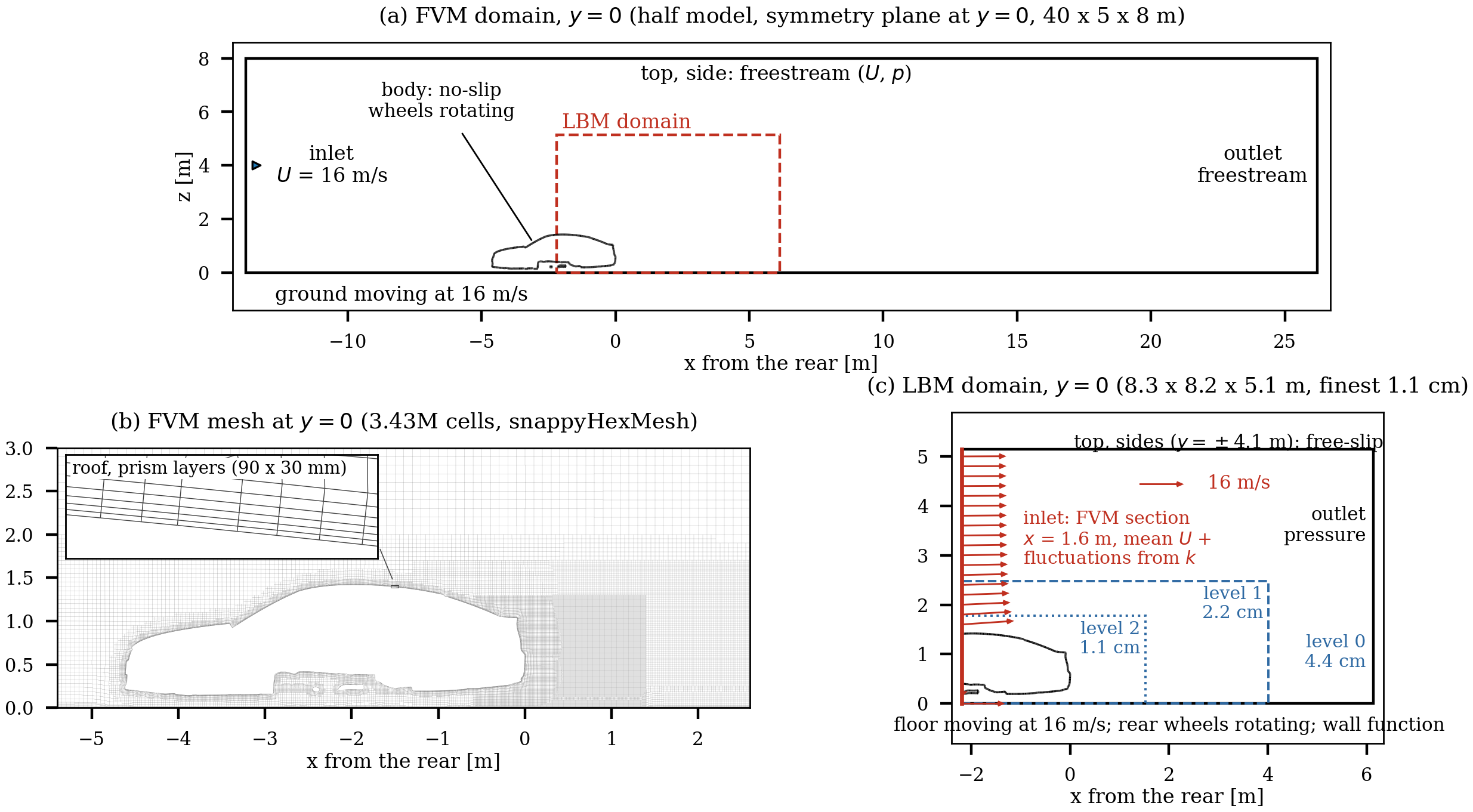
- (a) FVM and LBM domains.
- (b) FVM mesh at y = 0 (3.43M cells, snappyHexMesh).
- (c) LBM domain and refinement boxes (level 0/1/2 = 4.4/2.2/1.1 cm), with the mean inflow velocity vectors at y = 0 (every 0.2 m). The figure is the one of the OpenCAE Symposium 2026 talk.
Results
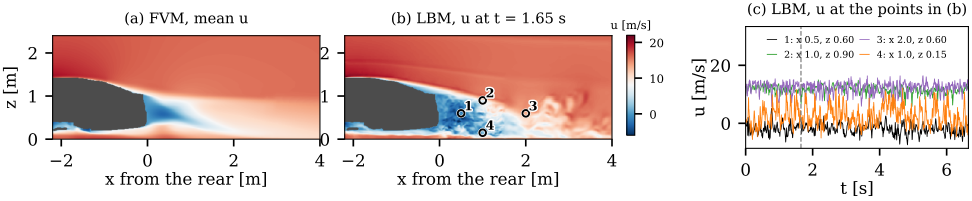
- (a) FVM mean u.
- (b) LBM instantaneous u at t = 1.65 s.
- (c) LBM u against time at the four points of (b).
|u| of the LBM on the plane y = 0 (0 to 22 m/s, x from the rear end). Same set-up as the table below (wall function evaluated with the velocity relative to the moving floor and wheels), rerun to write the plane every 100 steps (0.014 s); the last 2.1 s (150 frames) play in 10 s. The shear layer from the roof becomes turbulent as it moves downstream, and vortices are exchanged in the recirculation behind the rear end.
| FVM (simpleFoam, k-omega SST) | LBM (D3Q27 cumulant) | |
|---|---|---|
| reverse-flow length behind the rear at y = 0 | 0.72 m | 0.93 m (1.02 m with a 0.55 cm underbody; 1.08 m with 0.55 cm also around the rear end) |
| underbody u at the rear | 12.8 m/s | 12.9 m/s (0.55 cm underbody; 12.0 m/s with 0.55 cm also around the rear end) |
| Cd | 0.2571 (mean of iterations 501-1000) | not evaluated |
The LBM numbers are from the rerun after the wall function was changed to use the velocity relative to the moving floor and wheels (2026-10-29/30, Miyabi-G GH200, 56,000 steps, averaged from step 28,000). The change against the earlier runs is within 2.5 % in Cd and 0.06 m in the reverse-flow length. The run with 0.55 cm cells also around the rear end (x -0.29 to 0.82 m, |y| < 0.84 m, z < 1.02 m) was added on 2026-10-30.
Wake probes u (mean / std, m/s):
| point | mean | std |
|---|---|---|
| 1 | -2.27 | 1.67 |
| 2 | 11.47 | 1.16 |
| 3 | 12.23 | 1.88 |
| 4 | 2.93 | 3.46 |
The spectral peaks lie at 3.75-5.0 Hz (St = 0.33-0.44 with the car height 1.418 m and 16 m/s; frequency resolution 0.63 Hz). The peak moves between the first and second 0.8 s of the same run, so the frequency is not settled at this averaging length.
Numbers of the OpenCAE Symposium 2026 talk
From the OpenCAE Symposium 2026 talk; the whole talk is summarised in OpenCAE Symposium 2026 talk.
- FVM: simpleFoam, k-omega SST, 3.43 M cells (snappyHexMesh, 6 prism layers on body, wheels and ground), rotating wheels; Cd 0.257 at 16 m/s (experiment [Collin] 0.252).
- LBM inflow: the FVM velocity plus digital-filter fluctuations from k.
- LBM: D3Q27 cumulant, finest 1.1 cm (19.82 M cells), about 45 minutes on one Miyabi-G GH200; Spalding wall function, moving floor, rotating rear wheels.
| FVM | LBM | LBM, underbody cells halved | |
|---|---|---|---|
| Rear recirculation length | 0.72 m | 0.92 m | 1.08 m |
| Speed 0.1 m above the floor at the rear | 12.8 m/s | 8.8 m/s | 12.6 m/s |
Wake standard deviation 1.2–3.4 m/s; spectral peaks of the shear layer and wake 3.75–5.0 Hz (St = 0.33–0.44 on the car height). The figures and numbers of this table (including the 0.55 cm underbody column) are the abstract's runs; the rerun with the wall function relative to the moving floor and wheels gives 0.93 m and 9.4 m/s (Cd within 2 %). The current values are in the table under Results.
Settings
| Item | Value |
|---|---|
| Geometry | DrivAer fastback with wheels |
| Speed | 16 m/s, floor moving at 16 m/s, rear wheels rotating |
| Lattice | D3Q27, cumulant collision, wall model (Spalding) |
| Refinement | 3 levels, finest cell 1.1 cm, 19,818,112 cells |
| Steps | 16,000, statistics over steps 8,000-16,000. The instantaneous field and the probe records come from a 56,000-step run |
| Machine | Miyabi-G (GH200) |
| FVM | the DrivAer fastback case of the OpenFOAM training course: 3.43M cells, 64 Grace ranks, 335 s |
Geometry
The DrivAer geometry is under the licence of TUM (Technical University of Munich), so this repository and wiki contain no geometry files (STL, meshes); users obtain the geometry themselves. The training-course case fetches the surfaces distributed with the OpenFOAM-13 tutorial (incompressibleFluid/drivaerFastback) with run/getGeometry.
FVM case of the training course
The FVM solution is the DrivAer fastback case of the OpenFOAM training course (OpenCAE Society).
| Content | Link |
|---|---|
| Case files | Flow2/drivaerFastback |
| Course document (Markdown, Japanese) | Supercomputer-OpenFOAM-Training-drivaerFastback-Flow2.md |
| Common settings and mesh | run/base |
| CPU run (simpleFoam) | run/CPU |
| GPU runs (AmgX, openfoam-ecse) | run/AmgX, run/eCSE |
| Geometry download | run/getGeometry |
Data
| File | Content |
|---|---|
| README.md | Data provenance, run ids, the source of the numbers on this page |
| domain.json | FVM domain, LBM domain and refinement boxes, inlet section |
| probe_stats.py | Mean, std and spectral peak at the four wake points (its input probes_y0.csv is too large for the wiki) |
Validation
| Tier | T3 — demo (no quantitative gate) |
| QoI | reverse-flow length at y = 0, wake u |
| Reference | OpenFOAM simpleFoam k-omega SST of the training course (no published reference) |
| Gate | — no gate |
Source and runs
The case ran on a development branch (drivaer) that is not yet in the public main. The data provenance and the numbers come from the README.md of the symposium paper data: run ids run_nh32_ml2.3548845, run_nh32_ml2.3553357, and 3553360 -> 3556610.