forest-bfs
English | Japanese
« Home · « Turbulence (checked against DNS/LES)
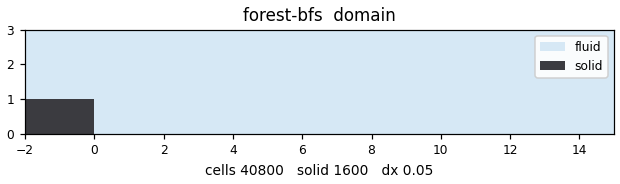
Turbulent backward-facing step (BFS), Kasagi & Matsunaga (1995) config -- the reference behind the OpenFOAM V&V case backwardFacingStepKasagi (gitlab.com/OpenCAE/VandV). Solved on the FOREST (block-AMR) LBM solver. Cloned from benchmarks/forest_building.cpp: the case-specific changes are the geometry (BFSGeom step block instead of the wall-mounted prism), the closed- channel NO-SLIP top wall (ForestDomainBC::top_noslip -- the building/Ahmed tunnel has a free-slip open top), a plain UNIFORM (or 1/7-power-law channel) inlet into the upstream channel z in [h, 3h], and the QoI: the mean REATTACHMENT LENGTH x_r/h read off the near-floor mean-u_x sign change. Everything else (forest build, Bouzidi wall data, MEM force, MRT/RR/HRR collide, y=0 mean slice dump, time-averaging) is reused unchanged.
Geometry
Fields
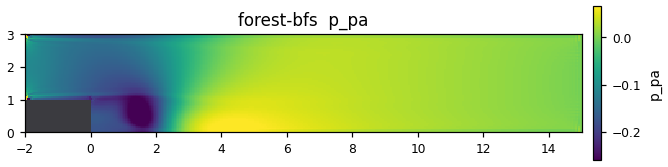
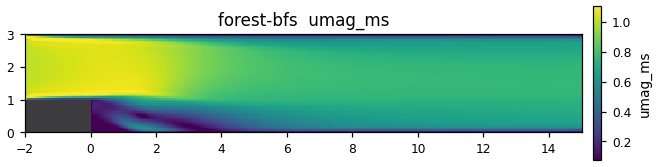
The fields this computation wrote at its last output step, plotted as they are. 3D cases show the mid-plane.
Build & run
Cost of the computation that made the figures on this page (Miyabi-G Grace CPU (72 cores, -stdpar=multicore)): 112.9 s wall.
Validation
| Tier | T2 — single-point comparison |
| QoI | reattachment_length |
| Reference | Kasagi & Matsunaga (1995) -- turbulent BFS Re_h=5540 (forest_bfs.cpp IS the turbulent config; the laminar Armaly regime lives in orheo-expansion-loss2d) |
| Gate | — no gate |
Source & run details
| Item | Value |
|---|---|
| Target | orheo-forest-bfs |
| Source | native/benchmarks/forest_bfs.cpp |
| Lattice | — |
| GPU twin | yes (orheo-forest-bfs-gpu) |
| Modules | ahmed_solver.hpp, bfs_geom.hpp, forest_inflow.hpp, forest_regrid.hpp, forest_step.hpp, rans_ke.hpp |
| Gallery run | 2026-07-27 @ fc5fbb30 |
| Args | `` |
| Wall time | 112.86 s |
| CPU time | 4155.41 s |
| Device | Miyabi-G Grace CPU (72 cores, -stdpar=multicore) |
Computation log
The actual output of this computation (head and tail).
=== forest BFS (Kasagi, ER=1.5) ===
nh=20 steps=40000 ulat=0.0500 Re_h=5540.0 cs=0.160 max_level=0 collide=2
h=1.000m H=3.000m dx0=0.05000m  domain x[-2.00,15.00] z[0,3.00] span=0.200  blocks=85x1x15 (kNb=4)  tau=0.5005  nu_lat=0.0001805
forest: 1275 leaves, max_level reached=0 (requested 0)
=== wall data (solid mask + Bouzidi qlink) ===
solid cells=10800 (of 275400 pool cells)
inlet = uniform U0=ulat over the open upstream channel
outflow = anti-bounce-back pressure Dirichlet (rho_out=1)
top wall = NO-SLIP (closed channel); floor = no-slip; lateral = free-slip (2D)
collide=HRR sigma=0.9800
probe rake -> probe.csv: P0(x/h=5.28,z/h=0.12) P1(x/h=1.98,z/h=0.98) P2(x/h=7.98,z/h=0.12) every 1 step(s)
=== time-stepping ===
step      0/40000  t_conv=0.000  umax=0.0500 | 0.0s  0 step/s  0.0 MLUPS | Mdrift=+0.0 ppm
step   1000/40000  t_conv=0.147  umax=0.0718 | 2.6s  384 step/s  31.3 MLUPS | Mdrift=+0.0 ppm
...

  probe z/h=0.15: x_r/h = 3.174  (min ux=-0.5924)
  probe z/h=0.20: x_r/h = 2.971  (min ux=-0.5398)
  probe z/h=0.25: x_r/h = 2.795  (min ux=-0.4732)
  probe z/h=0.30: x_r/h = 2.622  (min ux=-0.4081)
  first-row (legacy): x_r/h = 3.604
  backflow extent (z/h<0.5): max x/h with mean ux<0 = 3.575;  min ux=-0.6209 at (x/h=1.675, z/h=0.125)
=== REATTACHMENT: x_r/h = 3.384  (probe z/h=0.10; Kasagi reference ~6.5) ===
=== wrote profiles.csv (x/h = 1,4,6,10) ===
=== done: x_r/h=3.384 (ref ~6.5), navg=20001 ===