venturi3d
English | Japanese
« Home · « Laminar flow and analytic verification
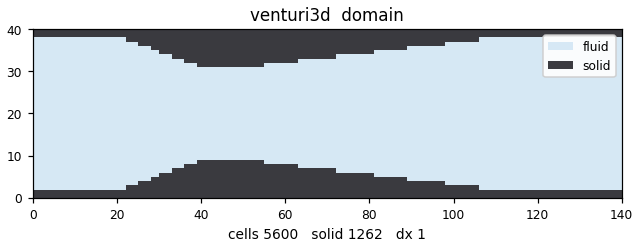
Venturi tube -- axisymmetric converging-throat-diverging duct, the classic obstruction flow meter. Single-phase D3Q19, ISO C++ stdpar. Validates two textbook results at once: (1) the axial static-pressure signature -- a drop at the throat that RECOVERS in the diffuser, matched against the Bernoulli + continuity prediction; and (2) the venturi DISCHARGE COEFFICIENT Cd, the ratio of the true volumetric flow to the ideal flow the measured throat pressure drop would imply.
Geometry
Animation
Fields
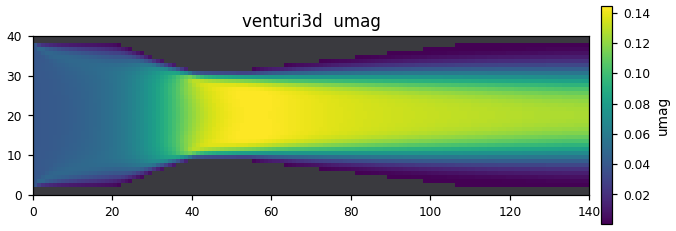
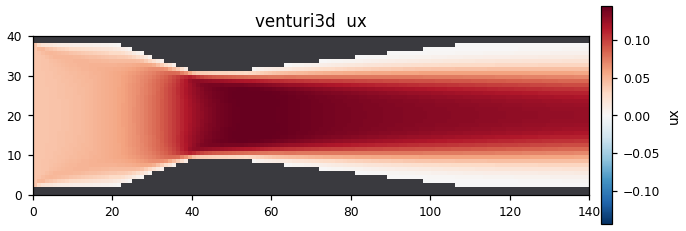
The fields this computation wrote at its last output step, plotted as they are. 3D cases show the mid-plane.
Build & run
venturi3d [Rin] [Rthroat] [Re] [steps] [umean] [axial_csv] [field_csv]
Cost of the computation that made the figures on this page (Miyabi-G Grace CPU (72 cores, -stdpar=multicore)): 46.1 s wall.
Validation
| Tier | T2 — single-point comparison |
| QoI | discharge_coefficient |
| Reference | Bernoulli + Borda-Carnot; ISO 5167 discharge coefficient |
| Gate | — no gate |
Source & run details
| Item | Value |
|---|---|
| Target | orheo-venturi3d |
| Source | native/benchmarks/venturi3d.cpp |
| Lattice | D3Q19 |
| GPU twin | no |
| Modules | lbm_d3q19.hpp |
| Gallery run | 2026-07-27 @ 7628c0cf |
| Args | `` |
| Wall time | 46.10 s |
| CPU time | 1628.78 s |
| Device | Miyabi-G Grace CPU (72 cores, -stdpar=multicore) |
Computation log
The actual output of this computation (head and tail).
=== venturi3d D3Q19 -- converging-throat-diverging duct ===
grid 140x40x40 (0.22 Mcell)  axis (19.5,19.5)
Rin=18.0 Rthroat=11.0  beta=d_t/d_in=0.611  area ratio A_in/A_t=2.678
sections: bore[0,20) cone[20,40) throat[40,50) diffuser[50,110) bore[110,140)
u_in=0.0400 (peak throat Mach~0.186)  Re_Din=200.0  nu=0.00720  tau=0.52160
solid cells=115276  fluid cells=108724  A_inlet=1020 A_throat=384 (ratio 2.656)
step      0/40000  throat: u_bulk=0.0369  Q=14.19  dQ=1.42e+01  p_c=0.33333
step   2000/40000  throat: u_bulk=0.0898  Q=34.48  dQ=2.03e+01  p_c=0.32601
step   4000/40000  throat: u_bulk=0.1063  Q=40.83  dQ=6.35e+00  p_c=0.32557
step   6000/40000  throat: u_bulk=0.1126  Q=43.24  dQ=2.41e+00  p_c=0.32832
step   8000/40000  throat: u_bulk=0.1129  Q=43.35  dQ=1.09e-01  p_c=0.33103
step  10000/40000  throat: u_bulk=0.1107  Q=42.51  dQ=8.40e-01  p_c=0.33258
step  12000/40000  throat: u_bulk=0.1085  Q=41.68  dQ=8.29e-01  p_c=0.33300
step  14000/40000  throat: u_bulk=0.1073  Q=41.21  dQ=4.69e-01  p_c=0.33281
...

    axis u1=0.0440  ut=0.1356
(1b) bulk/tap static drop dp_meas=0.008800  dp_Bernoulli(bulk)=0.004718 (86.5%)
     [bulk over-predicts dp: peaked laminar profile carries extra KE]
     inlet u1=0.0395  throat ut=0.1049 (=u1*A_in/A_t=0.1049)
(2) diffuser recovery   (p_out-p_th)/(p_in-p_th) = 0.168 (1=lossless; mean p)
(3) discharge coeff     Cd = Q_actual/Q_ideal = 0.7331
    Re_throat = ut*Dt/nu = 320 (venturi Cd is Re-dependent; ISO 0.98
    is the Re>2e5 asymptote -- lower at this laminar Re)
caveats: staircased bore (few-% area error) + weak LBM compressibility (Mach)