forest-bfs
英語 | 日本語
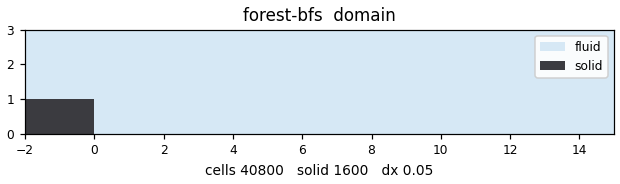
Turbulent backward-facing step (BFS), Kasagi & Matsunaga (1995) config -- the reference behind the OpenFOAM V&V case backwardFacingStepKasagi (gitlab.com/OpenCAE/VandV). Solved on the FOREST (block-AMR) LBM solver. Cloned from benchmarks/forest_building.cpp: the case-specific changes are the geometry (BFSGeom step block instead of the wall-mounted prism), the closed- channel NO-SLIP top wall (ForestDomainBC::top_noslip -- the building/Ahmed tunnel has a free-slip open top), a plain UNIFORM (or 1/7-power-law channel) inlet into the upstream channel z in [h, 3h], and the QoI: the mean REATTACHMENT LENGTH x_r/h read off the near-floor mean-u_x sign change. Everything else (forest build, Bouzidi wall data, MEM force, MRT/RR/HRR collide, y=0 mean slice dump, time-averaging) is reused unchanged.
概要: 乱流後ろ向きステップ(Kasagi & Matsunaga 1995、Re_h=5540)。剥離・再付着という予測の難しい現象を forest AMR + LES で解き、再付着長を実験と比較する。
Geometry
Fields
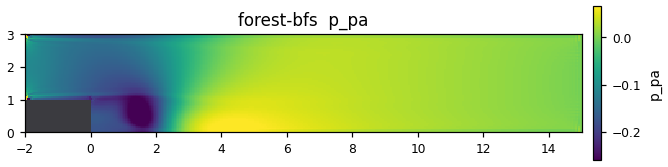
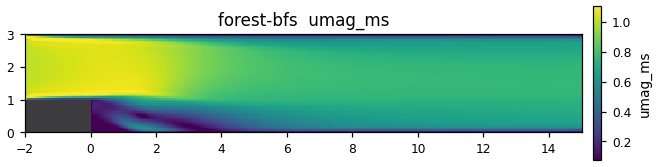
この計算が最後の出力ステップで書き出した場をそのまま描いたもの。3D ケースは中央断面。
Build & run
このページの図を作った計算のコスト(Miyabi-G Grace CPU (72 cores, -stdpar=multicore)): 112.9 s wall。
Validation
| Tier | T2 — 単点比較 |
| QoI | reattachment_length |
| Reference | Kasagi & Matsunaga (1995) -- turbulent BFS Re_h=5540 (forest_bfs.cpp IS the turbulent config; the laminar Armaly regime lives in orheo-expansion-loss2d) |
| Gate | — ゲートなし |
Source & run details
| Item | Value |
|---|---|
| Target | orheo-forest-bfs |
| Source | native/benchmarks/forest_bfs.cpp |
| Lattice | — |
| GPU twin | yes (orheo-forest-bfs-gpu) |
| Modules | ahmed_solver.hpp, bfs_geom.hpp, forest_inflow.hpp, forest_regrid.hpp, forest_step.hpp, rans_ke.hpp |
| Gallery run | 2026-07-27 @ fc5fbb30 |
| Args | `` |
| Wall time | 112.86 s |
| CPU time | 4155.41 s |
| Device | Miyabi-G Grace CPU (72 cores, -stdpar=multicore) |
Computation log
この計算の実際の出力(先頭と末尾)。
=== forest BFS (Kasagi, ER=1.5) ===
nh=20 steps=40000 ulat=0.0500 Re_h=5540.0 cs=0.160 max_level=0 collide=2
h=1.000m H=3.000m dx0=0.05000m  domain x[-2.00,15.00] z[0,3.00] span=0.200  blocks=85x1x15 (kNb=4)  tau=0.5005  nu_lat=0.0001805
forest: 1275 leaves, max_level reached=0 (requested 0)
=== wall data (solid mask + Bouzidi qlink) ===
solid cells=10800 (of 275400 pool cells)
inlet = uniform U0=ulat over the open upstream channel
outflow = anti-bounce-back pressure Dirichlet (rho_out=1)
top wall = NO-SLIP (closed channel); floor = no-slip; lateral = free-slip (2D)
collide=HRR sigma=0.9800
probe rake -> probe.csv: P0(x/h=5.28,z/h=0.12) P1(x/h=1.98,z/h=0.98) P2(x/h=7.98,z/h=0.12) every 1 step(s)
=== time-stepping ===
step      0/40000  t_conv=0.000  umax=0.0500 | 0.0s  0 step/s  0.0 MLUPS | Mdrift=+0.0 ppm
step   1000/40000  t_conv=0.147  umax=0.0718 | 2.6s  384 step/s  31.3 MLUPS | Mdrift=+0.0 ppm
...

  probe z/h=0.15: x_r/h = 3.174  (min ux=-0.5924)
  probe z/h=0.20: x_r/h = 2.971  (min ux=-0.5398)
  probe z/h=0.25: x_r/h = 2.795  (min ux=-0.4732)
  probe z/h=0.30: x_r/h = 2.622  (min ux=-0.4081)
  first-row (legacy): x_r/h = 3.604
  backflow extent (z/h<0.5): max x/h with mean ux<0 = 3.575;  min ux=-0.6209 at (x/h=1.675, z/h=0.125)
=== REATTACHMENT: x_r/h = 3.384  (probe z/h=0.10; Kasagi reference ~6.5) ===
=== wrote profiles.csv (x/h = 1,4,6,10) ===
=== done: x_r/h=3.384 (ref ~6.5), navg=20001 ===