D3Q27, wall models and turbulence
English | Japanese
External flows at high Reynolds number (the Ahmed body, the AIJ building cases, a cube canopy) run on the D3Q27 lattice with the cumulant collision on the block forest. The wall cannot be resolved at those Reynolds numbers, so the solver needs a wall model, and the turbulence below the grid needs a subgrid model. This page says what is in the code, what was measured and what did not work. The wall model for a separated body is not solved yet: the drag to quote is the pressure part (Cd_pressure), not the total.
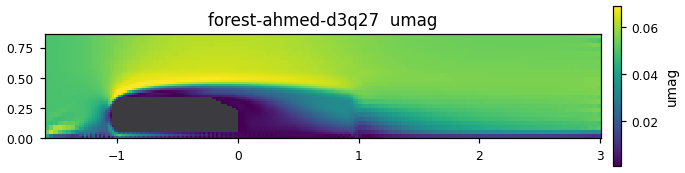
D3Q27 on the block forest
The D3Q27 forest kernels are templated on a lattice type (lattice.hpp,
forest_step_lat.hpp); the validated D3Q19 kernels in forest_step.hpp were
left untouched rather than templated or copied (2026-07-15). D3Q27 has to fill
the corner ghosts as well as the faces and edges. The D3Q27 path couples the
levels with partition2 (see AMR).
| D3Q19 forest | D3Q27 forest | |
|---|---|---|
| collision | MRT (default), RR, HRR, central moment, cumulant, KBC | cumulant (default), BGK, KBC |
| drivers | forest_ahmed_body, forest_building, … |
forest_ahmed_d3q27, forest_aij_d3q27, forest_cube_canopy, forest_channel_d3q27, … |
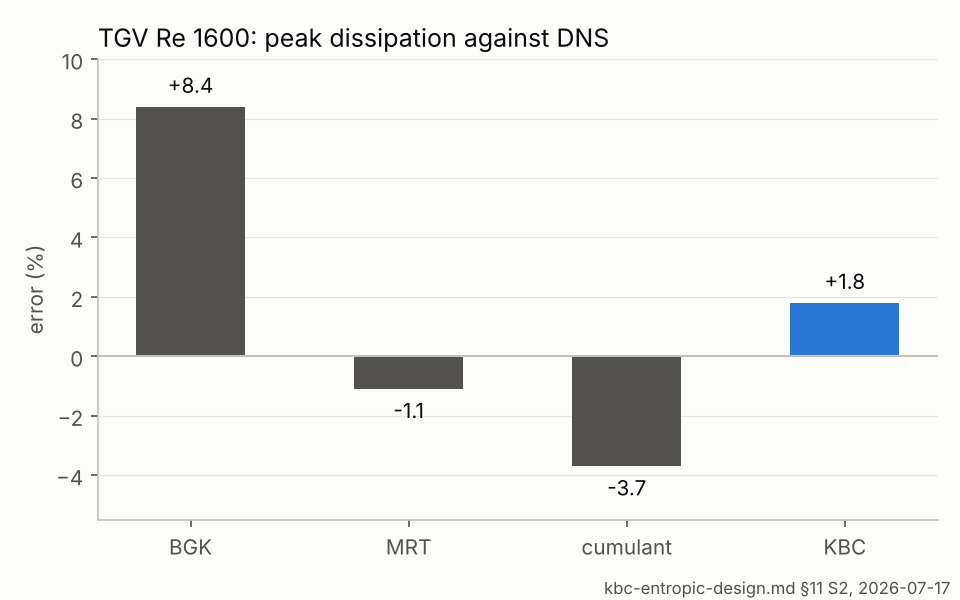
KBC (entropic, 2026-07-17): on D3Q19 it gave the same result as MRT; on D3Q27 it works as an implicit LES on the Taylor–Green vortex, but on a sharp-cornered cube at τ close to 0.5 it diverged where cumulant with Smagorinsky stayed stable (Cd 1.05). For separated wakes the choice stays cumulant with Smagorinsky.
Wall models
WMODEL selects the wall model (default 0, none; the Miyabi job script uses
2). Six were built:
| WMODEL | what | result |
|---|---|---|
| 1, 2 | Werner–Wengle, Spalding: raise τ in the first cell (τ-bump) | production (2). In the channel the friction is 0.066 of the log law (2026-07-23, below) |
| 3 | log law with a pressure-gradient term | no gain on the Ahmed body or the backward-facing step (2026-07-15) |
| 4 | neural-network wall law | on hold, off: 19 usable training samples; the teacher missed its 5 % gate (2026-07-15) |
| 5 | bounce-back whose wall flux equals the modelled wall stress | channel right at every y+; on the Ahmed body near-slip, Cd ≈ 1.8 (2026-07-23) |
| 6 | first-cell reconstruction (Malaspinas–Sagaut) | depends on y+ in the channel; on the Ahmed body Cd swings between −0.72 and +0.67 (2026-07-23) |
The channel test that exposed the problem (forced D3Q27 channel, Re_τ = 1600):
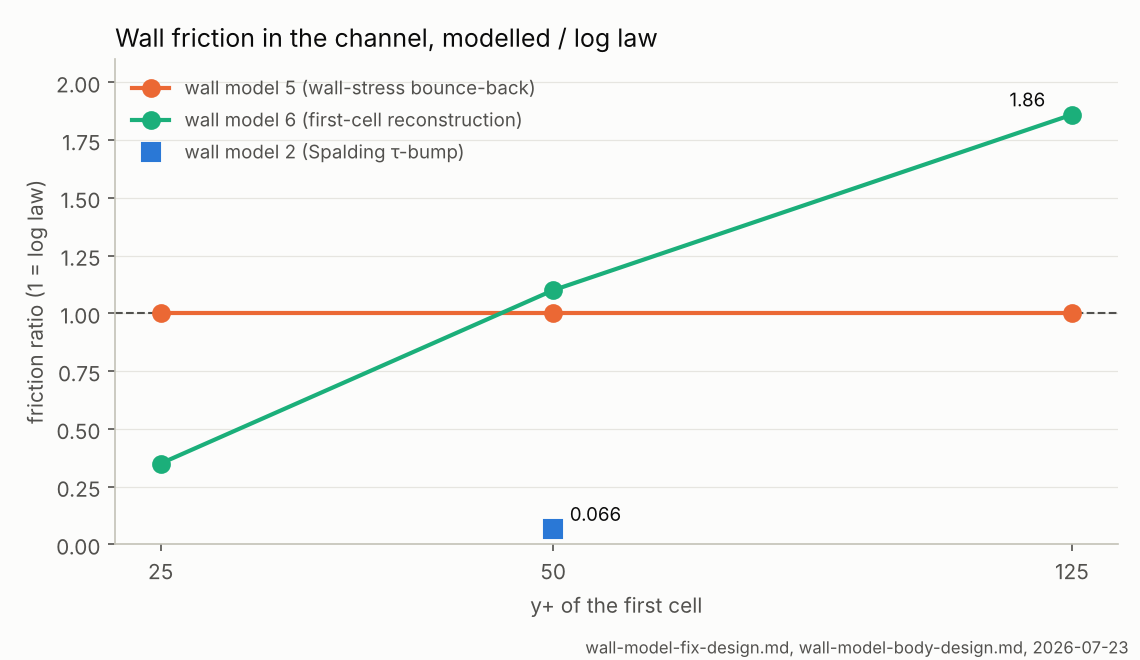
The τ-bump of models 1 and 2 only adds dissipation, so it cannot supply the log-law intercept, and its wall distance was off by half a cell; correcting the distance moved the ratio from 0.066 to 0.095. Removing the extra dissipation makes the run diverge, so the stability depends on it.
On the Ahmed body the wall model lowered the drag, but the friction part of that result came from the same τ-bump readout, which the channel test later showed to be about 15 times too small:
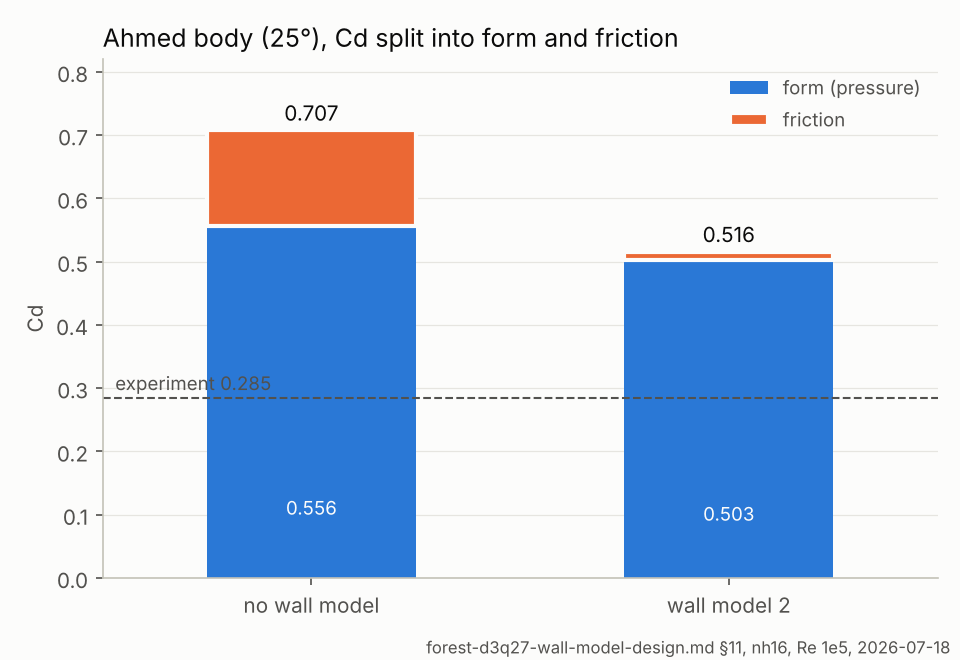
Until the wall model is fixed, quote the pressure drag Cd_pressure; the total Cd with a wall model is not valid.
How forces are read
Momentum exchange read 40–50 times the pressure Cd on the long Ahmed body, even
on a uniform grid (2026-07-18). Forces are now the surface integral of the
pressure and the viscous stress over the exposed faces
(forest_surface_force.hpp), which also splits form drag from friction. On a
sphere the total Cd is within 3.7 % of Clift–Gauvin.
Turbulence below the grid
- Smagorinsky is the default.
DYNSGSselects dynamic Smagorinsky (Germano–Lilly) andWALEselects WALE, both on the D3Q27 path. - Transported SGS energy (
sgs_ke.hpp, 2026-07-15): Smagorinsky destroys the subgrid energy in the wake of the AIJ building (resolved 0.009 against 0.05–0.17 m²/s² measured). The transported model runs on the D3Q19 forest; it is switched off with the partition2 coupling, and the AMR, Ahmed and AIJ steps of the plan are still open. - Inflow turbulence comes from a digital filter (
synthetic_turbulence.hpp). - Canopy drag (
forest_canopy.hpp) adds the drag of vegetation as a volume force; it is in the D3Q19 forest only.
Steady mode
An in-engine steady LBM-RANS (preconditioning, k–ε, multigrid restart, 2026-07-15) reached the backward-facing-step reattachment 4.36–4.81 h against 6.51 h measured, with 3.1 times fewer steps at nh = 20. It missed one of its gates, so the OpenFOAM backend stays the default for the steady tier; the in-engine mode is kept for STL cases and warm starts.
Still open
- A wall model that is right on a separated body. The next steps in the record (anchor only on attached flow, sample further out, a smooth stress boundary) have not been tried.
- Bouzidi walls together with wall models 5 and 6.
- The SGS-energy model with partition2 and on the Ahmed and AIJ cases.
- Volumetric turbulence forcing: designed, not built.
- Steady mode on AMR.
Design records
Frozen; they are not updated and are not translated.
- forest-d3q27-design.md — D3Q27 on the forest, cube canopy
- kbc-entropic-design.md — KBC
- forest-d3q27-surface-force-design.md — surface force
- forest-d3q27-wall-model-design.md, wall-model-fix-design.md, wall-model-bc-design.md, wall-model-body-design.md — wall models on D3Q27
- wall-model-pgrad-design.md, pinn-wall-model-design.md — pressure-gradient and neural-network wall laws
- vles-sgsk-design.md, vles-implementation-status.md — transported SGS energy
- turb-forcing-control-design.md — turbulence forcing
- canopy-drag-design.md — canopy drag
- steady-lbm-design.md — steady mode