settling-sphere3d
English | Japanese
« Home · « Particles and fluid-structure interaction
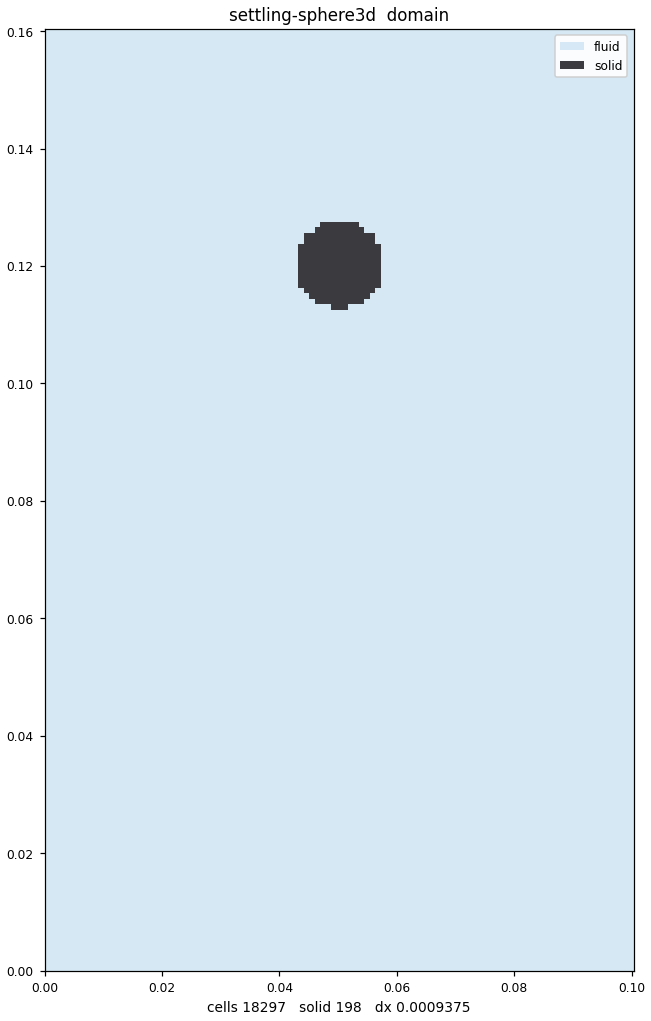
Fully-resolved settling-sphere FSI benchmark (Ten Cate et al. 2002). --------------------------------------------------------------------------- A single rigid sphere released from rest in a closed, quiescent container settles under gravity and is TWO-WAY coupled to the fluid: the fluid exerts a hydrodynamic force on the sphere (momentum exchange), the sphere's motion drives the fluid through a MOVING no-slip boundary. The signature result is the vertical-velocity history v(t): the sphere accelerates from rest, approaches a terminal velocity U_inf, then DECELERATES as it nears the bottom wall (the lubrication squeeze of the closing gap). Reproducing that accelerate -> plateau -> wall-approach-deceleration curve, and the terminal velocity, is the validation.
Geometry
Animation
Fields
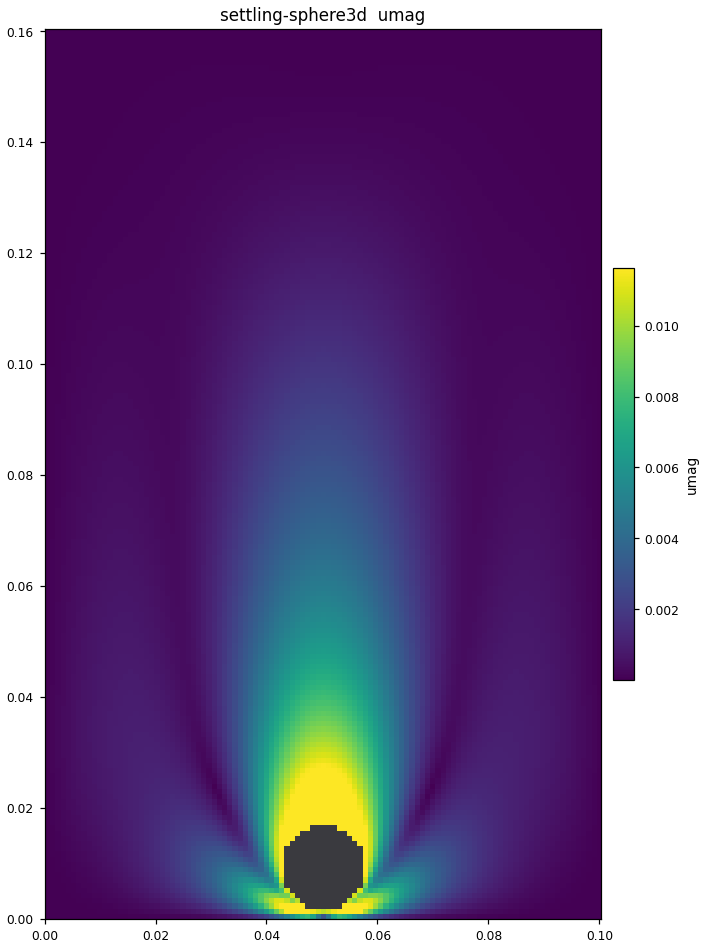
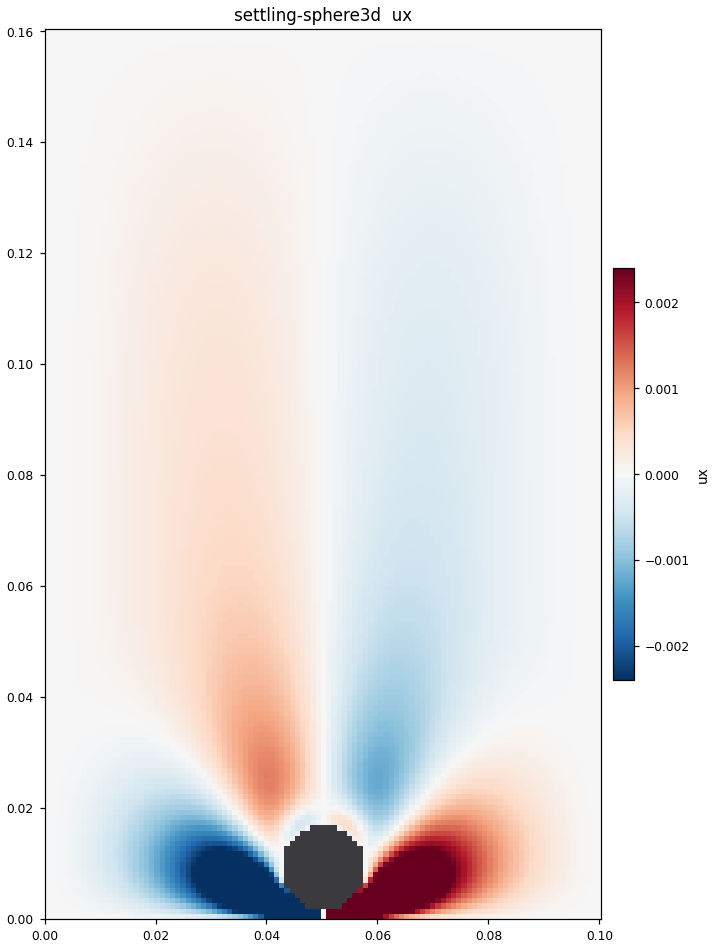
The fields this computation wrote at its last output step, plotted as they are. 3D cases show the mid-plane.
Results
A fully resolved FSI reproduction of the PIV experiment of Ten Cate et al. (2002), case E3 (Re = 11.6, ρ_f = 962 kg/m³, μ = 0.113 Pa·s, experimental terminal velocity U_inf = 0.091 m/s, nylon sphere d = 15 mm, ρ_p/ρ_f = 1.1642). Grid 107×107×171 = 1.96 M cells, d = 16 cells (dx = 9.375e-4 m, dt = 2.060e-4 s), MRT (τ = 0.5828, ν_lat = 2.7586e-2), target lattice velocity 0.020 (Ma = 0.035), g_lat = 4.442e-4, initial height z0 = 120.2 mm. Wall-clock time 125.5 s on 72 Grace CPU cores.
The signature is the 3 phases of the vertical velocity history v(t) — acceleration → terminal plateau → deceleration on approaching the wall — which the CSV traces directly:
- Acceleration: v/U_inf = 0.239 (t = 0.041 s) → 0.641 (0.206 s) → 0.810 (0.371 s).
- Plateau: maximum v/U_inf = 0.9474 (t = 1.154 s, t* = 7.0, v = 0.08621 m/s). That is, the computed terminal velocity is 94.7% of the experimental 0.091 m/s, about 5% low.
- Deceleration on approaching the wall: v/U_inf = 0.827 at gap = 4.61 mm (t = 1.442 s), 0.644 at gap = 1.78 mm, and 0.464 at the final gap = 0.94 mm (t = 1.500 s). Stops at gap ≤ 1 cell (step 7280 / maxsteps 20038). The deceleration due to lubrication squeeze in the closing gap appears qualitatively, within the limits of the grid resolution.
Candidates for the 5% shortfall are the staircase sphere surface at nd = 16 (effective-radius error), the finite container (the same 100×100×160 mm box as the experiment, but the grid is a discretization of it), and the treatment of forces with respect to added mass at a near-neutral density ratio; the header anticipates all of these as CAVEATS. Because the grid mapping is derived self-consistently from (nd, ulat, case), the terminal velocity is not an input but a pure prediction, and this 94.7% is that prediction's score.
Governing equations
The sphere is a two-way-coupled rigid body. Newton's equation (semi-implicit Euler, dt = 1 lattice step):
\[
m_p\frac{d\boldsymbol{v}_p}{dt}=\boldsymbol{F}_h+(\rho_p-\rho_f)V_p\,\boldsymbol{g},
\qquad V_p=\tfrac43\pi R^{3}
\]
The fluid is D3Q19 MRT; the static walls of the closed box use halfway bounce-back. The reflected distributions on the sphere surface carry the moving-wall momentum term:
\[
f_i(\boldsymbol{x}_f)=f^{*}_{\bar i}(\boldsymbol{x}_f)
+6\,w_i\,\rho_w\,(\boldsymbol{c}_i\cdot\boldsymbol{v}_p)
\]
(Ladd 1994; Aidun–Lu–Ding 1998). The fluid force is the momentum exchange on the sphere's boundary links, \(\boldsymbol{F}=\sum \boldsymbol{c}_i (f^{*}_i+f_{\bar i})\) — the same convention as the one pinned against Clift–Gauvin in sphere_drag.cpp. Cells vacated by the sphere are refilled with the equilibrium distribution at the neighbour-averaged density and the wall velocity v_p (a known delicate step). A density ratio of 1.16 is prone to added-mass oscillations, and a low-pass filter on the force (relax) is available, but this run uses relax = 1.00 (no filter).
Grid mapping: choosing nd and the target lattice terminal velocity ulat closes everything: dx = d/nd, dt = ulat·dx/U_inf, ν_lat = ulat·nd/Re, g_lat = g·dt²/dx. This is why velocities and times in physical units appear directly in the CSV.
Code walkthrough
Source (440 lines).
%%{init: {'themeVariables': {'fontSize': '11px'}}}%%
flowchart TB
    subgraph BOX["Closed box 107×107×171 (100×100×160 mm)<br/>halfway BB on all six faces / interior MRT"]
      S(("Sphere d=16 cells<br/>moving-wall BB + MEM force<br/>covered/uncovered refill"))
      W["Bottom wall: on approach,<br/>deceleration by lubrication squeeze"]
      S -->|"gravity (ρp−ρf)Vg"| W
end- Mapping — derive and print (dx, dt, ν_lat, g_lat) from the physical constants of case = E3.
- collide/stream — MRT. The sphere mask is rebuilt every step from the sphere-centre position.
- Force — MEM sum over the boundary links. Optional low-pass filter (passed through in this run).
- Rigid-body update — Newton in 1 direction (vertical). Covered cells are removed, uncovered cells are refilled with equilibrium.
- Output — z, gap, v, F in physical units to the CSV every 200 steps. At gap ≤ 1 cell it prints "sphere reached the bottom wall; stopping." and exits.
Build & run
cmake -S native -B native/build && cmake --build native/build -j
./native/build/orheo-settling-sphere3d
Cost of the computation that made the figures on this page (Miyabi-G Grace CPU (72 cores, -stdpar=multicore)): 125.5 s wall.
Things to try
- Change nd from 16 → 24 (memory and time ~(24/16)⁴ ≈ 5 times). If the 5% shortfall in terminal velocity is a resolution error of the staircase sphere surface, it should shrink here.
- Sweep case over 1–4. Trace the whole experimental series from E1 (Re = 1.5) to E4 (Re = 31.9) with the same code, and look at how the speed of reaching terminal velocity and the sharpness of the wall deceleration differ with Re.
- Switch to collision = 1 (BGK). How different is v(t) between BGK and MRT at τ = 0.583? If the difference is small, the collision operator is not the dominant factor at this Re.
- Try relax < 1. How does the filter change the added-mass oscillations at the near-neutral density ratio (the fine wiggles early in v(t))? Also confirm that the static terminal value does not move.
Validation
| Tier | T2 — single-point comparison |
| QoI | terminal_velocity |
| Reference | Ten Cate et al. (2002) Phys.Fluids 14:4012 settling sphere |
| Gate | 🧩 module gate (rigid_body) |
Source & run details
| Item | Value |
|---|---|
| Target | orheo-settling-sphere3d |
| Source | native/benchmarks/settling_sphere3d.cpp |
| Lattice | D3Q19 |
| GPU twin | yes (orheo-settling-sphere3d-gpu) |
| Modules | lbm_d3q19.hpp |
| Gallery run | 2026-07-27 @ 7628c0cf |
| Args | `` |
| Wall time | 125.48 s |
| CPU time | 6632.55 s |
| Device | Miyabi-G Grace CPU (72 cores, -stdpar=multicore) |
Computation log
The actual output of this computation (head and tail).
Ten Cate settling sphere: case E3  Re=11.6  rho_f=962 mu=0.113 U_inf=0.091 m/s
  grid 107x107x171 = 1.96M cells,  d=16 cells (R=8.0),  dx=9.375e-04 m  dt=2.060e-04 s
  nu_lat=2.7586e-02 tau=0.5828 (MRT)  ulat_target=0.020 (Ma=0.035)  g_lat=4.442e-04  rho_p/rho_f=1.1642
  z0=128.2 cells (120.2 mm), maxsteps=20038, force relax=1.00
step      0  t=0.000s  z=120.23mm gap=112.73mm  vz=0.0003 m/s (v/Uinf=0.003)  Fz=1.421e-14
step    200  t=0.041s  z=119.72mm gap=112.22mm  vz=0.0218 m/s (v/Uinf=0.239)  Fz=1.111e-01
step    400  t=0.082s  z=118.54mm gap=111.04mm  vz=0.0350 m/s (v/Uinf=0.385)  Fz=1.249e-01
step    600  t=0.124s  z=116.89mm gap=109.39mm  vz=0.0446 m/s (v/Uinf=0.490)  Fz=1.369e-01
step    800  t=0.165s  z=114.89mm gap=107.39mm  vz=0.0523 m/s (v/Uinf=0.574)  Fz=1.354e-01
step   1000  t=0.206s  z=112.60mm gap=105.10mm  vz=0.0584 m/s (v/Uinf=0.641)  Fz=1.393e-01
step   1200  t=0.247s  z=110.09mm gap=102.59mm  vz=0.0634 m/s (v/Uinf=0.697)  Fz=1.412e-01
step   1400  t=0.288s  z=107.39mm gap=99.89mm  vz=0.0675 m/s (v/Uinf=0.742)  Fz=1.414e-01
step   1600  t=0.330s  z=104.53mm gap=97.03mm  vz=0.0709 m/s (v/Uinf=0.779)  Fz=1.396e-01
step   1800  t=0.371s  z=101.55mm gap=94.05mm  vz=0.0737 m/s (v/Uinf=0.810)  Fz=1.507e-01
...

step   6200  t=1.277s  z=25.77mm gap=18.27mm  vz=0.0857 m/s (v/Uinf=0.942)  Fz=1.585e-01
step   6400  t=1.319s  z=22.24mm gap=14.74mm  vz=0.0851 m/s (v/Uinf=0.935)  Fz=1.522e-01
step   6600  t=1.360s  z=18.76mm gap=11.26mm  vz=0.0839 m/s (v/Uinf=0.922)  Fz=1.515e-01
step   6800  t=1.401s  z=15.35mm gap=7.85mm  vz=0.0814 m/s (v/Uinf=0.894)  Fz=1.661e-01
step   7000  t=1.442s  z=12.11mm gap=4.61mm  vz=0.0753 m/s (v/Uinf=0.827)  Fz=1.888e-01
step   7200  t=1.484s  z=9.28mm gap=1.78mm  vz=0.0586 m/s (v/Uinf=0.644)  Fz=2.554e-01
step   7280  t=1.500s  z=8.44mm gap=0.94mm  vz=0.0422 m/s (v/Uinf=0.464)  Fz=2.661e-01
sphere reached the bottom wall (gap<=1 cell); stopping.
wrote settling_sphere.csv
References
- A. ten Cate, C. H. Nieuwstad, J. J. Derksen & H. E. A. van den Akker, "Particle imaging velocimetry experiments and lattice-Boltzmann simulations on a single sphere settling under gravity", Phys. Fluids 14(11) (2002) 4012–4025.
- A. J. C. Ladd, J. Fluid Mech. 271 (1994), Parts I & II.
- C. K. Aidun, Y. Lu & E.-J. Ding, J. Fluid Mech. 373 (1998).