sediment-shields2d
英語 | 日本語
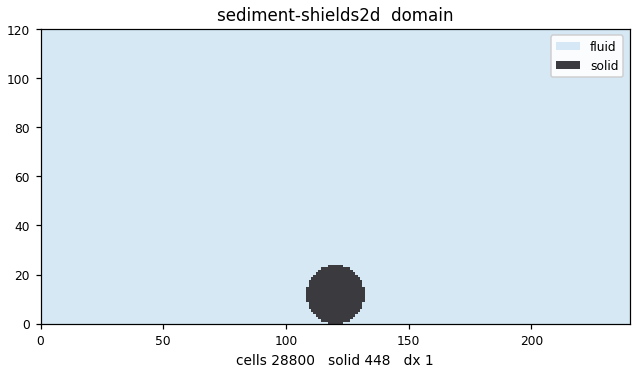
Sediment incipient motion -- the Shields threshold for a resolved bed grain. A single sediment grain (a 2D disk, d = nd cells) rests on a flat bed at the bottom of a plane Couette shear channel. The fluid exerts a hydrodynamic drag F_D, lift F_L and moment T on the grain (momentum exchange); the grain begins to move once that load overcomes its submerged weight and bed friction. The dimensionless mobility group is the Shields number theta = tau_b / ((rho_s - rho) g d) (bed shear stress over the submerged specific weight of a grain of diameter d), and motion sets in above a critical theta_cr, given classically by the Shields (1936) curve as a function of the grain Reynolds number Re_* = u_* d / nu. In the relevant range theta_cr ~ 0.03-0.06.
概要: クエットせん断下の底面粒子。移動開始時の Shields 数を測る。土砂移動の閾値評価。
Geometry
Animation
Fields
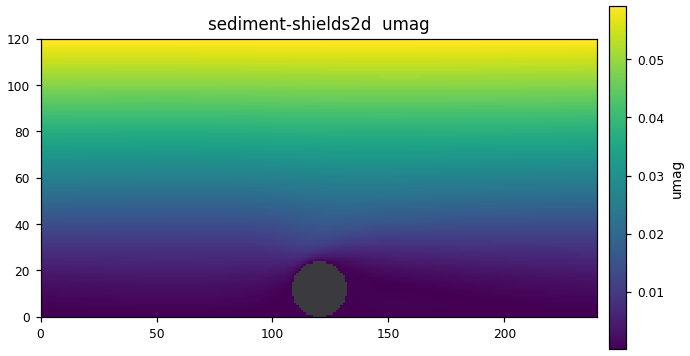
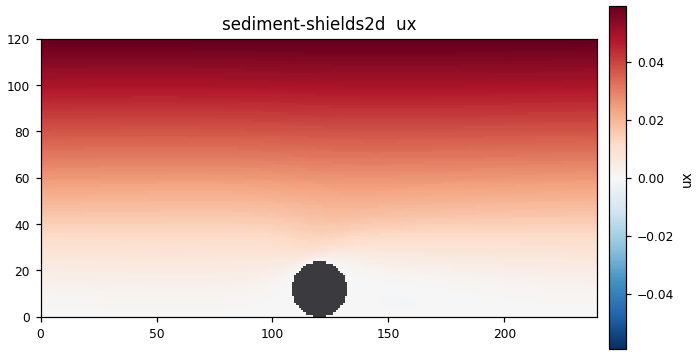
この計算が最後の出力ステップで書き出した場をそのまま描いたもの。3D ケースは中央断面。
Results
平底に置かれた 1 個の底質粒(2D 円板、d = 24 セル)に平面 Couette 剪断をかけ、 粒は固定したまま(「動かすのではなく、動くはずかを問う」静的な初動判定)、 運動量交換で抗力・揚力・モーメントを測って臨界 Shields 数を求める。格子 240×120 = 0.029 M セル、TRT(τ = 0.5667、ν = 2.2233e-2、Λ = 3/16)、上壁速度 U_w = 0.06、H = 120、摩擦係数 μ_s = 0.6。Grace CPU 72 コアで壁時計 11.2 秒。
床剪断は解析値:\(\tau_b=\rho\nu U_w/H = 2.2233\times10^{-2}\times0.06/120 = 1.1117\times10^{-5}\)、\(u_*=\sqrt{\tau_b}=3.3342\times10^{-3}\)、 \(\mathrm{Re}_*=u_*d/\nu=3.599\)。静止流体でのベースライン力(Fy0 = -2.0 等)は 先に測って差し引く。
時系列では theta_cr が 0.0296(step 20000)から 0.0339(step 200000)まで単調に 締まっていく — 粒の後流が拡散的に緩和する長い尻尾で、20 000 ステップの平均窓での 最終値は
\[
\theta_{cr}=\frac{\tau_b\,\pi R}{2\,(F_D/\mu_s+F_L)}
=\frac{1.1117\times10^{-5}\times\pi\times12}
{2\,(2.95381\times10^{-3}/0.6+1.27479\times10^{-3})}=0.0338
\]
(⟨F_D⟩ = 2.95381e-3、⟨F_L⟩ = 1.27479e-3 はログの平均値)。measured theta_cr = 0.0338 は古典的 Shields 帯 0.03–0.06 の下端に入る。ただしソースの ヘッダが先回りして述べるとおり、これは (i) 3D 球でなく 2D 円板(前面積・体積の O(1) 幾何係数が違う)、(ii) 充填床でない孤立粒(hiding/exposure なし)、 (iii) 滑り(Coulomb)しきい値、という理想化の下での「帯を挟む」検証であって 1 点をピン留めするものではない。
粒を実際に動かす movable=1 変種は particles-dem-design.md (静止摩擦の slide/stick に接触履歴が要る、が設計の核心)と sediment-morphodynamics-design.md に将来項目として設計されている。
Governing equations
無次元の可動性は Shields 数
\[
\theta=\frac{\tau_b}{(\rho_s-\rho)\,g\,d}
\]
で、臨界値 θ_cr は粒レイノルズ数 Re_* = u_* d/ν の関数として Shields (1936) の 曲線で与えられる(本レンジで θ_cr ~ 0.03–0.06)。固定粒では流れ(従って F_D, F_L) は粒の重さと独立なので、1 回の解で臨界水中重量が閉じる:滑り出しの条件 \(F_D=\mu_s(W_{\mathrm{sub}}-F_L)\) から \(W_{\mathrm{sub,cr}}=F_D/\mu_s+F_L\)、これを 2D 円板の水中重量 \(W_{\mathrm{sub}}=(\rho_s-\rho)g\,\pi R^2\) に代入して上の θ_cr 式を得る。
TRT の magic Λ = 3/16 は、バウンスバック壁の実効位置を粘性と独立にするために 本質的である — Shields 曲線の Re_* 軸に沿って ν を掃引するとき、粒の実効半径が 一緒に動いてしまっては力の比較にならない。
スコープの正直な注記:これは初動(incipient motion)のみであり、掃流砂量 (Meyer-Peter–Müller)でも河床変動(Exner)でも antidunes でもない。それらは 設計ノート側のロードマップである。
Code walkthrough
ソース(421 行)。
%%{init: {'themeVariables': {'fontSize': '11px'}}}%%
flowchart TB
    T["上壁 y=H: U_w=0.06 で並進<br/>(移動壁バウンスバック)"]
    subgraph CH["内部 TRT / x 方向周期"]
      G(("粒 d=24<br/>固定・MEM で F_D, F_L, T"))
    end
    B["床 y=0: ハーフウェイBB<br/>粒は床上に静置"]
T --- CH --- B- 初期化 — 線形 Couette 分布で開始。粒の局所後流だけが緩和対象になり速い。
- ベースライン — 静止流体で粒の力を測り(閉じた圧力の寄与 Fy0 = -2.0 など)、 本計算から差し引く。
- collide/stream — TRT、粒と床はバウンスバック、上壁は移動壁 BB、x 周期。
- 測定 — 粒の境界リンク上の MEM で F_D, F_L, T。最後の avgwin = 20 000
ステップで平均し、θ_cr を計算して CSV に追記(
sediment_shields2d.csv、 履歴はsediment_hist_run.csv)。
Build & run
cmake -S native -B native/build && cmake --build native/build -j
./native/build/orheo-sediment-shields2d
このページの図を作った計算のコスト(Miyabi-G Grace CPU (72 cores, -stdpar=multicore)): 11.2 s wall。
Things to try
- Uw を掃引して θ_cr(Re_) の曲線を描く*。τ_b ∝ U_w なので Re_ 軸を動ける。 Shields 曲線の形(低 Re_ で上昇、Re_* ~ 10 付近で極小)を追えるか。
- μ_s を 0.4–0.8 で振る。θ_cr ∝ 1/(F_D/μ_s+F_L) の感度を見る。摩擦係数の 不確かさが古典帯の幅の一部を説明することが分かる。
- maxsteps を 400 000 に。theta_cr の 0.0296 → 0.0339 の単調ドリフトがどこで 完全に飽和するかを確認する(この実行の最終 2 万ステップでの変化は既に 0.0002 程度)。
- nd を 24 → 48 に。階段状の粒表面が細かくなり、揚力(壁近傍量で最も敏感)の 変化を見る。
Validation
| Tier | T2 — 単点比較 |
| QoI | 限界 Shields 数 theta |
| Reference | Shields (1936) 移動限界曲線 |
| Gate | 🧩 モジュールゲート (rigid_body) |
Source & run details
| Item | Value |
|---|---|
| Target | orheo-sediment-shields2d |
| Source | native/benchmarks/sediment_shields2d.cpp |
| Lattice | D2Q9 |
| GPU twin | no |
| Gallery run | 2026-07-27 @ 7628c0cf |
| Args | `` |
| Wall time | 11.16 s |
| CPU time | 631.75 s |
| Device | Miyabi-G Grace CPU (72 cores, -stdpar=multicore) |
Computation log
この計算の実際の出力(先頭と末尾)。
sediment_shields2d [run]  (D2Q9 TRT, resolved bed grain, MEM force)
  grid 240x120 = 0.029M cells,  d=24 cells (R=12.0)
  tau=0.5667 nu=2.2233e-02 (Lambda=3/16)  U_w=0.0600  H=120
  tau_b=1.1117e-05 u_*=3.3342e-03 Re_*=3.599  mu_s=0.600
  grain @ (120.0,12.0) resting on bed;  maxsteps=200000 avgwin=20000
  quiescent baseline (subtracted): Fx0=1.3878e-16 Fy0=-2.0000e+00 T0=4.4409e-16
step       0  Fx=3.2450e-01 Fy=-1.8000e-05 T=-1.2596e+00  theta_cr=0.0004
step   20000  Fx=3.2531e-03 Fy=1.6583e-03 T=-1.4169e-02  theta_cr=0.0296
step   40000  Fx=3.2604e-03 Fy=1.4110e-03 T=-1.3361e-02  theta_cr=0.0306
step   60000  Fx=3.1470e-03 Fy=1.4077e-03 T=-1.2732e-02  theta_cr=0.0315
step   80000  Fx=3.1252e-03 Fy=1.3596e-03 T=-1.2463e-02  theta_cr=0.0319
step  100000  Fx=3.0534e-03 Fy=1.3204e-03 T=-1.2275e-02  theta_cr=0.0327
step  120000  Fx=3.0079e-03 Fy=1.3030e-03 T=-1.2141e-02  theta_cr=0.0332
step  140000  Fx=2.9856e-03 Fy=1.2913e-03 T=-1.2057e-02  theta_cr=0.0334
References
- A. Shields, "Anwendung der Aehnlichkeitsmechanik und der Turbulenzforschung auf die Geschiebebewegung", Preuss. Versuchsanstalt f. Wasserbau u. Schiffbau, Heft 26 (1936).
- P. L. Wiberg & J. D. Smith, Water Resour. Res. 23(8) (1987) 1471.
- E. Meyer-Peter & R. Müller, Proc. 2nd IAHR Congress (1948)(ロードマップ); F. M. Exner, Sitzungsber. Akad. Wiss. Wien (1925)(ロードマップ).
- A. J. C. Ladd, J. Fluid Mech. 271 (1994); C. K. Aidun, Y. Lu & E.-J. Ding, J. Fluid Mech. 373 (1998).