radiative-transfer2d
English | Japanese
« Home · « Advection-diffusion, reaction and radiation
Lattice-Boltzmann / discrete-ordinate solver for the STEADY radiative transfer equation (RTE) in a 2D absorbing-scattering gray medium -- a validation benchmark against analytic radiative-transport solutions.
Geometry

Fields
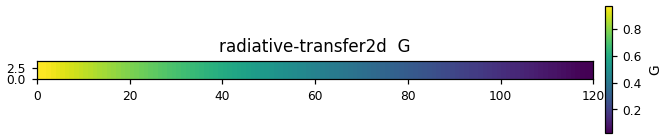
The fields this computation wrote at its last output step, plotted as they are. 3D cases show the mid-plane.
Results
A validation benchmark that solves the steady radiative transfer equation (RTE) with D2Q8 discrete ordinates. No animation — the tables of the 2 analytic checks are the deliverable as they stand. Wall-clock 0.35 s (72 Grace CPU cores).
Check 1: purely absorbing slab (Beer–Lambert). No scattering (ω = 0), collimated light incident on the x = 0 face. The exact transmittance is T = e^{−τ}. The transmittance of the 1st-order relaxation collision is identically T_lbm = (1 − τ/N)^N (comment in the source); checking, τ = 0.5, N = 20 gives 0.975^20 = 0.602688 — matching the table in the log. Key points of the τ × N sweep:
- τ = 0.5: T_err 6.34e-3 → 3.15e-3 → 1.57e-3 → 7.83e-4 (N = 20→160). Error halves with each doubling of N = 1st-order convergence.
- τ = 1.0: 2.55e-2 → 1.26e-2 → 6.28e-3 → 3.13e-3. The leading value matches exactly the prediction τ²/2N = 1/40 = 0.025 of the expansion (1−τ/N)^N ≈ e^{−τ}e^{−τ²/2N}.
- τ = 2.0: 1.02e-1 → 5.04e-2 → 2.51e-2 → 1.25e-2 (prediction 4/40 = 0.1 ✓).
- τ = 5.0: 5.29e-1 → 2.89e-1 → 1.50e-1 → 7.67e-2. The optically thicker, the more the exponential truncation error of the 1st-order collision hurts — the header states explicitly that this was deliberately kept, giving priority to "the convergence trend being visible".
Check 2: nearly purely scattering slab (diffusion/P1 limit). N = 120, β = 0.5/cell, ω = 0.9999, τ_L = 60, hot wall I = 1 / cold wall I = 0. Converged in 31460 iterations; the interior fit of the incident radiation G is G(x) = 9.253618e-01 − 7.930998e-03 x. Converting the gradient from per cell to per optical depth gives 7.931e-3/0.5 = 1.586e-2/τ. The P1 + Marshak prediction is span/(τ_L + 4/3) = 1/61.333 = 1.630e-2/τ, a difference of 2.7%. The deviation from a straight line is 3.500e-02 in the interior and 7.233e-02 over the whole domain — the whole-domain value is dominated by near-wall P1 slip + ray effects of the finite ordinate set (as noted in the log).
Governing equations
Steady RTE for a grey medium:
\[
\boldsymbol{s}\cdot\nabla I=-(\kappa_a+\kappa_s)I+\kappa_a I_b
+\frac{\kappa_s}{4\pi}\int I\,d\Omega
\]
This is transported with discrete ordinates on the LBM lattice: the D2Q8 lattice directions c_i serve as the ordinate set, and each direction carries an intensity distribution I_i. Extinction β = κ_a + κ_s is a linear relaxation, and scattering couples all directions through the mean intensity Ĝ = Σ w_i I_i:
\[
I_i^{*}=I_i+\beta\,ds_i\,(S-I_i),\qquad
S=(1-\omega)I_b+\omega\hat G,\qquad
I_i(\boldsymbol{x}+\boldsymbol{c}_i)=I_i^{*}(\boldsymbol{x})
\]
ω = κ_s/β is the albedo, and ds_i = |c_i| (axis 1, diagonal √2) is the per-ordinate path length.
The weights are the normalised D2Q9 moving set (axis 1/5, diagonal 1/20), and the isotropy of the 2nd-order moment
Σ w_i c_iα c_iβ = 0.6 δ_αβ gives the correct diffusion/P1 limit.
The implementation is the radiative.hpp module (the d2q8 constants also come from there); this driver contains only
the setup and post-processing of the 2 validations. The 1st-order relaxation is a BGK-type relaxation of the same form as the time-evolving LBM,
so it is classified as bgk in the front matter.
Code walkthrough
Source (218 lines) and radiative.hpp.
%%{init: {'themeVariables': {'fontSize': '11px'}}}%%
flowchart LR
    L["x=0 face<br/>Check1: collimated light I0<br/>Check2: diffuse wall I=1"] --> M["Nx×Ny grid<br/>D2Q8 ordinates / β relaxation + in-scattering<br/>y periodic"]
M --> R["x=L face<br/>Check1: transmission measurement<br/>Check2: cold wall I=0"]- solve() — steady solver that imposes intensity BCs on both x faces and iterates stream + collide until the residual reaches 1e-11–1e-12.
- Check 1 — ω = 0, τ ∈ {0.5, 1, 2, 5} × N ∈ {20, 40, 80, 160}, 16 combinations. Profile L2 and wall transmittance are tabulated.
- Check 2 — optically thick slab with ω = 0.9999. Least-squares straight-line fit excluding the inner 10%, and the deviation norm.
- Output — CSV (profiles) and a wiki dump of the G field.
Build & run
cmake -S native -B native/build && cmake --build native/build -j
./native/build/orheo-radiative-transfer2d
radiative_transfer2d [out_dir] (defaults to ./)
Cost of the computation that made the figures on this page (Miyabi-G Grace CPU (72 cores, -stdpar=multicore)): 0.3 s wall.
Things to try
- Double N further: does the 7.67% at τ = 5 halve (extrapolation of 1st-order convergence)?
- Modify to an exponential-integral collision: as the header says, switching to the e^{−β ds} form makes Check 1 exact to machine precision. The diff patch from the 1st-order form is small.
- Set ω to 0.5: in the intermediate regime where absorption and scattering are balanced, how far does the P1 straight line break down (there is no analytic solution, but you get a feel for interpolating between the two checks).
- Observe ray effects: confirm, by changing the diagonal weights, that the near-wall deviation in Check 2 (whole domain 7.2% vs interior 3.5%) is due to the finiteness of the 8 ordinate directions.
Validation
| Tier | T1 — automatic gate |
| QoI | intensity |
| Reference | analytic solutions of the radiative transfer equation |
| Gate | 🧩 module gate (radiative) |
Source & run details
| Item | Value |
|---|---|
| Target | orheo-radiative-transfer2d |
| Source | native/benchmarks/radiative_transfer2d.cpp |
| Lattice | D2Q8 (ordinates) |
| GPU twin | no |
| Modules | radiative.hpp |
| Gallery run | 2026-07-27 @ 7628c0cf |
| Args | `` |
| Wall time | 0.35 s |
| CPU time | 23.93 s |
| Device | Miyabi-G Grace CPU (72 cores, -stdpar=multicore) |
Computation log
The actual output of this computation (head and tail).
radiative_transfer2d -- clean-room LBM/DOM steady RTE benchmark
D2Q8 ordinates, first-order extinction relaxation + in-scattering

=== Check 1: pure absorption, collimated +x incidence (Beer-Lambert) ===
  exact  I(x)=I0 exp(-kappa_a x);  transmittance T=exp(-tau)
  tau    N     L2(profile)  T_lbm        T_exact      T_err
  0.50   20    3.0663e-03   0.602688     0.606531     6.34e-03
  0.50   40    1.5542e-03   0.604622     0.606531     3.15e-03
  0.50   80    7.8233e-04   0.605580     0.606531     1.57e-03
  0.50   160   3.9248e-04   0.606056     0.606531     7.83e-04
  1.00   20    1.0591e-02   0.358486     0.367879     2.55e-02
  1.00   40    5.3493e-03   0.363232     0.367879     1.26e-02
  1.00   80    2.6885e-03   0.365568     0.367879     6.28e-03
  1.00   160   1.3477e-03   0.366727     0.367879     3.13e-03
...

=== Check 2: near-pure isotropic scattering slab (diffusion / P1 limit) ===
  N=120  beta/cell=0.500  omega=0.9999  tau_L=60.0  (hot wall I=1, cold I=0)
    converged in 31460 iterations
  converged in 31460 iterations
  interior fit: G(x) = 9.253618e-01 + -7.930998e-03 x   (linear diffusion profile)
  max |G - linear| / span:  interior = 3.500e-02   whole domain = 7.233e-02
  (whole-domain figure dominated by near-wall P1 slip + finite-ordinate ray effect)

CSVs written to ./
References
- P. Asinari, S. C. Mishra & R. Borchiellini, Numerical Heat Transfer B 57 (2010) 126–146 — LBM radiative transfer formulation.
- S. C. Mishra & H. K. Roy, J. Comput. Phys. 223 (2007) 89–107.
- M. F. Modest, Radiative Heat Transfer, 3rd ed., Academic Press (2013) — Beer's law and P1/Marshak analytic solutions.