hindered-settling2d¶
English | Japanese
« Home · « Particles and fluid-structure interaction
Multi-particle HINDERED SETTLING / batch sedimentation in 2D: N identical, slightly-heavy circular disks are released as a randomly-seeded suspension in a tall, quiescent, CLOSED column and settle under gravity. Every disk is TWO-WAY coupled to the fluid (moving bounce-back + momentum-exchange force AND torque; Newton translation + rotation each). As the solid area fraction c rises the disks hinder one another (crowding + fluid backflow in the closed vessel) and the ensemble settling velocity u_s drops below the single-disk terminal velocity u_t. The Richardson-Zaki law
Geometry¶
Animation¶
Fields¶
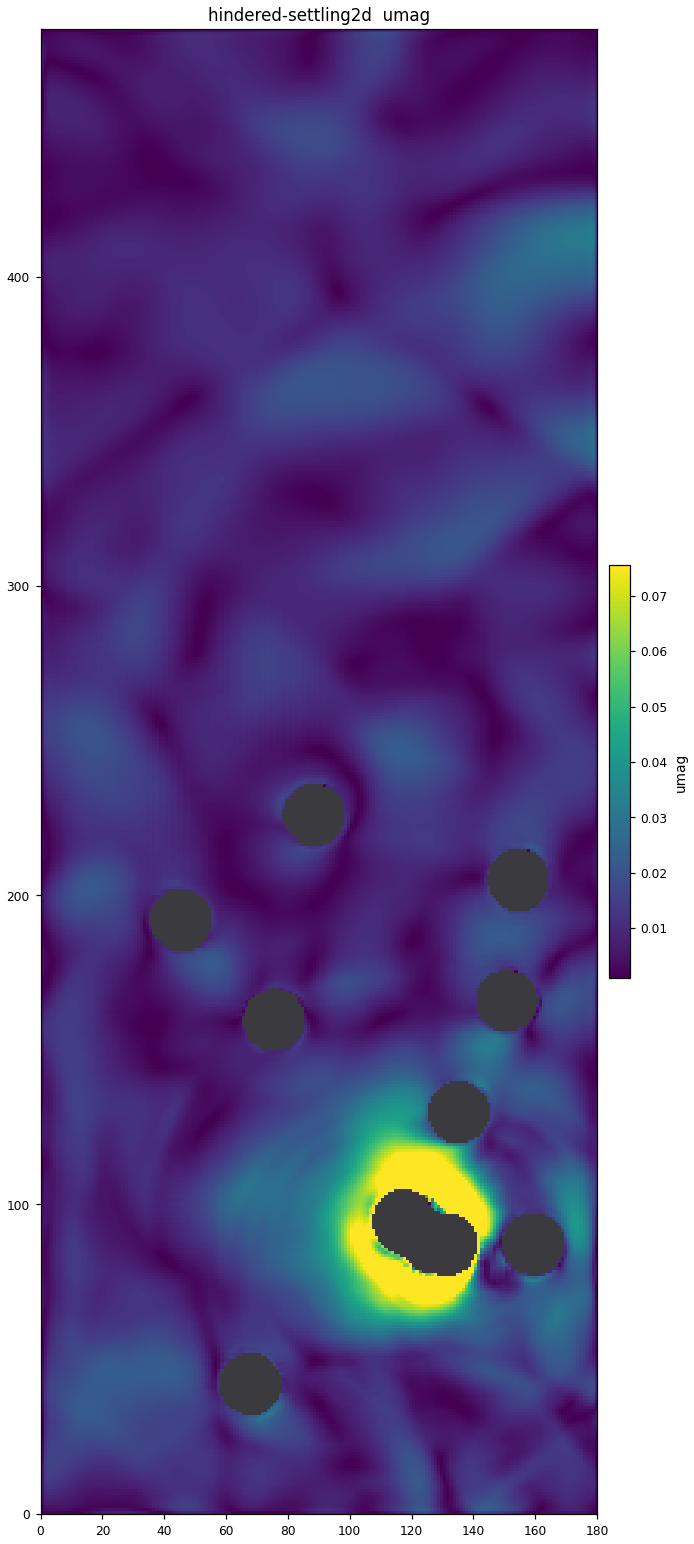
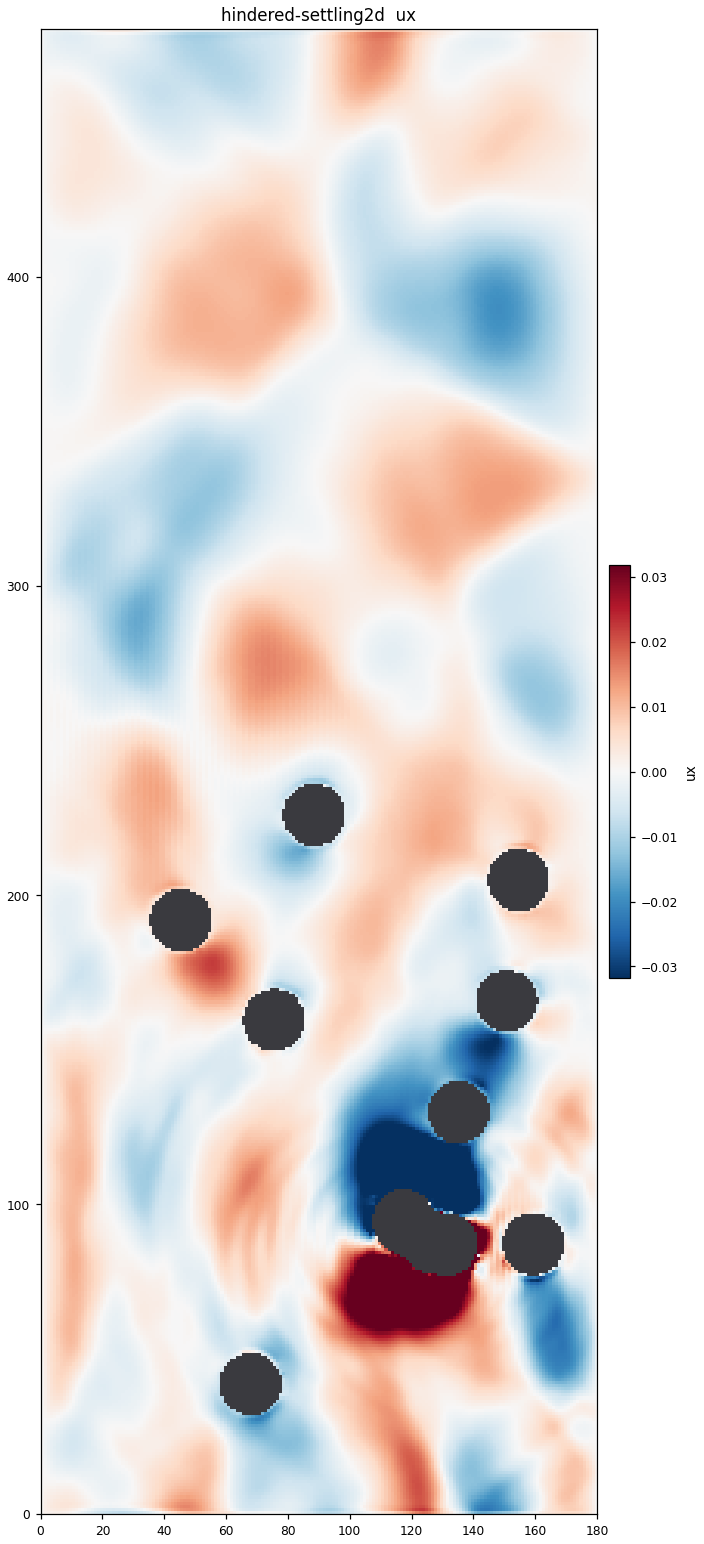
The fields this computation wrote at its last output step, plotted as they are. 3D cases show the mid-plane.
Results¶
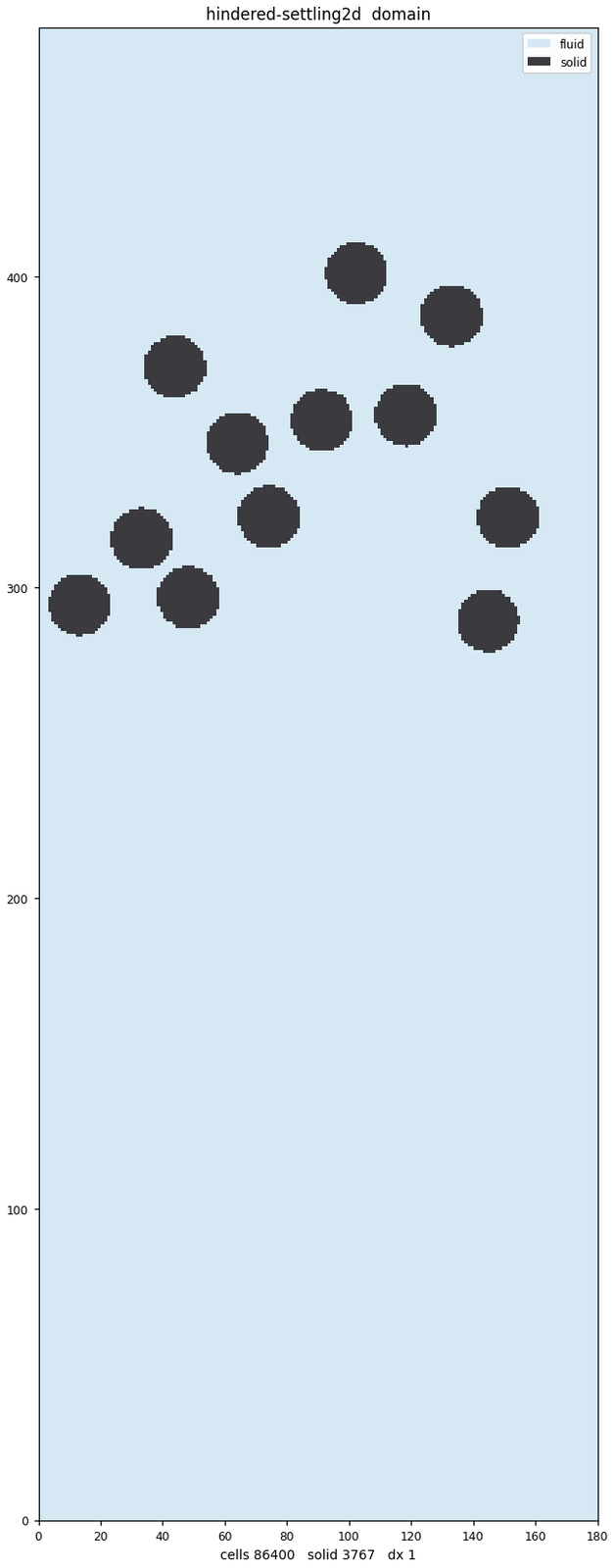
A computation of 1 case in which N = 12 identical disks (d = 20 cells, density ratio 4.0) are placed at random in the upper band y = [288.0, 412.8] (H = 124.8) of a closed tall column of 180×480 = 0.086 M cells (seed = 20260716) and released into quiescent fluid. The local area fraction of the initial suspension band is \(c=N\pi R^2/(n_x H_{\mathrm{band}})=12\times\pi\times100/(180\times124.8) =0.1678\). TRT (τ = 0.55, ν = 1.6667e-2, Λ = 3/16), g_lat = 6.0e-6, net weight per disk 5.655e-3. Wall-clock 36.7 s on 72 Grace CPU cores.
The time series in the log is the settling dynamics itself. The instantaneous settling velocity us_inst accelerates after release and reaches ~0.008 at step 8000–10000, after which the plug (settling cluster) descends the column while fluctuating between 0.009–0.014. The time-averaging window opens when the plug centroid has descended 5 diameters (settle_d = 5.0) (navg = 1249 at step 16000), and the computation stops at step 25348 when the plug reaches the floor (maxsteps = 36000 is not used up). The result is
- ensemble + time-averaged settling velocity u_s = 0.010519 (averaged over 9 936 steps), Re = u_s d/ν = 0.010519×20/0.016667 = 12.62
(this matches the last row of hs_summary.csv, us = 1.051907e-2, navg = 9936. That file is
in append mode, and the preceding 2 rows are leftovers from other invocations in the same output directory.
Only the last row corresponds to this log).
The validation target for this case is the Richardson–Zaki law \(u_s/u_t=(1-c)^n\), but the exponent n cannot be determined from 1 run at a single concentration. The single-particle terminal velocity u_t in the denominator is designed to be measured separately with an np = 1 run (Things to try); what this run provides is 1 point, the numerator u_s at c = 0.1678. The animation shows disks overtaking one another inside the plug while the upward return flow, forced by the closed container, slows the plug (the substance of hindering).
Governing equations¶
The physics is the same two-way coupling as dkt2d (D2Q9 TRT + moving-wall bounce-back carrying the local wall velocity + MEM force and torque + equilibrium refill), generalised to N bodies. For each disk
\[
m\frac{d\boldsymbol{v}_p}{dt}=\boldsymbol{F}_h+(\rho_p-\rho_f)\pi R^2\boldsymbol{g}
+\sum\boldsymbol{F}_{\mathrm{rep}},\qquad
I\frac{d\omega}{dt}=T_h
\]
As concentration rises, settling is hindered by 2 effects: (i) crowding, where disks block one another's wakes, and (ii) the interstitial return flow enforced by mass conservation in the closed container. Richardson–Zaki:
\[
\frac{u_s}{u_t}=(1-c)^{n},\qquad n=n(\mathrm{Re})
\ \ (\text{in the Stokes limit } n\simeq4.65,\ \text{decreases at high Re; Di Felice 1994})
\]
The repulsive force is the Glowinski/Wan gapped spring (xi = 2.5 cells, krep = 1.086e-2), acting on all disk–disk pairs and on disk–wall. It is a numerical overlap guard, not a contact model (no damping or friction; it activates at a positive gap). Physical contact is a future item of the two-layer design in particles-dem-design.md §9.
Note that c here is the local area fraction of the initial band (the voidage that is physically effective in Kynch's zone settling), not the average over the whole column.
Code walkthrough¶
Source (508 lines, an N-body generalisation of dkt2d.cpp).
%%{init: {'themeVariables': {'fontSize': '11px'}}}%%
flowchart TB
    subgraph BOX["Closed column 180×480<br/>halfway BB on all four walls / TRT interior"]
      P["N=12 disks (solid id 1..N)<br/>moving-wall BB + MEM<br/>per-particle force sums via atomic_ref"]
      B["Released from band<br/>y=[288,412.8] → plug settling"]
end- Placement — non-overlapping placement in the band from a random seed. c is fixed here.
- collide/stream — the same TRT + moving-wall BB as dkt2d. Mask carries particle ids.
- Force summation — for each boundary link, add to F, T of the owning particle with
atomic_ref. - Rigid N-body update — add Glowinski repulsion for all pairs + walls, then semi-implicit Euler.
- Measurement — once the centroid descent exceeds 5d, start time-averaging u_s. When ymin approaches the floor,
stop, append 1 row to
hs_summary.csv, and write the full history tohs_trace.csv.
Build & run¶
cmake -S native -B native/build && cmake --build native/build -j
./native/build/orheo-hindered-settling2d
Cost of the computation that made the figures on this page (Miyabi-G Grace CPU (72 cores, -stdpar=multicore)): 36.7 s wall.
Things to try¶
- Measure u_t with np = 1. Measuring the single-particle terminal velocity with the same τ, g_lat and combining it with this run's u_s = 0.010519 gives 1 point of \(n=\ln(u_s/u_t)/\ln(1-c)\).
- Sweep np over 6, 12, 18, 24 and regress n from the slope of log(u_s) vs log(1-c). Compare with the Di Felice correlation at Re ≈ 12 (state the exponent difference between 2D disks and 3D spheres honestly alongside).
- Run several times with different seeds. N = 12 is small, and the value from 1 run cannot be trusted without estimating the scatter of u_s (finite-N effect).
- Lengthen Hd. The quasi-steady interval before reaching the floor (9 936 steps in this run) gets longer and the average stabilises.
Validation¶
| Tier | T2 — single-point comparison |
| QoI | settling_ratio |
| Reference | Richardson & Zaki (1954) hindered-settling exponent |
| Gate | 🧩 module gate (rigid_body) |
Source & run details¶
| Item | Value |
|---|---|
| Target | orheo-hindered-settling2d |
| Source | native/benchmarks/hindered_settling2d.cpp |
| Lattice | D2Q9 |
| GPU twin | no |
| Gallery run | 2026-07-27 @ 7628c0cf |
| Args | `` |
| Wall time | 36.66 s |
| CPU time | 1137.02 s |
| Device | Miyabi-G Grace CPU (72 cores, -stdpar=multicore) |
Computation log¶
The actual output of this computation (head and tail).
Hindered settling (D2Q9 TRT, N=12 disks, moving BB + MEM force)
  grid 180x480 = 0.086M cells,  d=20 cells (R=10.0)
  tau=0.5500 nu_lat=1.6667e-02 (Lambda=3/16)  rho_p/rho_f=4.000  g_lat=6.00e-06
  band y=[288.0,412.8] (H=124.8)  concentration c=0.1678  net weight/disk=5.655e-03
  seed=20260716  repulsion: xi=2.5 cells krep=1.086e-02  settle_d=5.0  maxsteps=36000
step       0  yc=338.0 ymin=289.3  us_inst=0.00000 us_avg=0.00000  Re_inst=0.01  navg=0
step    2000  yc=333.9 ymin=284.3  us_inst=0.00368 us_avg=0.00000  Re_inst=4.42  navg=0
step    4000  yc=324.6 ymin=272.2  us_inst=0.00552 us_avg=0.00000  Re_inst=6.62  navg=0
step    6000  yc=312.2 ymin=256.2  us_inst=0.00692 us_avg=0.00000  Re_inst=8.31  navg=0
step    8000  yc=297.3 ymin=238.1  us_inst=0.00787 us_avg=0.00000  Re_inst=9.44  navg=0
step   10000  yc=281.2 ymin=219.3  us_inst=0.00809 us_avg=0.00000  Re_inst=9.71  navg=0
step   12000  yc=264.7 ymin=200.2  us_inst=0.00932 us_avg=0.00000  Re_inst=11.19  navg=0
step   14000  yc=245.3 ymin=177.6  us_inst=0.00968 us_avg=0.00000  Re_inst=11.62  navg=0
step   16000  yc=227.8 ymin=153.5  us_inst=0.00906 us_avg=0.00818  Re_inst=10.87  navg=1249
References¶
- J. F. Richardson & W. N. Zaki, "Sedimentation and fluidisation: Part I", Trans. Instn Chem. Engrs 32 (1954) 35–53.
- R. Di Felice, "The voidage function for fluid-particle interaction systems", Int. J. Multiphase Flow 20 (1994) 153–159.
- A. J. C. Ladd, J. Fluid Mech. 271 (1994); C. K. Aidun, Y. Lu & E.-J. Ding, J. Fluid Mech. 373 (1998).
- R. Glowinski et al., J. Comput. Phys. 169 (2001).