rheoMesh — results and comparisons (dated)
English | Japanese
Dated comparisons and figures moved from the rheoMesh page, newest first. Each section keeps its date and its numbers as they were at the time. All figures and numbers are provisional. The latest comparison (DrivAer, 2026-11-10) and the current status are on the rheoMesh page.
Some times here were measured on Miyabi-C (each section names its machine). Since 2026-11-13 times are compared on Flow2 Type I only ("Current status" on the rheoMesh page).
MPI wall-band layer acceleration (C2g Step 4a/4b) & rotating-zone solver checks (2026-11-21)
C2g Step 4a/4b (LayerBand / DistLayerBand) timings and bit-identity
Measured on Miyabi-C 2 nodes (16 ranks × 14 threads, RHEOMESH_MPI_BIND=numa, RHEOMESH_MPI_TAIL_THREADS=112) for the experimental DrivAer geometry (6.3 M and 22.6 M cells). Times are Miyabi-C reference values. MPI build ctest passes 50/50.
| Case (cells) | Mode | extrude |
check |
layers total |
Full total |
Output MD5 |
|---|---|---|---|---|---|---|
| DrivAer (6.3 M) | 4a OFF (LBAND=0) |
— | 8.14 s | 20.46 s | — | 761b5b2c5598f181 |
| DrivAer (6.3 M) | 4a ON (LBAND=1, default) |
6.13 s | 4.20 s | 18.17 s | 46.36 s | 761b5b2c5598f181 (match) |
| DrivAer (6.3 M) | 4a + 4b (MPI_LBAND=1) |
2.12 s (2.89×) | 5.09 s | 16.44 s (−1.73 s) | 44.57 s (−1.79 s) | 761b5b2c5598f181 (match) |
| DrivAer (22.6 M) | 4a OFF (LBAND=0) |
— | 12.48 s | 45.67 s | — | 0c3d4a7110866077 |
| DrivAer (22.6 M) | 4a ON (LBAND=1, default) |
15.14 s | 5.94 s | 41.70 s | 112.09 s | 0c3d4a7110866077 (match) |
| DrivAer (22.6 M) | 4a + 4b (MPI_LBAND=1) |
5.92 s (2.56×) | 4.31 s (1.38×) | 34.69 s (−7.01 s / −11.0 s vs 4a OFF) | 104.07 s (−8.02 s) | 0c3d4a7110866077 (match) |
- The
4a ONand4a + 4brows are paired in the same 2-node (16×14) job; the4a OFFrow is the Step 4a baseline (paired with4a ONat 16.16 s / 41.31 s). - Step 4b runs interior face rescue in parallel on all ranks and routes only seam-touching components (mean 1.0–3.9 % of the wall band) to rank 0, preserving exact bitwise identity while cutting 22.6 M
layersby 1.20× (1.32× vs 4a OFF). - MPI 36(+1)-case bit-identity matrix (
RHEOMESH_MPI_LBAND=1, 2 nodesnp = 0, 1, 2, 4, 8): all 37 / 37 rows PASS (0 FAIL) against the non-MPI serial build (small34 rows includingshml motorBike7721a92dd8e28da4,dsnap2 rows, anddfull half3.09 M layered DrivAerf915ff9c9766bb0d).
Rotating zones (mixerVesselAMI / rotatingFanInRoom), 56-rank solver verification
After adding multi-wall-patch vertex sliding, per-zone adaptive 3-rim vertex release, and 4-round interior Laplacian relaxation (mesh/src/zones.cpp), both rotating-zone tutorials completed 56-rank parallel OpenFOAM solver runs on Miyabi-C without lowWeightCorrection:
| Case | checkMesh |
Solver run | Notes |
|---|---|---|---|
mixerVesselAMI |
Mesh OK (max non-orthogonality 62.17°) |
End (rc 0) |
reached t = 0.05001 s in 71.45 s wall time |
rotatingFanInRoom |
Mesh OK | End (rc 0) |
AMI weights 0.992–1.007 |
Full 88-tutorial comparison (2026-11-21, v2611.6 integration build 08e1dd8d)
All 88 tutorials with a snappyHexMeshDict (65 OpenFOAM v2606 + 23 Foundation OpenFOAM-13) were run with the v2611.6 integration build (rheomesh-08e1dd8d, RHEOMESH_MODE=shm) on Miyabi-C and compared with the 2026-11-20 snappyHexMesh and rheoMesh v2611.5 baselines. Times are Miyabi-C reference values.
| Mesher / version | Mesh OK (all 88) |
OpenFOAM-13 (23) | OpenFOAM v2606 (65) | Mesh written | Failed checkMesh |
Notes |
|---|---|---|---|---|---|---|
snappyHexMesh (2026-11-20) |
57 / 88 (64.8%) | 16 / 23 (69.6%) | 41 / 65 (63.1%) | 86 | 29 | baseline |
rheoMesh v2611.5 (2026-11-20) |
45 / 88 (51.1%) | 8 / 23 (34.8%) | 37 / 65 (56.9%) | 50 | 5 | baseline |
rheoMesh b9034d2f (2026-11-21) |
66 / 88 (75.0%) | 14 / 23 (60.9%) | 52 / 65 (80.0%) | 74 | 7 | +21 vs v2611.5, 0 regressions |
rheoMesh 08e1dd8d (2026-11-21) |
82 / 88 (93.2%, 82 / 83 runnable = 98.8%) | 23 / 23 (100.0%) | 59 / 65 (90.8%) | 83 | 1 | +37 vs v2611.5, +25 vs snappyHexMesh, 0 regressions |
- Speed comparison: On the cases where both pass
checkMesh,rheoMeshis faster on 40/45 of theb9034d2foverlap set (median speedup 1.98×), and up to 505× faster onv2606/mesh_moveDynamicMesh_relativeMotion_box_snappyHexMesh(1.48 sMesh OKvssnappyHexMesh747.84 sFailed 1). - 37 newly passing cases vs
v2611.5(0 regressions): - Phase 1 (
b9034d2f, +21): multi-region/CHT/solid (5:snappyMultiRegionHeater,snappyMultiRegionHeaterImplicit,cpuCabinet,sphere_multiRegion,multiSolidWithAnisoConduction), rotating/propeller (6:f13/rotorDisk,v2606/rotorDisk,rotorDisk_inclined,propeller,propeller1,interPhaseChangeDyMFoam/propeller), hull/overset/building (8: 5DTCHullvariants,aeroFoil_background_snappyHexMesh,rigidBodyHull_background,building_steady), other (2:faceZoneRegions,electrostaticDeposition). - Phase 2 (
6ee8065d+08e1dd8d, +16):- Negative
meshQualityControls/minVolfloor (1e-13, rejecting inverted face pyramids on Foundation OpenFOAM-13 dictionaries, 6 cases):f13/incompressibleFluid_drivaerFastback(14.55 s, 437,593 cells),f13/incompressibleFluid_motorBikeSteady(16.42 s, 360,771 cells),f13/incompressibleFluid_propeller(12.79 s, 513,796 cells),f13/incompressibleVoF_propeller(13.08 s, 513,796 cells),f13/incompressibleVoF_mixerVessel(12.67 s, 1,014,750 cells),f13/multiRegion_CHT_shellAndTubeHeatExchanger(33.76 s, 803,125 cells). - Non-box
blockMeshDictenclosing Cartesian grid,projectvertices,closedTriSurface*, andinsideSpan/outsideSpan(level (d l)) regions (4 cases):f13/incompressibleVoF_sloshingCylinder(0.74 s, 18,182 cells),v2606/multiphase_interFoam_laminar_sloshingCylinder(0.82 s, 18,182 cells),f13/mesh_snappyHexMesh_pipe(1.80 s, 116,915 cells),v2606/combustion_XiDyMFoam_annularCombustorTurbine(5.19 s, 204,757 cells). 1×1×1root leaf AABB fallback and staging (3 cases):v2606/mesh_snappyHexMesh_block_with_curvature(0.35 s, 1,542 cells),v2606/combustion_fireFoam_LES_compartmentFire(1.07 s, 291,756 cells),v2606/incompressible_pimpleFoam_laminar_cylinder2D(0.20 s, 5,268 cells).- Coplanar-subdivided triangle normal deduplication (64 representative normals) + octree fast paths (1 case):
v2606/mesh_snappyHexMesh_distributedTriSurfaceMesh(37.7 M triangles,52.99 s, 1,849,004 cells, max skewness2.994). - Empty-surface background-patch layer addition (1 case):
v2606/mesh_snappyHexMesh_addLayersToFaceZone(0.10 s, 240 cells). - 2D
empty-patch slice extrusion ([2d-empty], 1 case):v2606/mesh_moveDynamicMesh_relativeMotion_box_snappyHexMesh(1.48 s, 69,762 cells, max non-orthogonality30.87°, max skewness0.751).
- Negative
- Remaining 6 non-OK: 5 post-topology-optimization template cases (
v2606/..._3DBox_*_reEval, which reference a non-existent placeholderfile "stlName.stl";and also cannot run onsnappyHexMesh), and 1 extreme 20-layer case (v2606/mesh_snappyHexMesh_airfoilWithLayers,nSurfaceLayers 20; expansionRatio 1.5;, where first-layer aspect ratio exceedscheckMesh's fixed 1000 limit on both meshers:snappyHexMesh15,795 vsrheoMesh1,968 with 0 bad pyramids, 0 non-orthogonality errors, and 0 skewness errors).
Bulk comparison with snappyHexMesh and the snappyHexMeshLike mode (2026-11-05, note of 11-06)
111 cases with a snappyHexMeshDict (65 OpenFOAM v2606 tutorials, 21 Foundation OpenFOAM-13 tutorials, 25 public GitHub cases) were run with rheoMesh (no layers): 49 Mesh OK, 15 fail, and 47 use dictionary entries rheoMesh does not handle yet (multiple regions, multi-block blockMesh and others). snappyHexMesh was run keeping every stage, and its logs were turned into numbers per stage. A switch sets the layer thickness against the cell just outside the layer, as snappyHexMesh does. From this, two modes are being designed: one that produces nearly snappyHexMesh's mesh from a snappyHexMeshDict, fast and threaded, and one with the pillow that puts more layers on the same dictionary. Details: development, "Comparison with snappyHexMesh".
The first of these modes was renamed from "compatible mode" to snappyHexMeshLike on 2026-11-06 (RHEOMESH_MODE=snappyHexMeshLike, alias shm): snappyHexMesh's procedure (castellate → snap → shrink → extrude), aiming at snappyHexMesh-level quality; the output is not identical. On the course DrivAer (N = 5) at development version 38d99e21 it takes 21.5 s with layers against snappyHexMesh's 41.4 s, all three meshes Mesh OK; the native method takes 47.4 s and the reason its Cd is 15 % above snappyHexMesh's is under investigation. Numbers and figures: development, "The course DrivAer (N = 5) at development version 38d99e21".
In progress as of 2026-11-05: thin gaps, feature capture, snappyHexMesh's stages
Thin gaps without cells (a rheoMesh error)
Zoomed sections of motorBike show fluid gaps rheoMesh leaves without cells: between the rear fender and the tyre, at the tyre contact, round the engine and the exhaust. snappyHexMesh meshes them. rheoMesh removes the cells within about 1.4 cells of the surface from the core and fills the space with one pillow layer, so a gap narrower than the two removed bands (2-3 cells) is lost; flange's thin channels are the same. To be fixed (design WP2).
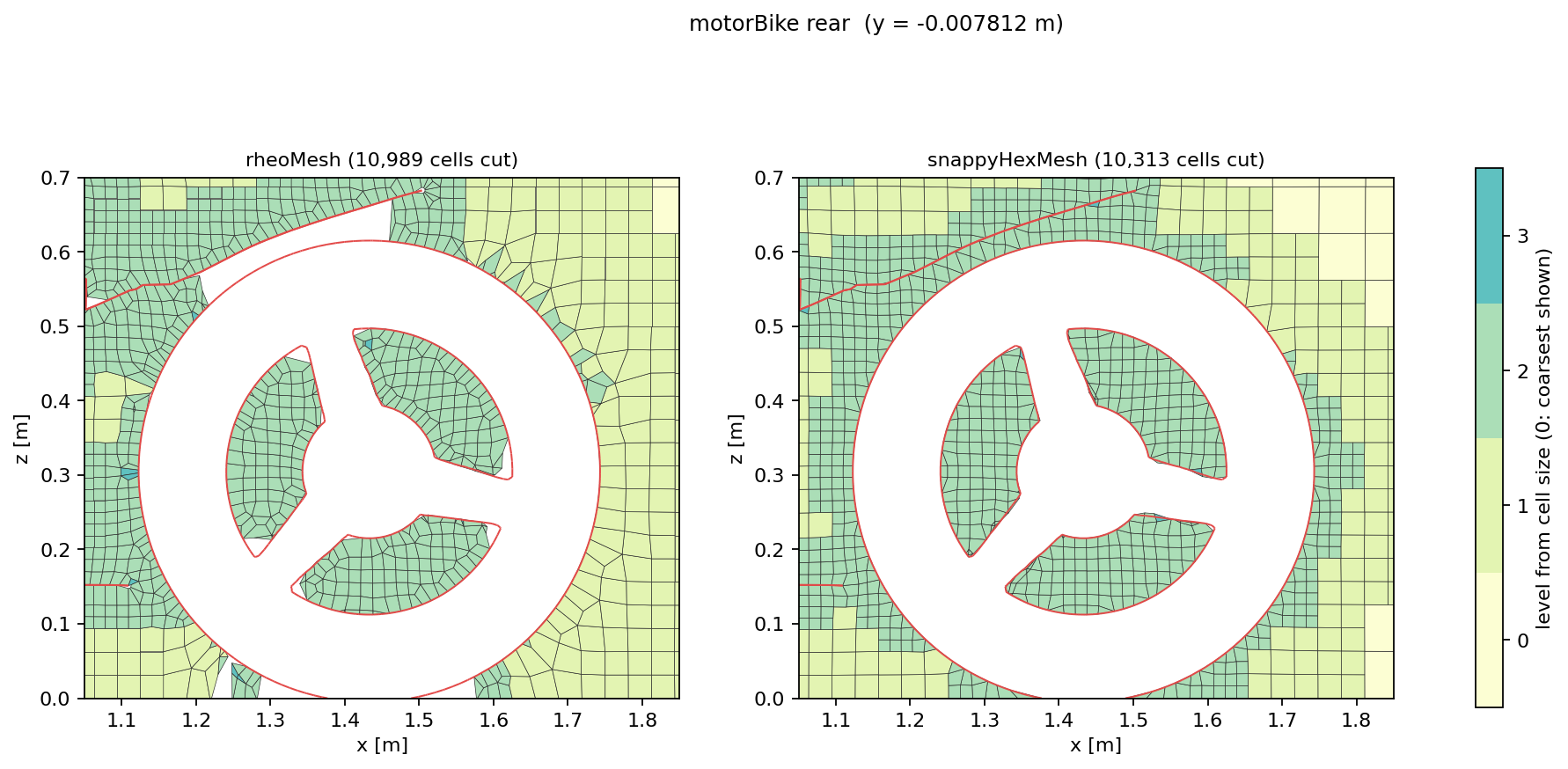
motorBike, no layers, section y = -0.0078 m, round the rear wheel. rheoMesh has no cells between the fender and the tyre, nor at the contact.
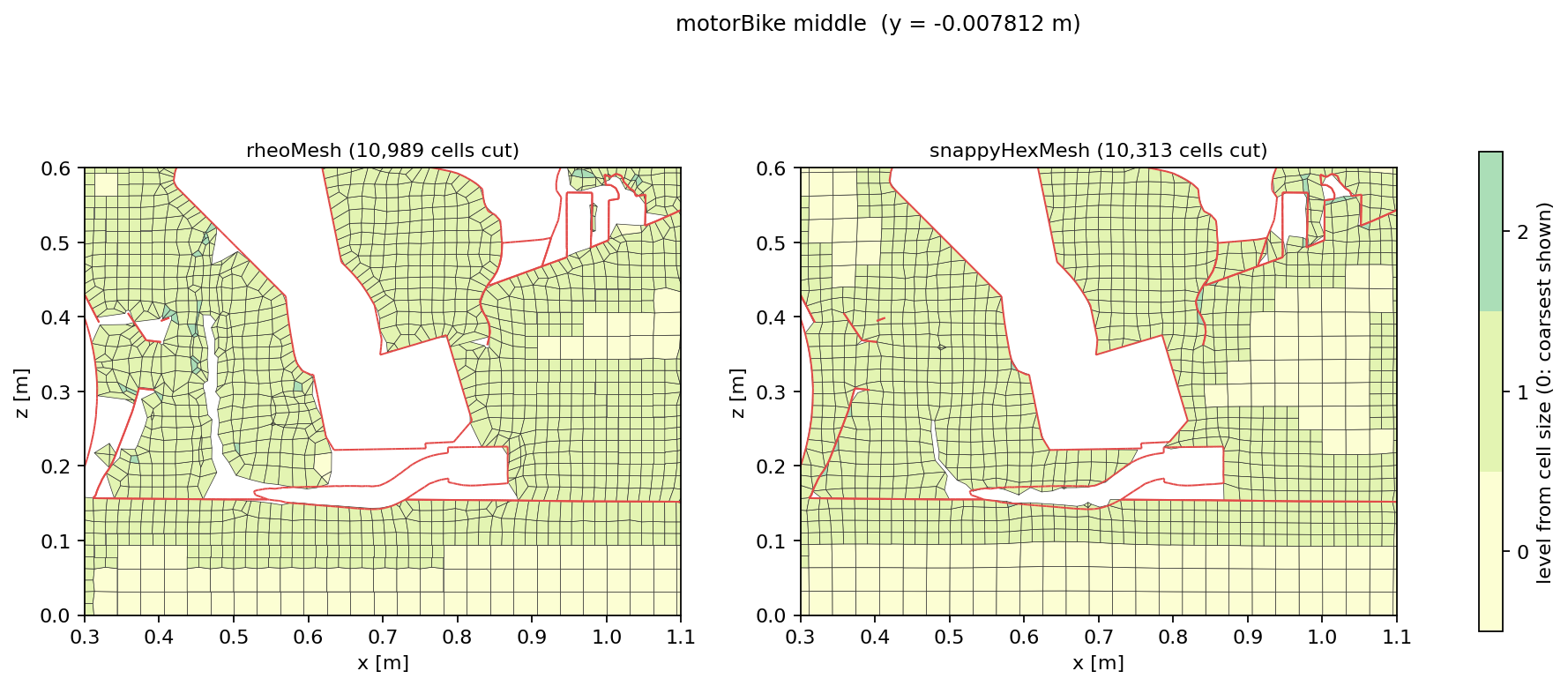
motorBike, no layers, section y = -0.0078 m, x = 0.3-1.1 m. rheoMesh has no cells in the thin gaps round the engine and the exhaust.
The fluid volume (checkMesh's Total volume) shows what is missing.
| case | rheoMesh | snappyHexMesh | difference |
|---|---|---|---|
| flange | 1.475e-05 m³ | 1.563e-05 m³ | -5.6 % |
| injectorPipe | 0.032945 m³ | 0.033011 m³ | -0.2 % |
| windAroundBuildings | 1.34506e7 m³ | 1.34599e7 m³ | -0.07 % |
| simpleCarSolarPanel | 39.819 m³ | 39.829 m³ | -0.03 % |
| motorBike | 1279.65 m³ | 1279.67 m³ | about 0.02 m³ (round the bike) |
| cavitatingBullet | 0.000102095 m³ | 0.000102095 m³ | equal |
A smaller core margin brings the volume back but fails the check; the existing gap refinement (RHEOMESH_GAP) fails motorBike and doubles to quadruples the cells. A rule of its own is needed.
As of 2026-11-05: filling with cut cells was dropped, because the seams with the main mesh do not close where the core boundary steps; the gaps are refined instead. flange (fluid volume 1.543e-5 m³, -1.3 % from snappyHexMesh) and windAroundBuildings are Mesh OK; motorBike still fails with 24 negative cells near the front wheel. None of the switches is a default. Details: development, "Thin gaps".
Feature capture
With the default (REACH=0) rheoMesh snaps almost no points to the feature lines: the boundary points lie about one cell off the surface, outside the capture radius (half a cell). The capture is being rebuilt to choose points by the topology of the surface instead of a distance (in progress, not the default): the wall faces are labelled with the surface region (the surface split at its feature edges) they belong to; the edge path along the border of two regions goes onto their feature line, a point where three or more meet onto the corner.
Coverage: the share of the feature-line length covered by the points snapped to it (gaps up to 1.5 wall edges count as covered); corners: a corner point within 0.25 wall edges. Measured locally (debug build).
| case | default: coverage (corners), check | in progress (TOPO=4): coverage (corners), check |
|---|---|---|
| motorBike | 5.6 % (corners 52/1649), Mesh OK | 21.9 % (corners 155/1649), Mesh OK |
| iglooWithFridges | 0.0 % (corners 0/16), Mesh OK | 100.0 % (corners 16/16), Mesh OK |
| windAroundBuildings | 0.8 % (corners 4/3055), Mesh OK | 64.5 % (corners 211/3055), Mesh OK |
| flange | 6.5 % (corners 0/16), Mesh OK | 56.8 % (corners 4/16), Mesh OK |
| injectorPipe | 0.0 % (corners 0/2), Mesh OK | 31.2 % (corners 0/2), Mesh OK |
| turbineSiting | 0.0 % (corners 0/4), Mesh OK | 0.0 % (corners 0/4), Mesh OK |
| simpleCarSolarPanel | 0.0 % (corners 0/14), Mesh OK | 89.3 % (corners 11/14), Mesh OK |
| cyclone | 1.4 % (corners 1/9), Mesh OK | 59.6 % (corners 2/9), Mesh OK |
| airRecirculationRoom | 2.3 % (corners 4/53), Mesh OK | 88.7 % (corners 10/53), Mesh OK |
| gap_detection | 0.7 % (corners 0/40), Mesh OK | 89.4 % (corners 27/40), Mesh OK |
| opposite_walls | 0.0 % (corners 0/11), FAILED | 2.9 % (corners 0/11), FAILED |
| block_with_curvature | 0.0 % (corners 0/7), Mesh OK | 8.3 % (corners 0/7), Mesh OK |
| sphere_gapClosure | 39.3 % (corners 0/3), Mesh OK | 39.3 % (corners 0/3), Mesh OK |
| insidePoints | 0.0 % (corners 0/8), Mesh OK | 50.0 % (corners 2/8), Mesh OK |
- The new capture keeps 15 of 16 Mesh OK as the default does and raises the coverage on every case: iglooWithFridges 0 -> 100 % (all 16 corners), gap_detection 0.7 -> 89 %, airRecirculationRoom 2.3 -> 89 %.
- Not the default yet: motorBike fails with small changes of the setting (a looser distance cap). Lowering the coverage to pass the check is not an option.
snappyHexMesh's stages (iglooWithFridges)
snappyHexMeshDict's debugFlags (mesh attraction) write the mesh of every stage; the sections round the fridge (output only, no source read).
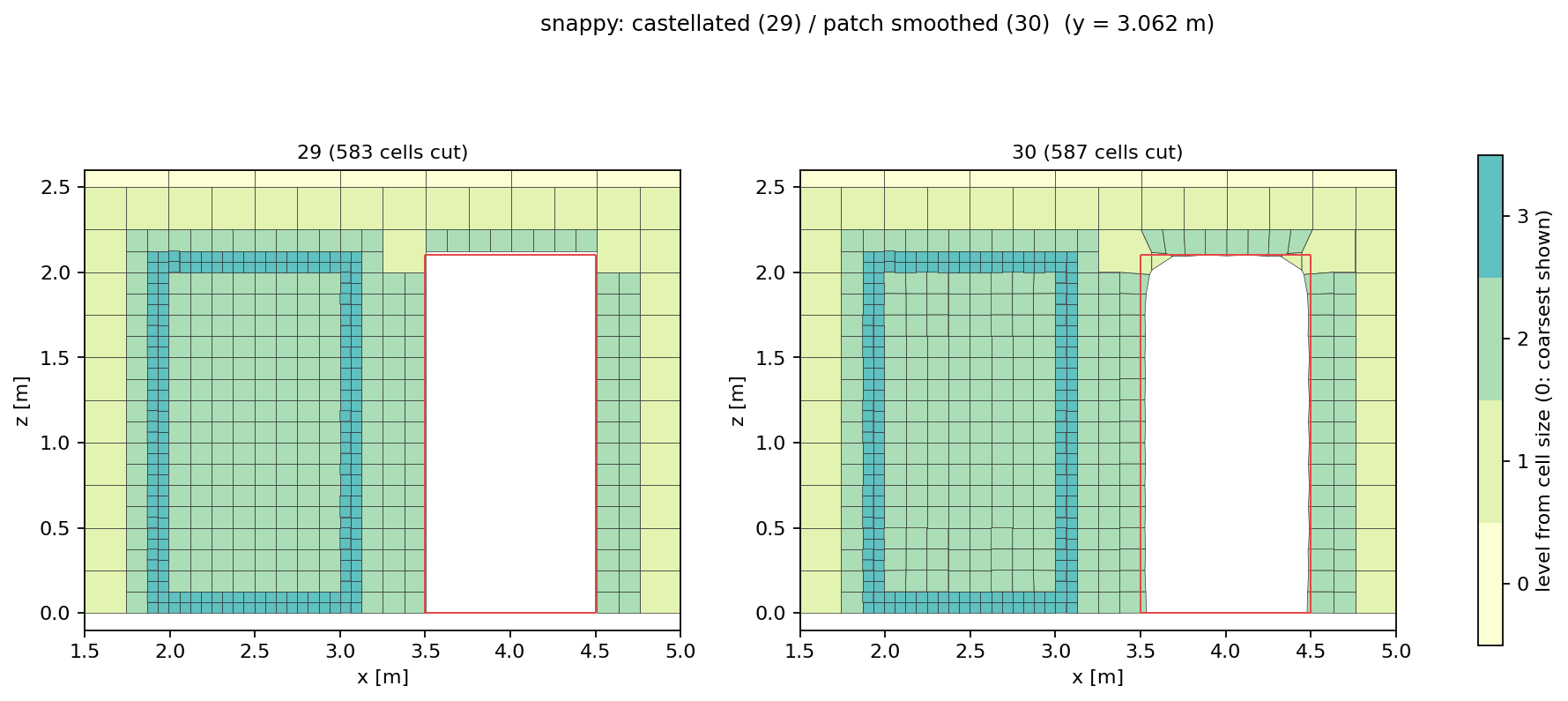
Time 29: after the refinement and the cell removal; the boundary already lies on the fridge (its faces are on cell planes). Time 30: the patch smoothing chamfers the top corners for a moment.
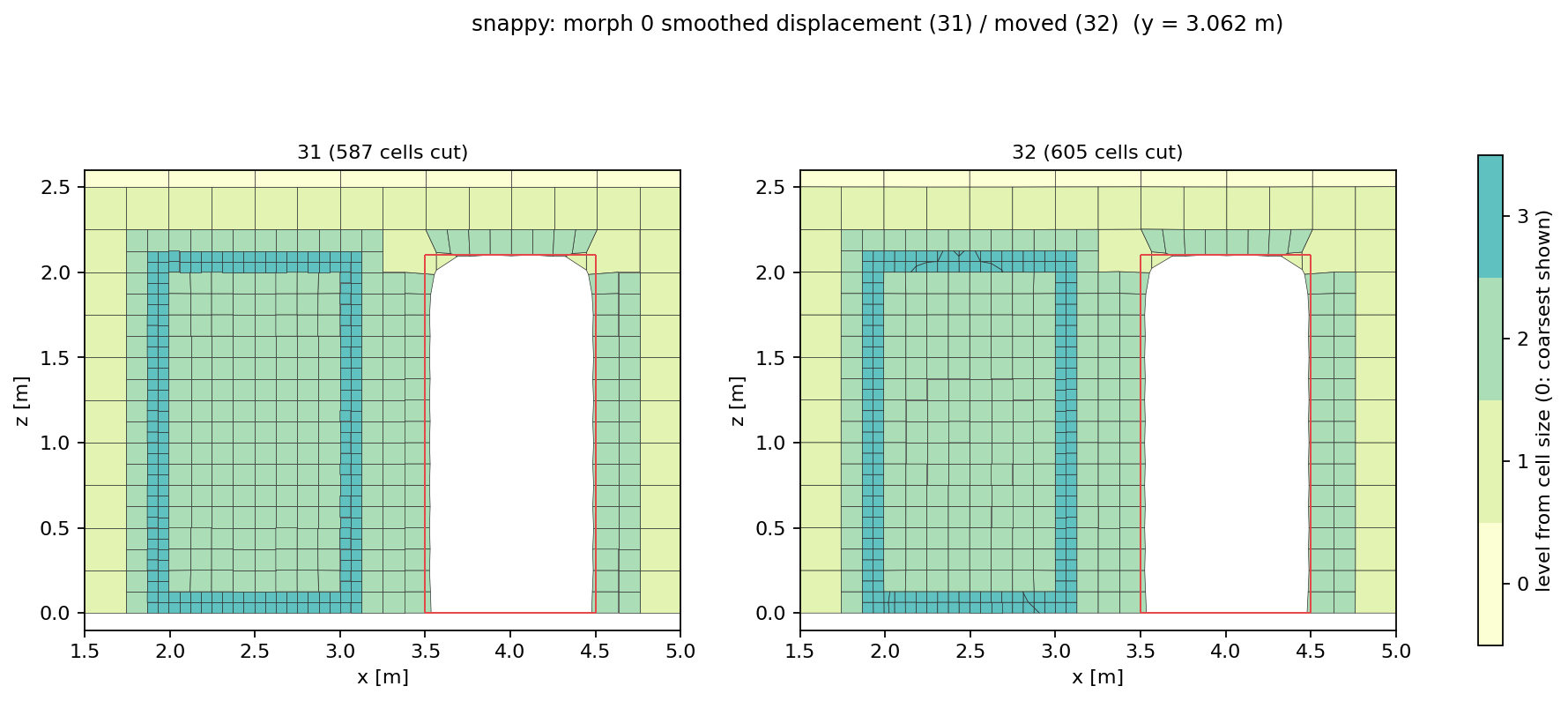
Iteration 0 attracts all 16 feature points and 484 feature-edge points at once; the displacement is smoothed 30 times before the move.
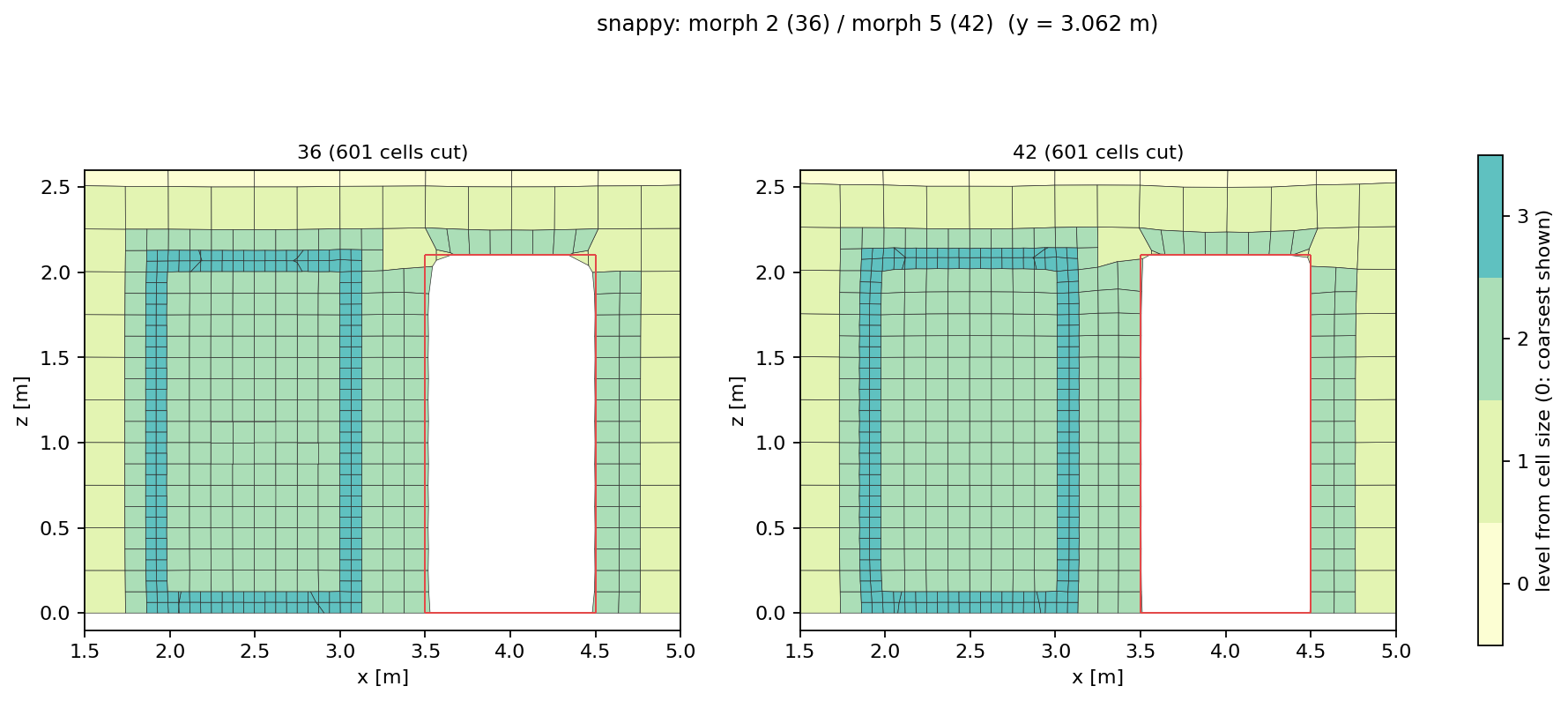
The corners come back over the iterations, nearly sharp by iteration 5.
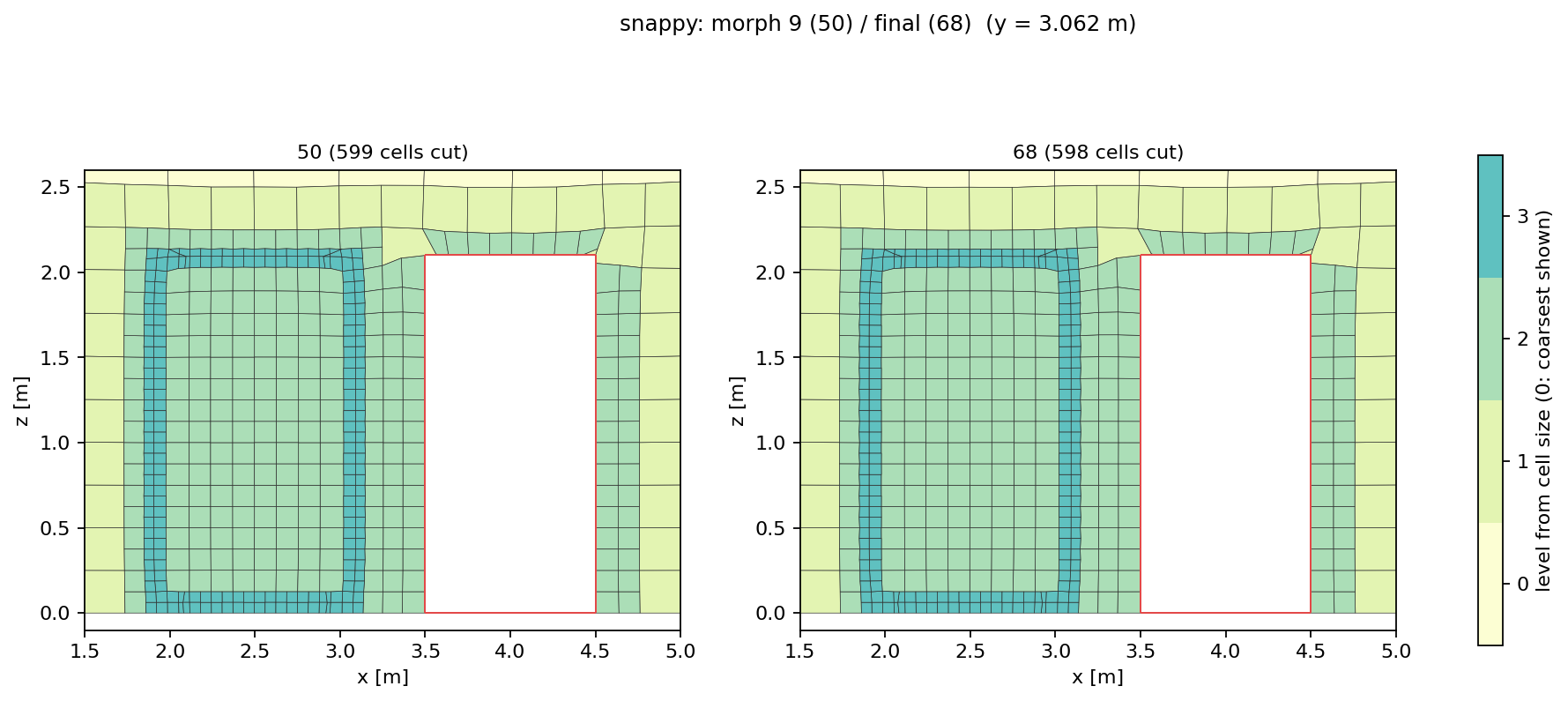
Sharp in the final mesh. Every iteration checks the faces and scales the move back where they fail (not needed here).
The difference to rheoMesh is the start: rheoMesh's core margin and pillow put the boundary points about one cell off the surface, so the moves onto the feature lines are long. Spreading the displacement into the interior and applying it in steps is being considered for rheoMesh.
OpenFOAM v2606 tutorials (2026-11-04)
Of the 17 OpenFOAM v2606 tutorials, 16 were compared (DTCHull is out of scope). On 15 of them rheoMesh gives Mesh OK and the stock checkMesh passes. The sections below show, however, that on flange rheoMesh meshes a different region than snappyHexMesh (a rheoMesh error). The same error on sphere_gapClosure (meshing outside the sphere) was fixed by supporting locationsOutsideMesh and useLeakClosure (2026-11-04). On the 6 cases where the two meshes are comparable, rheoMesh is 3.7-9.2x faster than snappyHexMesh. Both tools read the tutorial's own dictionaries (blockMeshDict and snappyHexMeshDict) unchanged; rheoMesh builds the core mesh without layers (recipes/core.recipe), and snappyHexMesh runs with addLayers false.
How it was measured:
- One Miyabi-C node (112 cores).
- rheoMesh: 112 threads, five runs, the median. Its mesh does not depend on the thread count, so one count is enough.
- snappyHexMesh: one run each at 1, 28, 56 and 112 processes, then five runs at the fastest count, the median. The time is decomposePar + snappyHexMesh; reconstructParMesh is not counted: the solver runs on the decomposed case and ParaView opens it as it is, so nobody waits for it (changed 2026-11-04; it was counted before).
The 16 tutorials
The number in brackets after a snappyHexMesh time is its process count. For motorBike and iglooWithFridges, snappyHexMesh ran once, and its whole process at 1 and at 112 processes (the earlier method) is given; for windAroundBuildings and flange, the snappyHexMesh step of one run at 28 processes. Cell counts and quality are those of the meshes in the sections below.
| tutorial | rheoMesh | snappyHexMesh | time: rheoMesh / snappyHexMesh | cells: rheoMesh / snappyHexMesh |
|---|---|---|---|---|
| injectorPipe | Mesh OK (max non-orth 59.9°) | Mesh OK | 0.98 s / 8.92 s (28) | 65.6 k / 74.6 k |
| cavitatingBullet | Mesh OK (42.8°) | Mesh OK | 3.13 s / 19.83 s (28) | 566 k / 373 k |
| turbineSiting | Mesh OK (47.2°) | Mesh OK | 1.25 s / 7.94 s (28) | 191 k / 120 k |
| simpleCarSolarPanel | Mesh OK (59.8°) | Mesh OK | 0.85 s / 5.53 s (28) | 77.4 k / 34.8 k |
| cyclone | Mesh OK (46.0°) | Mesh OK | 0.40 s / 3.66 s (28) | 30.7 k / 30.8 k |
| airRecirculationRoom | Mesh OK (56.7°) | Mesh OK | 5.94 s / 21.97 s (28) | 659 k / 627 k |
| windAroundBuildings | Mesh OK | Mesh OK | 3.6 s / 15.34 s (snappyHexMesh step, 28) | 235 k / 185 k |
| motorBike | Mesh OK | checkMesh: 1 failed check (skew) | 7.3 s / 95.2 s, 28.4 s | 413 k / 327 k |
| insidePoints | Mesh OK (59.8°); the zone's faces stay a staircase | Mesh OK | 0.19 s / 0.74 s (1) | 7 349 / 4 129 |
| gap_detection | Mesh OK (60.0°); almost the whole region two levels finer | Mesh OK | 6.18 s / 0.98 s (1) | 308 k / 7.8 k |
| iglooWithFridges | Mesh OK; no coarsest cells; the fridges' corners rounded | Mesh OK | 0.5 s / 2.7 s, 7.9 s | 13.9 k / 6 532 |
| rotated_block | Mesh OK (26.3°); the whole inside of the zone refined | checkMesh: 3 failed checks (max non-orth 119.6°) | 0.28 s / 13.90 s (1) | 81.9 k / 38.0 k |
| block_with_curvature | Mesh OK (36.4°); finer near the curved and the top face | Mesh OK | 1.16 s / 1.39 s (1) | 102 k / 9 273 |
| sphere_gapClosure | Mesh OK (59.9°). The hole of the sphere is closed and only the inside is meshed (fixed 2026-11-04); the fluid volume agrees with snappyHexMesh within 0.03 % | Mesh OK | 0.88 s / 5.04 s (28) | 77.7 k / 25.0 k |
| flange | Mesh OK, but the thin channels on the right are not meshed (wrong) | Mesh OK | 0.8 s / 3.83 s (snappyHexMesh step, 28) | 27.3 k / 19 k |
| opposite_walls | failed (3 incorrectly oriented face pyramids; checkMesh: 2 failed checks); uses blockLevel, which rheoMesh does not support | checkMesh: 1 failed check | 0.42 s / 1.86 s (1) | 9 518 / 2 995 |
| DTCHull | out of scope (a background refined in z only; rheoMesh refines all directions alike) | — | — / 125.8 s, 16.7 s | — |
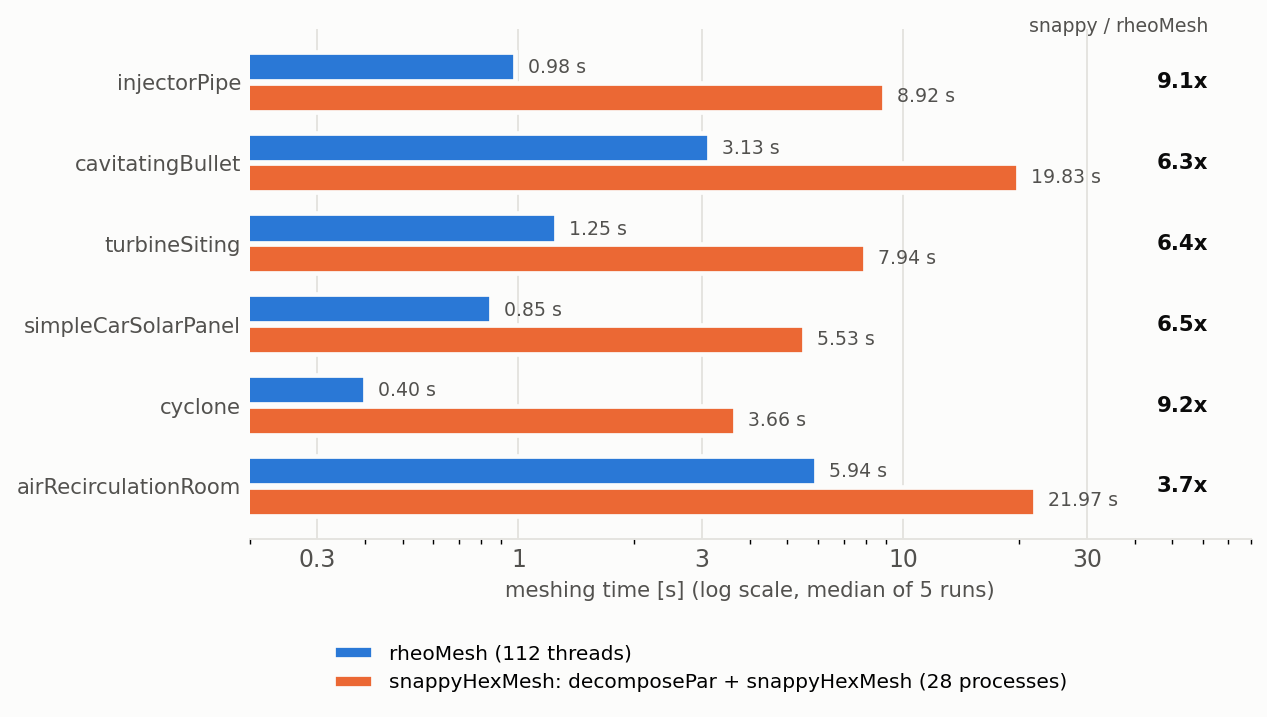
- The first six (injectorPipe to airRecirculationRoom) are comparable meshes. windAroundBuildings and motorBike are similar meshes too, but snappyHexMesh's times there are single runs of the earlier method.
- rheoMesh places surface-level cells in a band 3.5 cells thick along the surface. The core margin and the boundary construction (the pillow) need it; with 1 cell cavitatingBullet fails the check, with 0 cells three of four cases fail. rheoMesh therefore has more cells and a thicker band of fine cells.
- gap_detection and block_with_curvature: rheoMesh has 11-40x the cells, so their times are not compared. sphere_gapClosure has 3.1x the cells; its time is for reference only. In gap_detection the 3.5-cell band also surrounds the cells refined for the gaps (gapLevel, up to level 10).
- rotated_block and insidePoints make a surface internal faces with fluid on both sides (faceZone) and the cells inside it a cellZone. rheoMesh writes the inside cells and the faces between as zones, but those faces stay a staircase and are not put onto the surface as snappyHexMesh does.
- block_with_curvature's curvatureLevel (cells per radius of curvature) is read as a level per triangle from its curvature, and limitRegions (a cap on refinement inside a box) as a cap on the requested level.
- Snapping to feature lines is weak with the default setting (
RHEOMESH_REACH=0). In iglooWithFridges no point snaps to any of the 24 feature edges or 16 corners found: the boundary points lie about one cell off the surface, outside the capture radius (half a cell). Work in progress (2026-11-04). - motorBike became Mesh OK on 2026-11-04. When the check fails, the feature points in the cells of the failing faces are taken off their feature lines, and only those cells and four rings of cells around them are made again (
RHEOMESH_FEATURE_RETRY,RHEOMESH_FEATURE_RETRY_LOCAL). Meshes that pass are not changed.
Sections of the meshes (no layers, 14 cases)
Each section cuts both meshes with the same plane (placed between two layers of mesh points; a plane on a layer of points draws lines that are not cell edges): rheoMesh on the left, snappyHexMesh (no layers) on the right, the section of the geometry in red. The colour is a level from the cell size: with h the cube root of the cell volume, round(log2(h0 / h)), h0 being the coarsest cells in view, so 0 is the coarsest. The two meshers count cellLevel from different roots, so this gives both the same scale. The figures are drawn with tools/plot_compare_slice.py; click one to enlarge it.
The sections of the cases with layers (motorBike and iglooWithFridges) are with the layer comparison below.
injectorPipe (z ≈ 0, the junction)
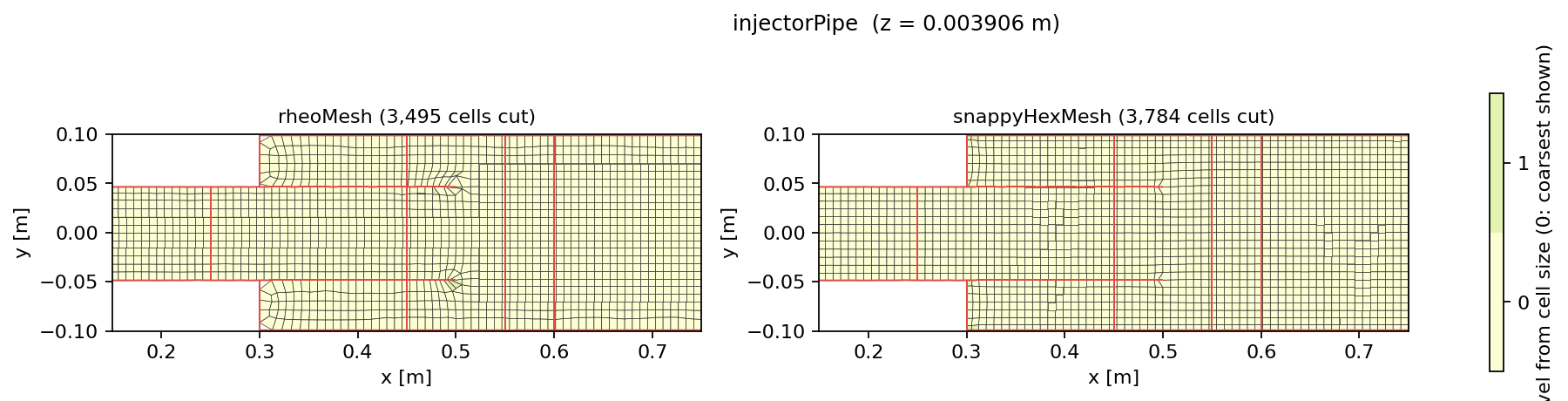
injectorPipe, section z = 0.0039 m
| rheoMesh | snappyHexMesh | |
|---|---|---|
| check | Mesh OK | Mesh OK (no layers) |
| time | 0.98 s | 8.92 s (28 processes) |
| cells | 65,588 | 74,631 |
| max non-orth | 59.86° | 51.62° |
| max skewness | 4.00 | 2.17 |
cavitatingBullet (x = 0)
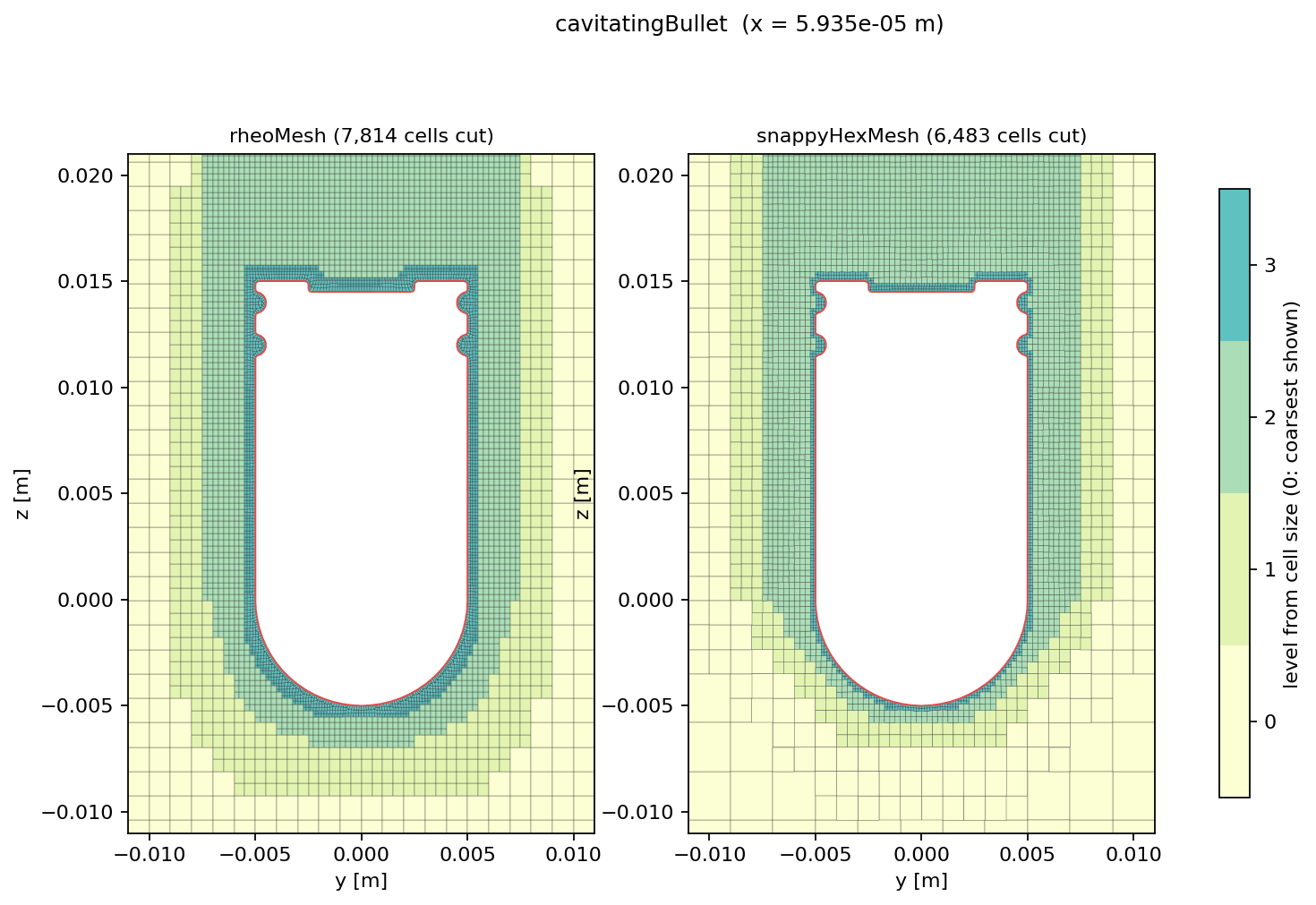
cavitatingBullet, section x = 0.000059 m
| rheoMesh | snappyHexMesh | |
|---|---|---|
| check | Mesh OK | Mesh OK (no layers) |
| time | 3.13 s | 19.83 s (28 processes) |
| cells | 566,406 | 372,938 |
| max non-orth | 42.77° | 44.45° |
| max skewness | 1.40 | 1.24 |
turbineSiting (part of a vertical section of the terrain)
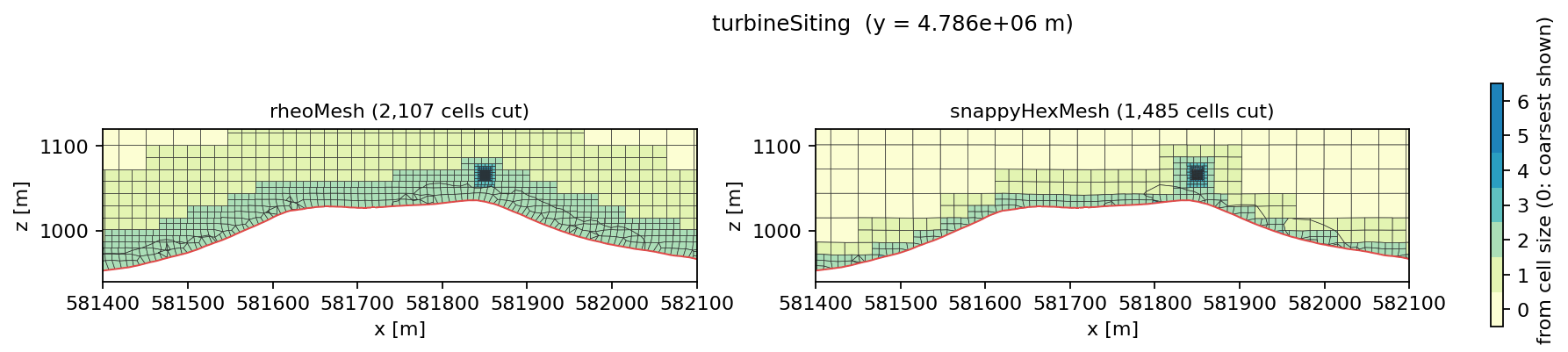
turbineSiting, section y = 4785810 m
| rheoMesh | snappyHexMesh | |
|---|---|---|
| check | Mesh OK | Mesh OK (no layers) |
| time | 1.25 s | 7.94 s (28 processes) |
| cells | 190,851 | 120,246 |
| max non-orth | 47.20° | 41.03° |
| max skewness | 3.66 | 0.47 |
simpleCarSolarPanel
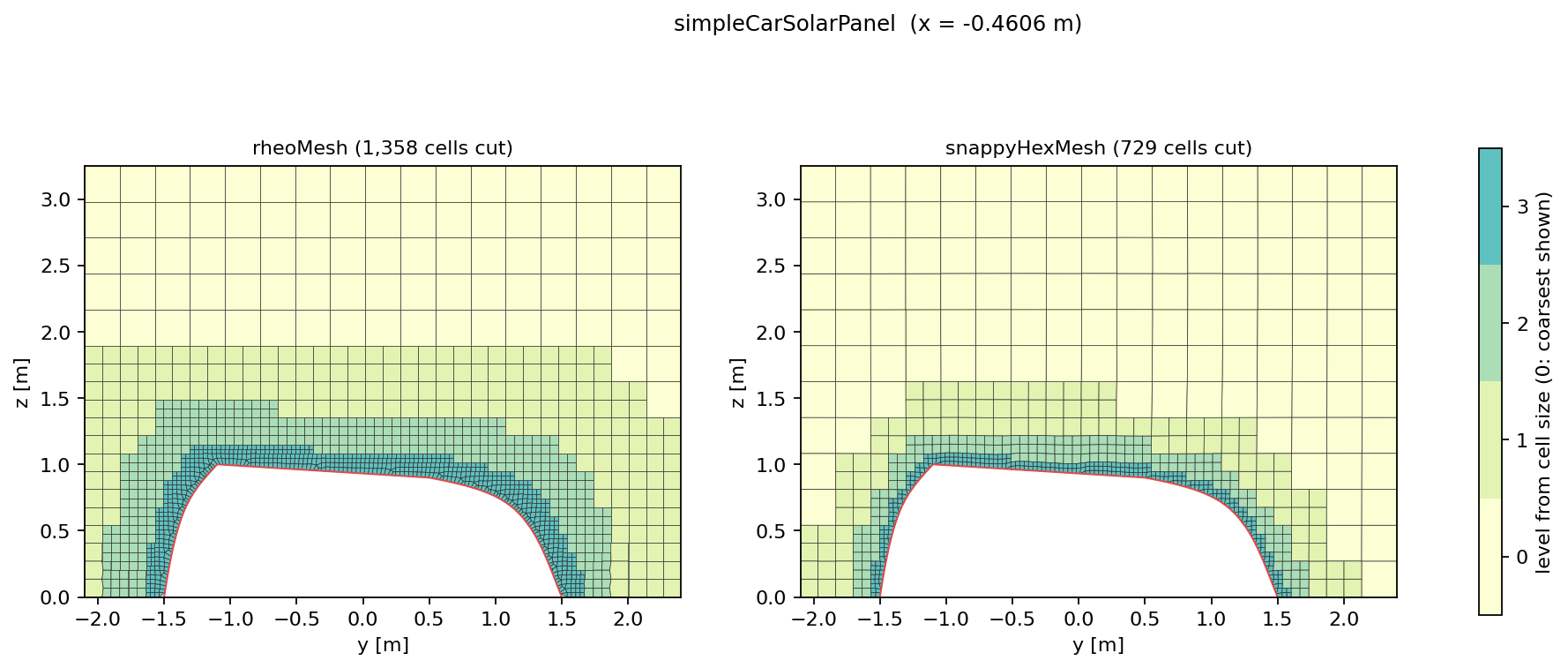
simpleCarSolarPanel, section x = -0.4606 m
| rheoMesh | snappyHexMesh | |
|---|---|---|
| check | Mesh OK | Mesh OK (no layers) |
| time | 0.85 s | 5.53 s (28 processes) |
| cells | 77,422 | 34,761 |
| max non-orth | 59.76° | 49.43° |
| max skewness | 3.94 | 3.18 |
cyclone (y = 0)
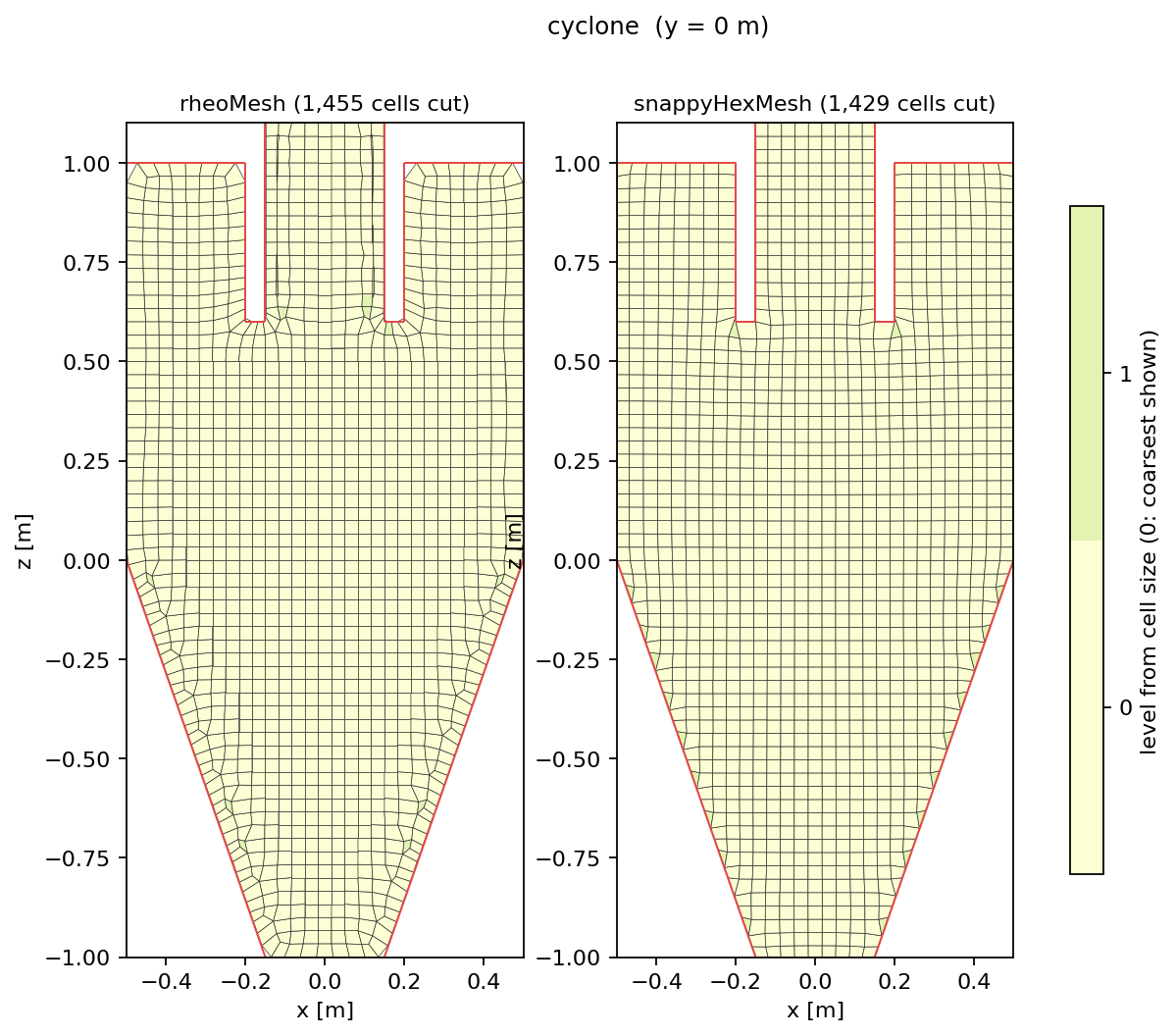
cyclone, section y = 0 m
| rheoMesh | snappyHexMesh | |
|---|---|---|
| check | Mesh OK | Mesh OK (no layers) |
| time | 0.40 s | 3.66 s (28 processes) |
| cells | 30,697 | 30,819 |
| max non-orth | 46.01° | 39.91° |
| max skewness | 3.48 | 3.72 |
airRecirculationRoom (y = 2 m)
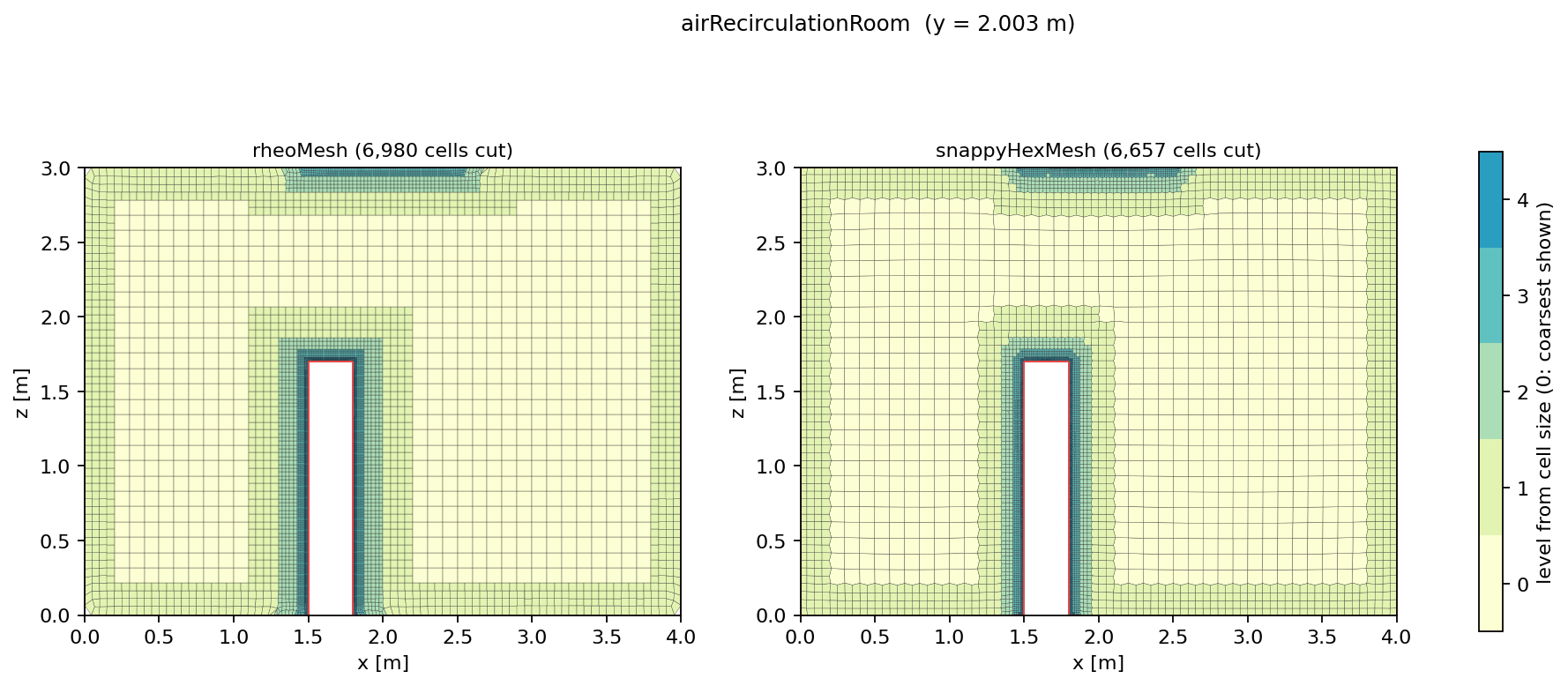
airRecirculationRoom, section y = 2.0031 m
| rheoMesh | snappyHexMesh | |
|---|---|---|
| check | Mesh OK | Mesh OK (no layers) |
| time | 5.94 s | 21.97 s (28 processes) |
| cells | 658,642 | 627,450 |
| max non-orth | 56.72° | 42.33° |
| max skewness | 3.34 | 0.60 |
windAroundBuildings (z = 5 m)
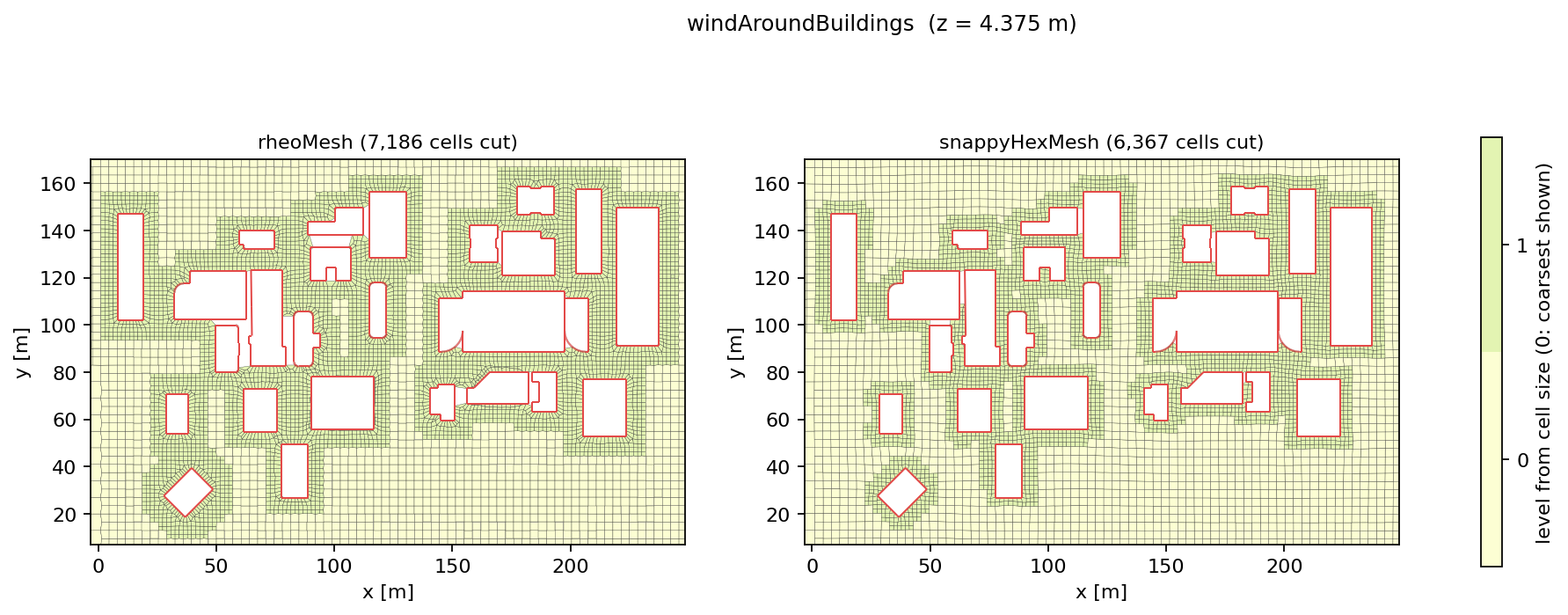
windAroundBuildings, section z = 4.375 m
| rheoMesh | snappyHexMesh | |
|---|---|---|
| check | Mesh OK | Mesh OK (no layers) |
| time | 3.6 s | 15.34 s (snappyHexMesh step, 28 processes) |
| cells | 235,369 | 184,747 |
| max non-orth | 59.31° | 47.41° |
| max skewness | 3.93 | 3.21 |
insidePoints
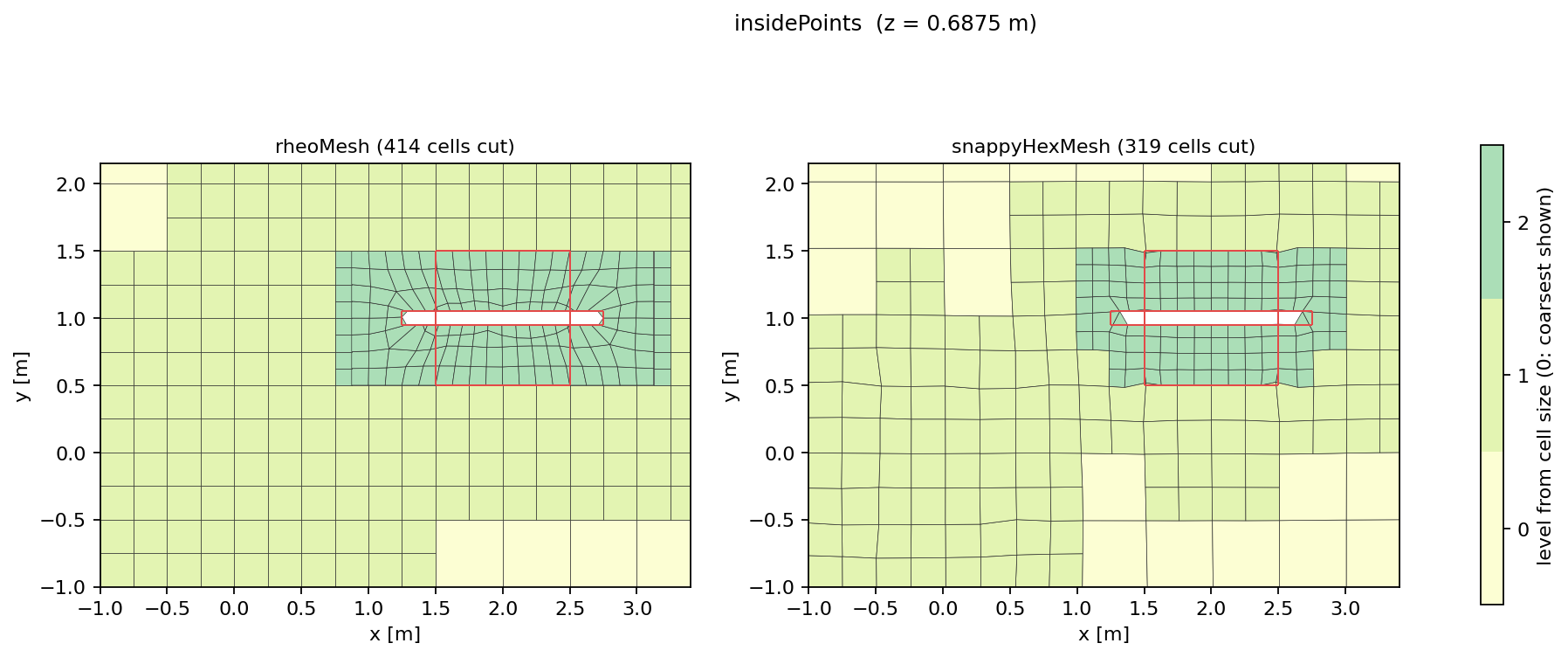
insidePoints, section z = 0.6875 m
| rheoMesh | snappyHexMesh | |
|---|---|---|
| check | Mesh OK | Mesh OK (no layers) |
| time | 0.19 s | 0.74 s (1 process) |
| cells | 7,349 | 4,129 |
| max non-orth | 59.82° | 35.33° |
| max skewness | 3.91 | 0.75 |
gap_detection: rheoMesh refines almost the whole region two levels finer
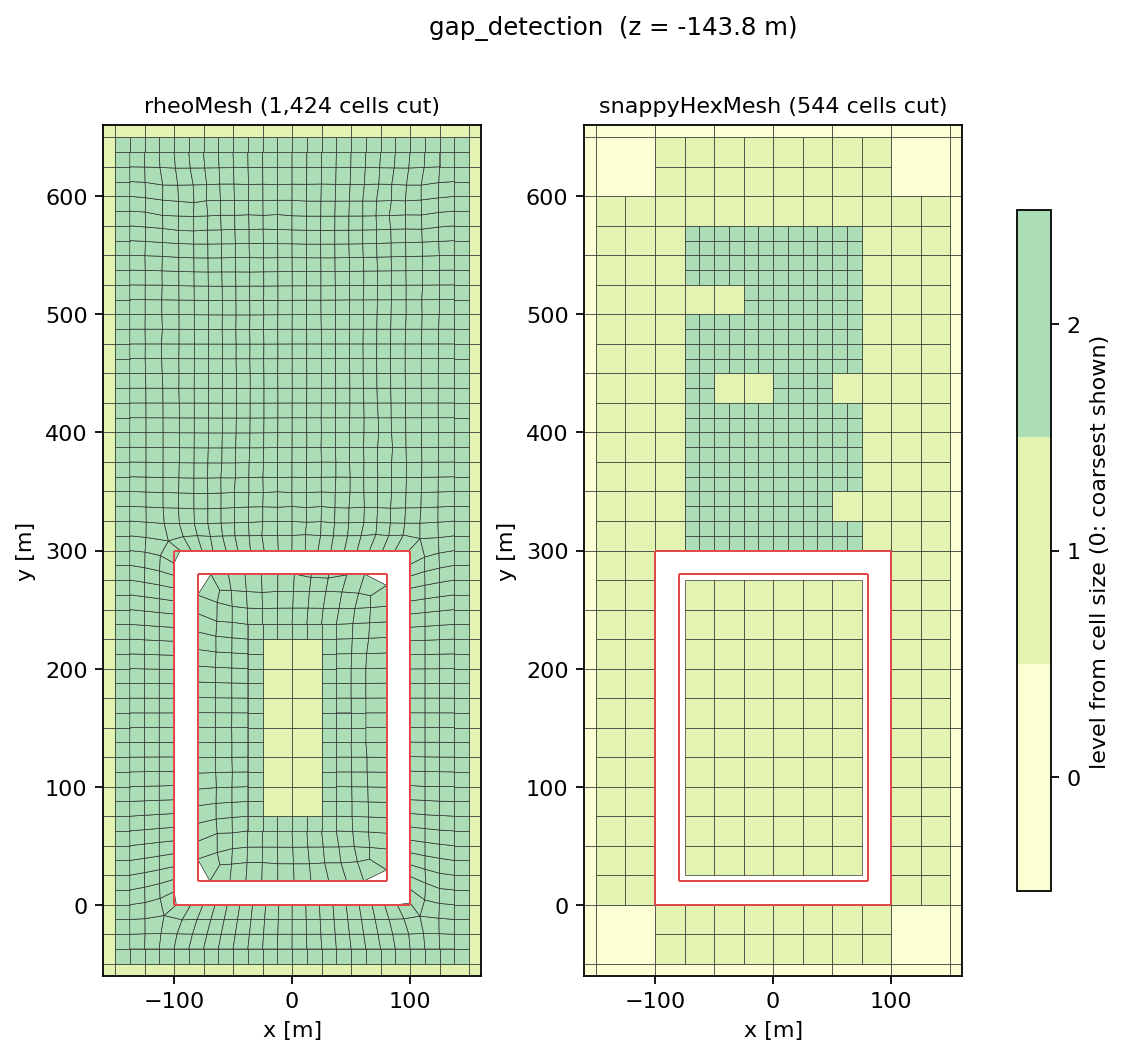
gap_detection, section z = -143.75 m
| rheoMesh | snappyHexMesh | |
|---|---|---|
| check | Mesh OK | Mesh OK (no layers) |
| time | 6.18 s | 0.98 s (1 process) |
| cells | 308,421 | 7,830 |
| max non-orth | 60.00° | 25.24° |
| max skewness | 3.99 | 1.00 |
rotated_block: rheoMesh refines the whole inside of the zone
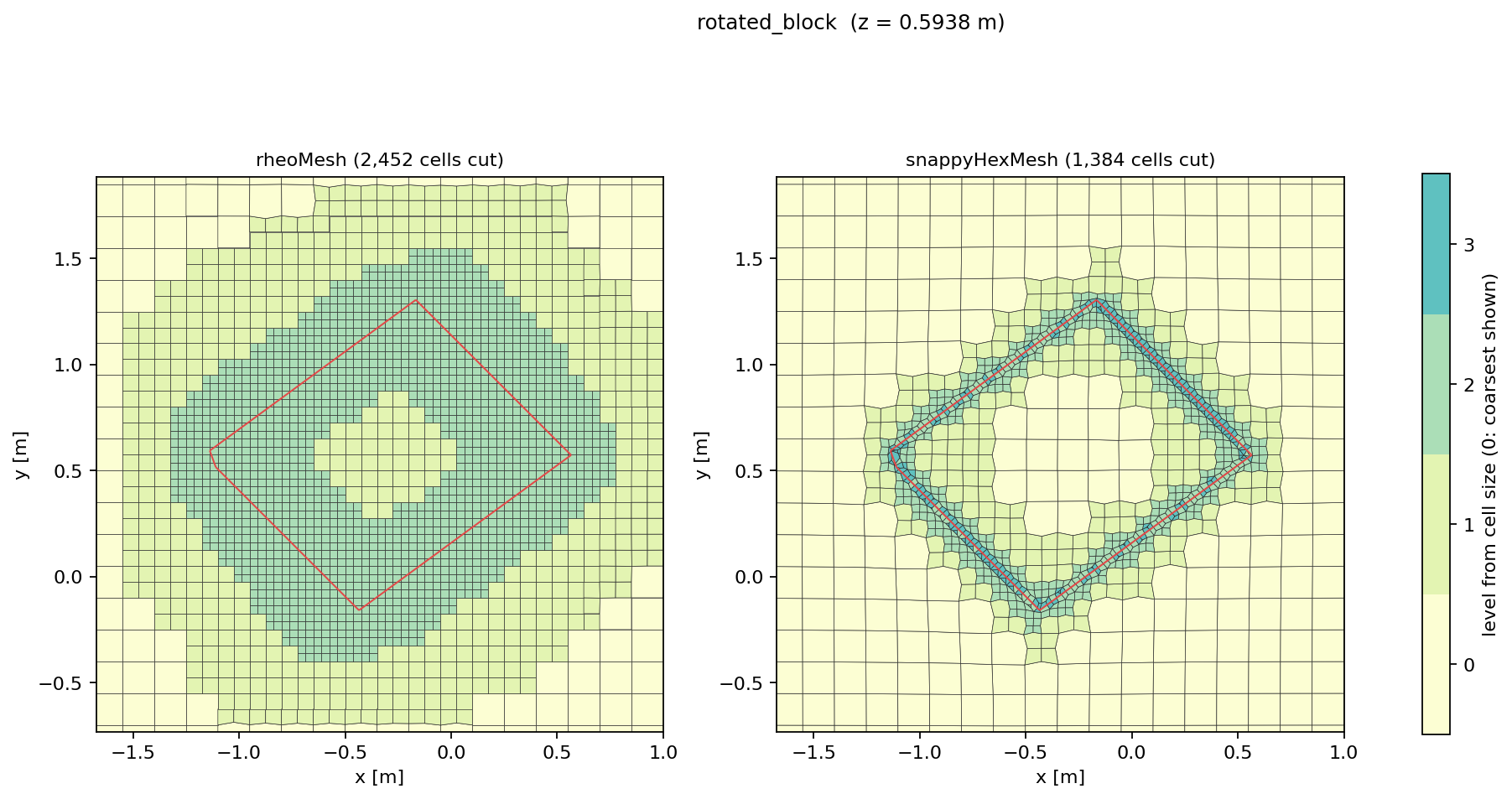
rotated_block, section z = 0.59375 m
| rheoMesh | snappyHexMesh | |
|---|---|---|
| check | Mesh OK | 3 failed checks (no layers) |
| time | 0.28 s | 13.90 s (1 process) |
| cells | 81,948 | 37,969 |
| max non-orth | 26.27° | 119.60° |
| max skewness | 0.37 | 307.81 |
block_with_curvature (z = 0.1 m)
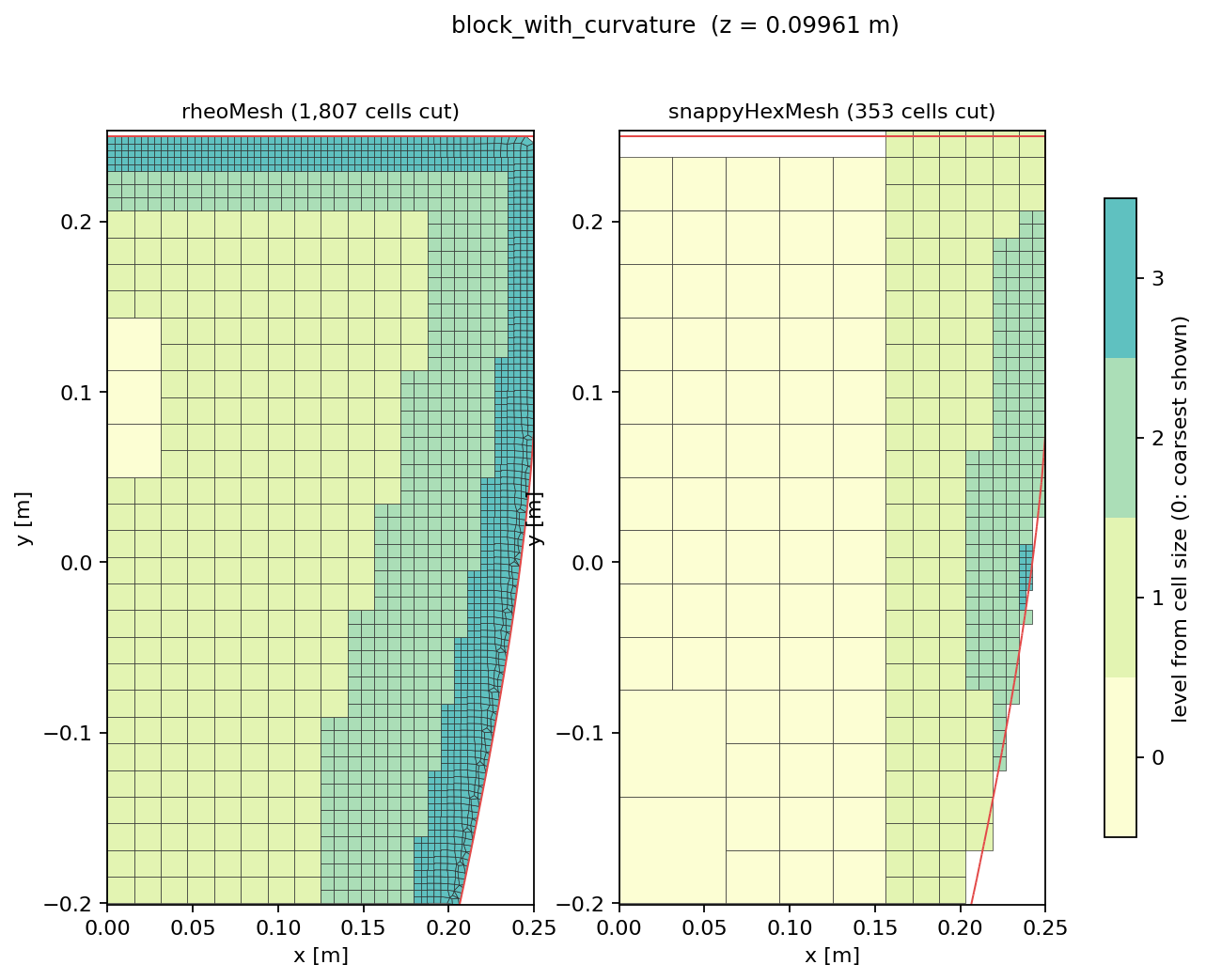
block_with_curvature, section z = 0.0996 m
| rheoMesh | snappyHexMesh | |
|---|---|---|
| check | Mesh OK | Mesh OK (no layers) |
| time | 1.16 s | 1.39 s (1 process) |
| cells | 101,862 | 9,273 |
| max non-orth | 36.38° | 25.24° |
| max skewness | 1.17 | 1.00 |
sphere_gapClosure: the hole is closed and only the inside is meshed (fixed 2026-11-04)
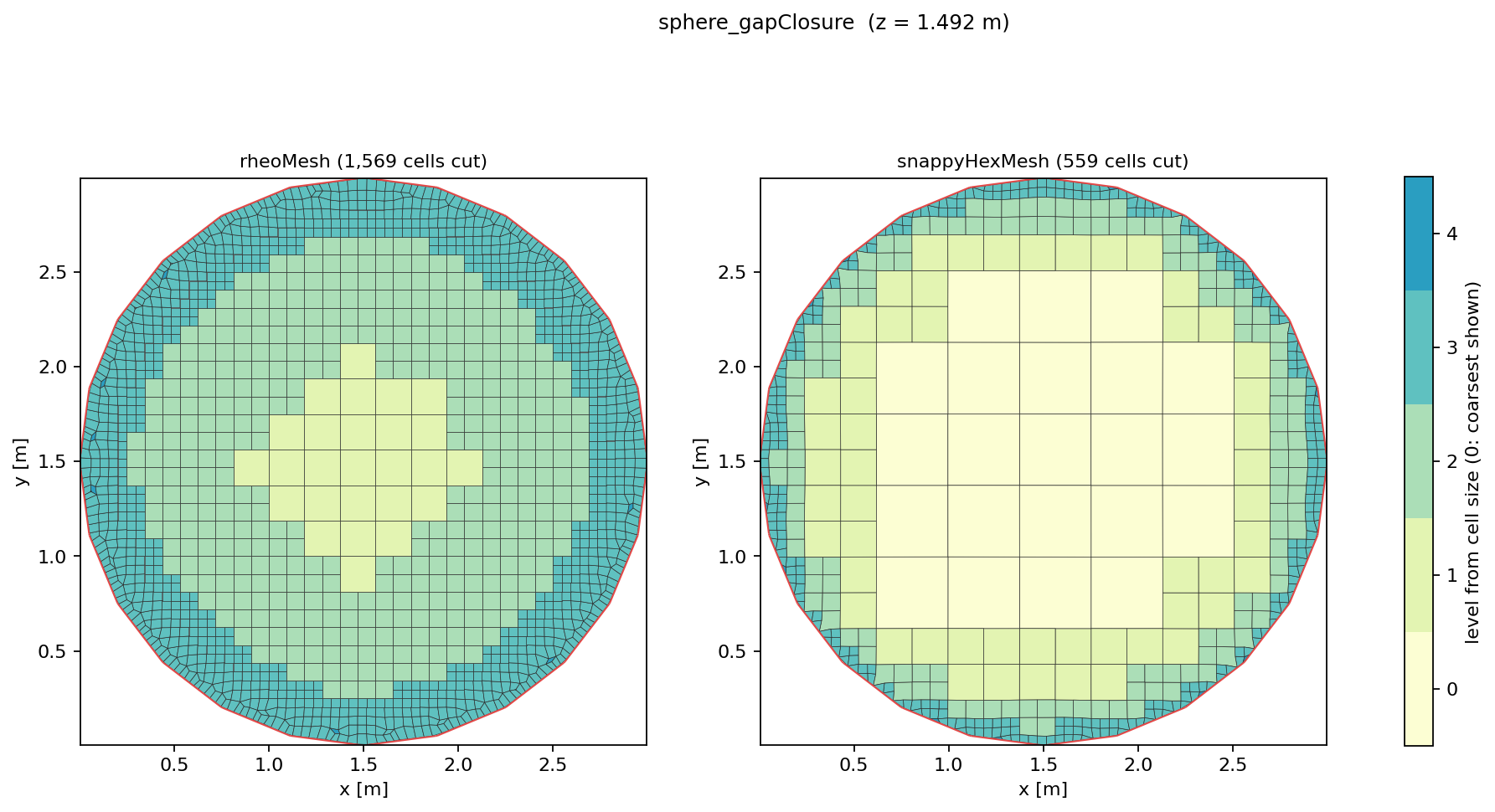
sphere_gapClosure, section z = 1.492 m. rheoMesh reads locationsOutsideMesh and useLeakClosure and closes cells from the rim of the hole outward until no outside point is connected to the fluid. Fluid volume: rheoMesh 13.5746 m³, snappyHexMesh 13.5715 m³.
| rheoMesh | snappyHexMesh | |
|---|---|---|
| check | Mesh OK | Mesh OK (no layers) |
| time | 0.88 s (median of 5) | 5.04 s (28 processes) |
| cells | 77,713 | 25,032 |
| max non-orth | 59.91° | 42.50° |
| max skewness | 3.83 | 1.42 |
flange (x = 0): rheoMesh does not mesh the thin channels on the right (wrong)
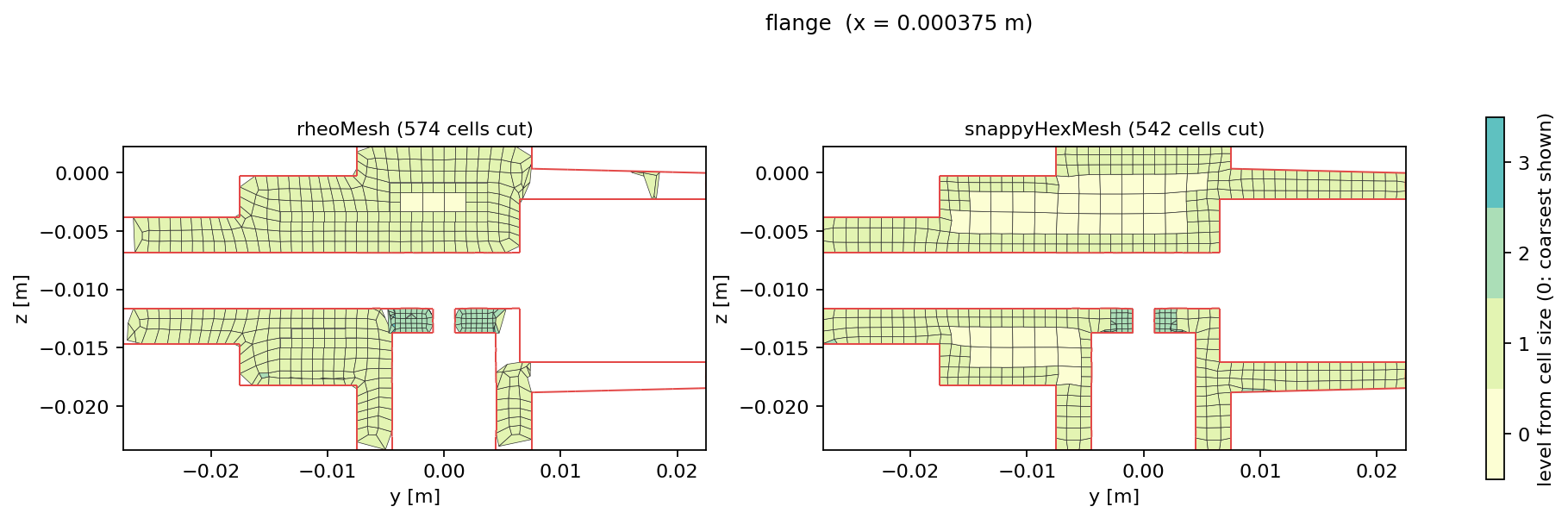
flange, section x = 0.000375 m
| rheoMesh | snappyHexMesh | |
|---|---|---|
| check | Mesh OK | Mesh OK (no layers) |
| time | 0.8 s | 3.83 s (snappyHexMesh step, 28 processes) |
| cells | 27,345 | 19,186 |
| max non-orth | 59.99° | 50.95° |
| max skewness | 3.77 | 3.38 |
opposite_walls: rheoMesh fails the check
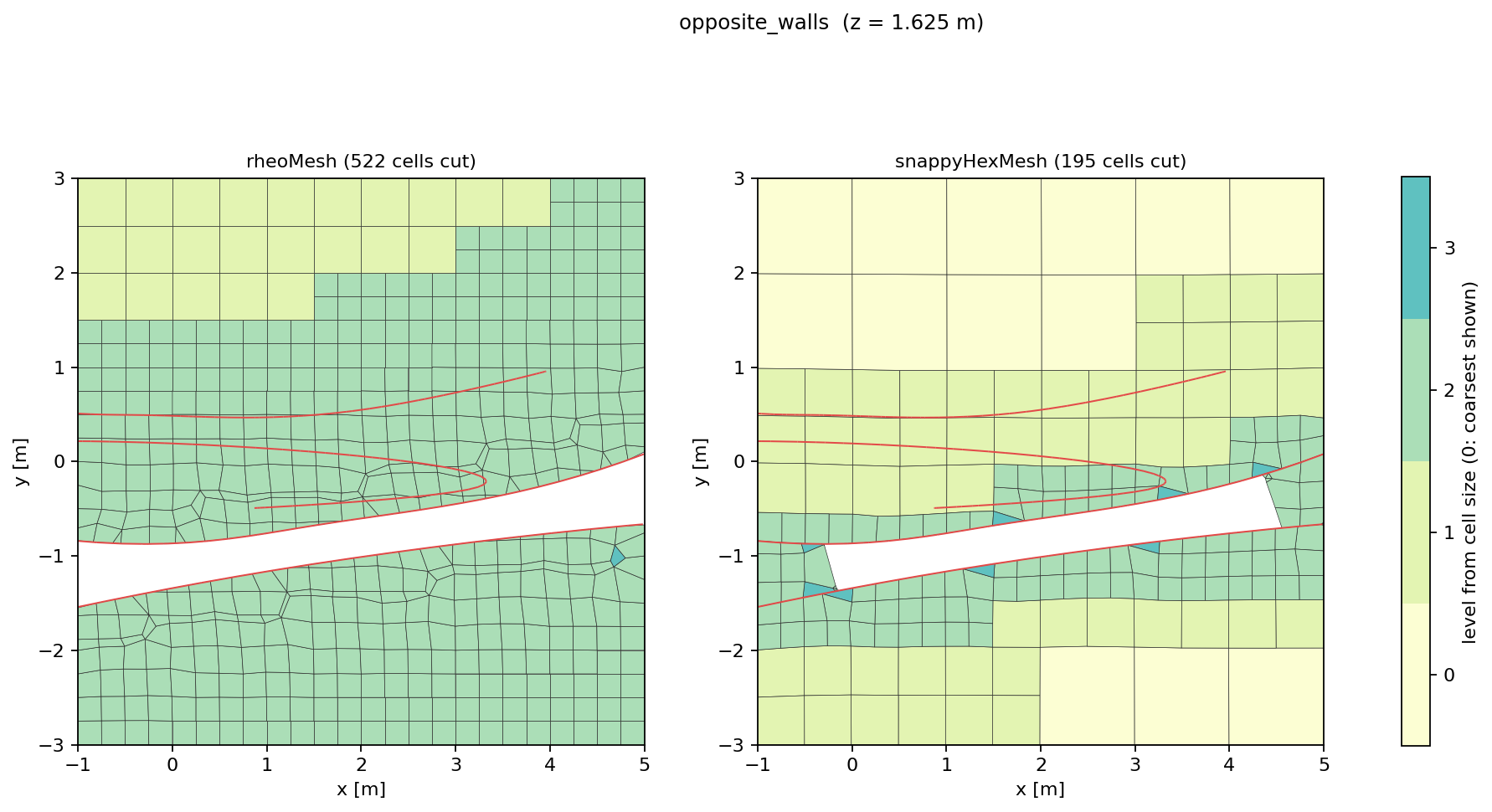
opposite_walls, section z = 1.625 m
| rheoMesh | snappyHexMesh | |
|---|---|---|
| check | 2 failed checks | 1 failed check (no layers) |
| time | 0.42 s | 1.86 s (1 process) |
| cells | 9,518 | 2,995 |
| max non-orth | 86.63° | 62.02° |
| max skewness | 4.38 | 5.19 |
Layers compared (3 cases, 2026-11-04)
Among the tutorials, only motorBike (1 layer) and iglooWithFridges (3 layers on the fridges, 1 on the igloo) add layers; cavitatingBullet and injectorPipe have addLayers true but no patch with layers. The third case is Flow2/drivaerFastback/run/base of the training repository (Supercomputer-OpenFOAM-Training; OpenFOAM-13's DrivAer fastback surfaces, half car, 6 layers on the body, wheels and ground). rheoMesh reads addLayersControls and adds the layers in two passes (recipes/tutorial-layers.recipe). snappyHexMesh adds them from the same dictionaries (28 processes for motorBike and iglooWithFridges, 112 for drivaerFastback, one run).
The mean layer counts are snappyHexMesh's own log table (patch, faces, layers) and rheoMesh's per-patch count of the extrusion; in brackets the share of faces with layers. For motorBike's snappyHexMesh, the motorBike part patches are averaged weighted by faces. The close-ups are sections near the wall, coloured as above.
| case | rheoMesh | snappyHexMesh |
|---|---|---|
| drivaerFastback (6 layers) | Mesh OK, about 65 s (pass 1: 15.8 s, pass 2: 49.3 s), 4.0 M cells. Layers: body 5.69 (98.3 %), front wheels 5.38 (96.9 %), rear wheels 5.40 (96.4 %), ground 5.88 (99.0 %) | checkMesh: 1 failed check (7 faces over skew 4), 128.5 s, 3.43 M cells. Layers: body 4.15, front wheels 1.02, rear wheels 0.89, ground 5.95 |
| iglooWithFridges (3 layers on the fridges, 1 on the igloo) | Mesh OK, 2.0 s, 28.0 k cells. Layers: fridges 2.53 (92.9 %), igloo 0.95 (94.9 %). The fridges' corners rounded and the wall inside the surface | Mesh OK, 1.7 s, 10.5 k cells. Layers: fridges 2.1, igloo 1.0 |
| motorBike (1 layer) | failed (1 negative-volume cell, 11 incorrectly oriented face pyramids), about 26 s. Layers: motorBike 0.47 (47.3 %), lowerWall 0.96 (95.6 %) | checkMesh: 1 failed check, 26.9 s (snappyHexMesh step), 355 k cells. Layers: motorBike 0.54, lowerWall 0.99 |
- drivaerFastback: rheoMesh's six layers go round the front lower corner and the rear complete. snappyHexMesh's layers break off at corners, and on the wheels it adds about one layer on average.
- iglooWithFridges: rheoMesh rounds the fridges' corners, and its wall lies a few cm inside the fridges' surface. The points do not snap to the feature lines, the same problem as noted above.
- motorBike: rheoMesh fails the check already in the first layer pass (the core made on the surface offset by the layer thickness), and only about half of the faces get a layer. The feature retry that made the core mesh pass is not yet in the first layer pass.
- iglooWithFridges with layers: rheoMesh has distorted cells and holes next to the left fridge (x = 1.8-3.4 m in the layered section below); without layers that space is meshed. The first layer pass offsets the surface by the layer thickness, which presumably closes the gap there (wrong, not fixed yet).
drivaerFastback (6 layers)
Section (y = 0.3 m, with layers)
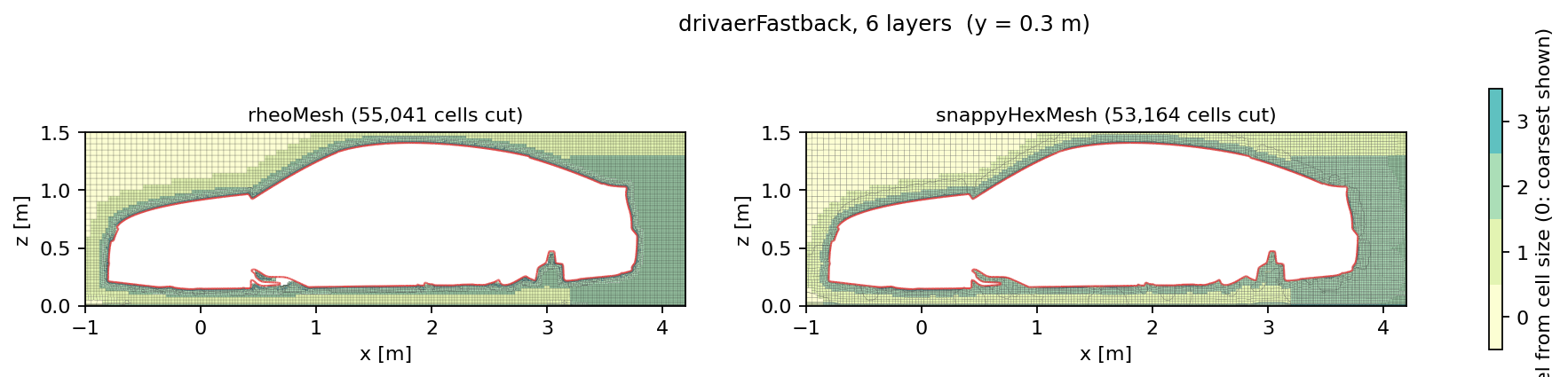
drivaerFastback (6 layers), with layers, section y = 0.3 m
| rheoMesh | snappyHexMesh | |
|---|---|---|
| check | Mesh OK | 1 failed check |
| time | about 65 s (pass 1: 15.8 s, pass 2: 49.3 s) | 128.5 s (snappyHexMesh step, 112 processes) |
| cells | 4,004,367 | 3,432,393 |
| max non-orth | 67.81° | 70.10° |
| max skewness | 4.00 | 9.34 |
| layers (mean) | body 5.69, front wheels 5.38, rear wheels 5.40, ground 5.88 | body 4.15, front wheels 1.02, rear wheels 0.89, ground 5.95 |
Close-up 1: the front lower corner
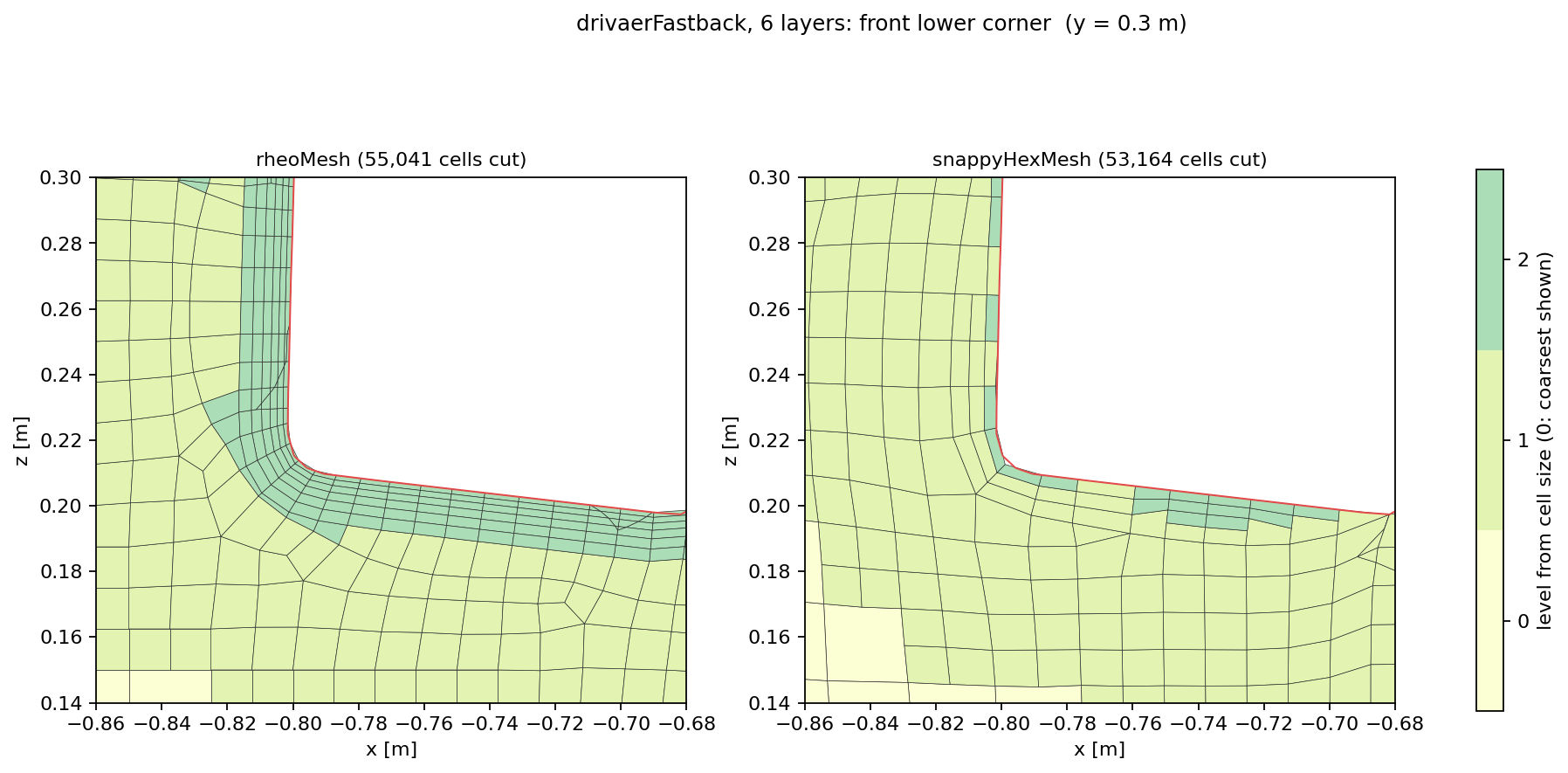
drivaerFastback (6 layers), close-up 1, section y = 0.3 m
Close-up 2: the rear
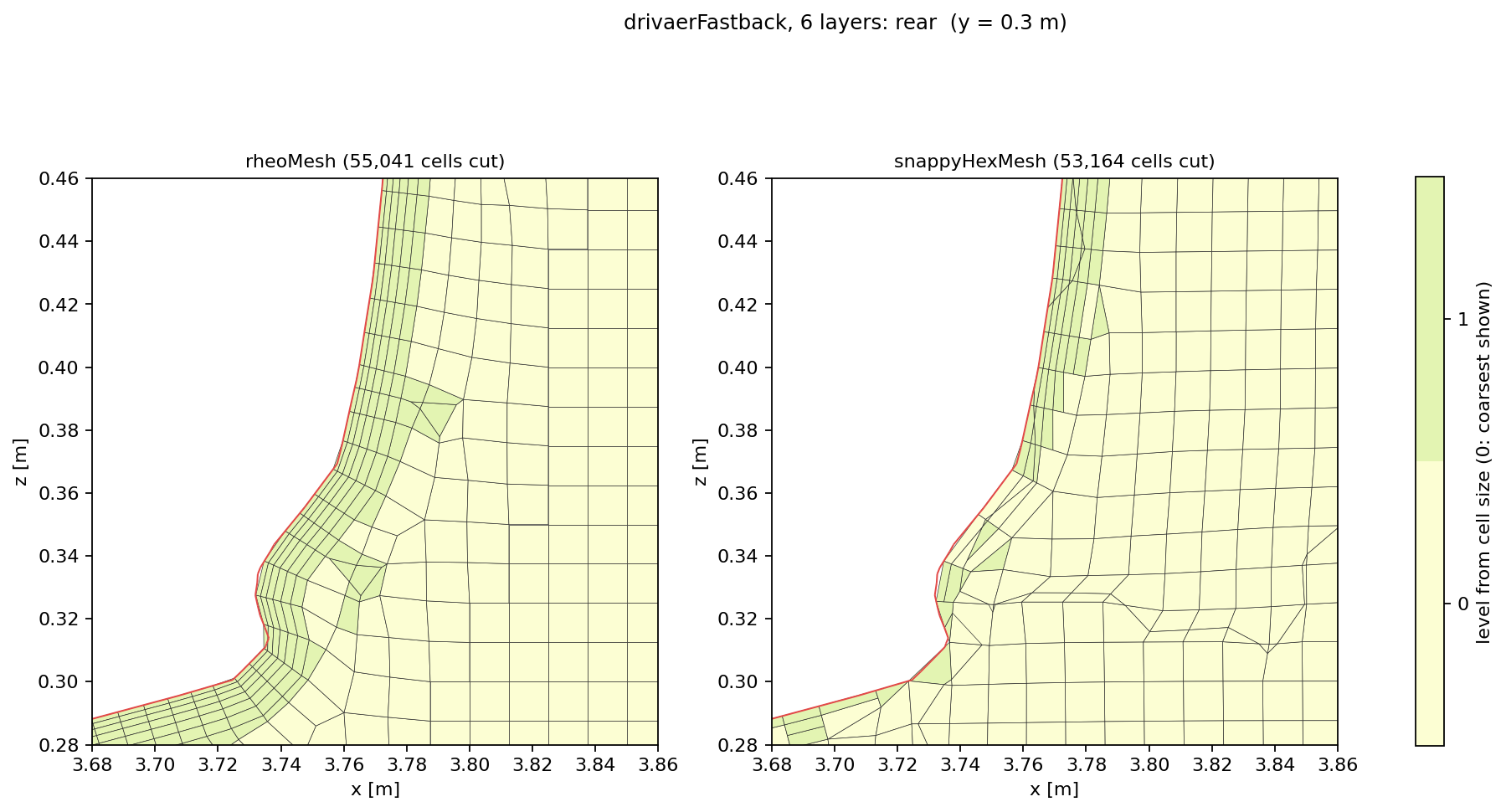
drivaerFastback (6 layers), close-up 2, section y = 0.3 m
The whole symmetry plane (y = 0), the earlier figure coloured by face size. Left rheoMesh, right snappyHexMesh

iglooWithFridges (3 layers on the fridges, 1 on the igloo)
Section (y ≈ 3.06 m, no layers)
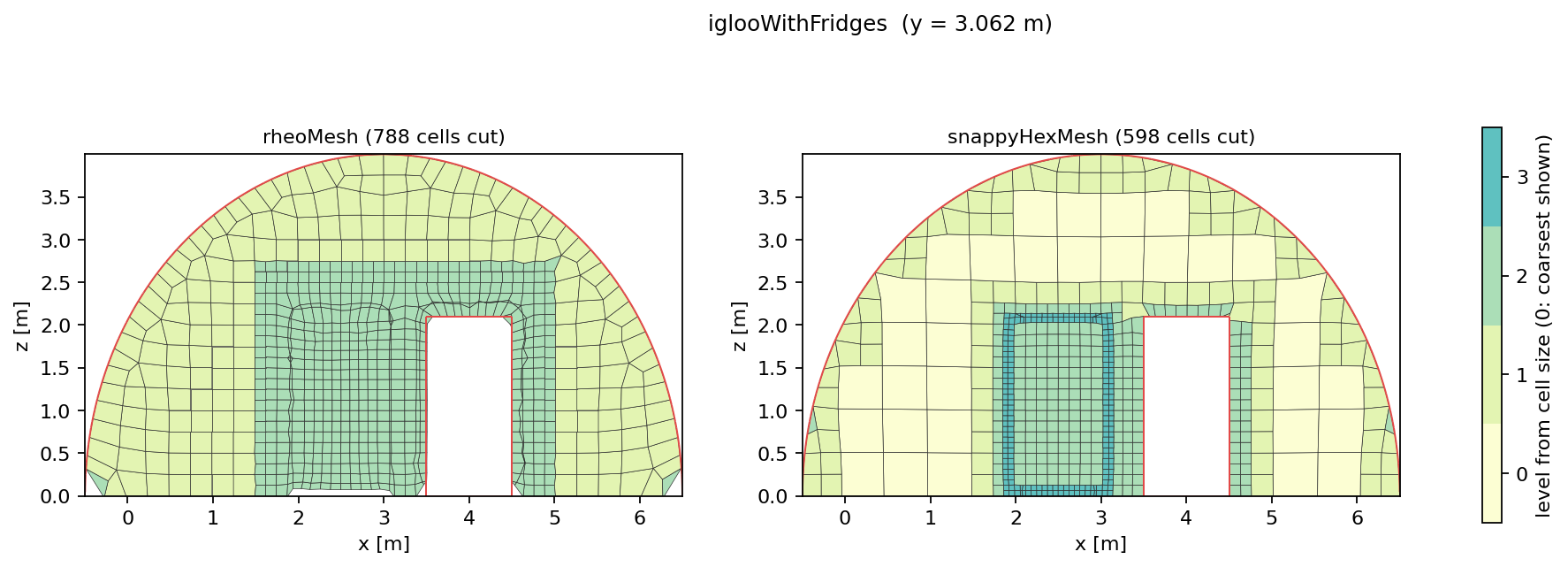
iglooWithFridges, no layers, section y = 3.0625 m
| rheoMesh | snappyHexMesh | |
|---|---|---|
| check | Mesh OK | Mesh OK (no layers) |
| time | 0.5 s | 7.9 s (whole process, 112 processes) |
| cells | 13,857 | 6,532 |
| max non-orth | 43.00° | 45.62° |
| max skewness | 1.99 | 3.53 |
Section (y ≈ 3.06 m, with layers). rheoMesh has distorted cells and holes next to the left fridge
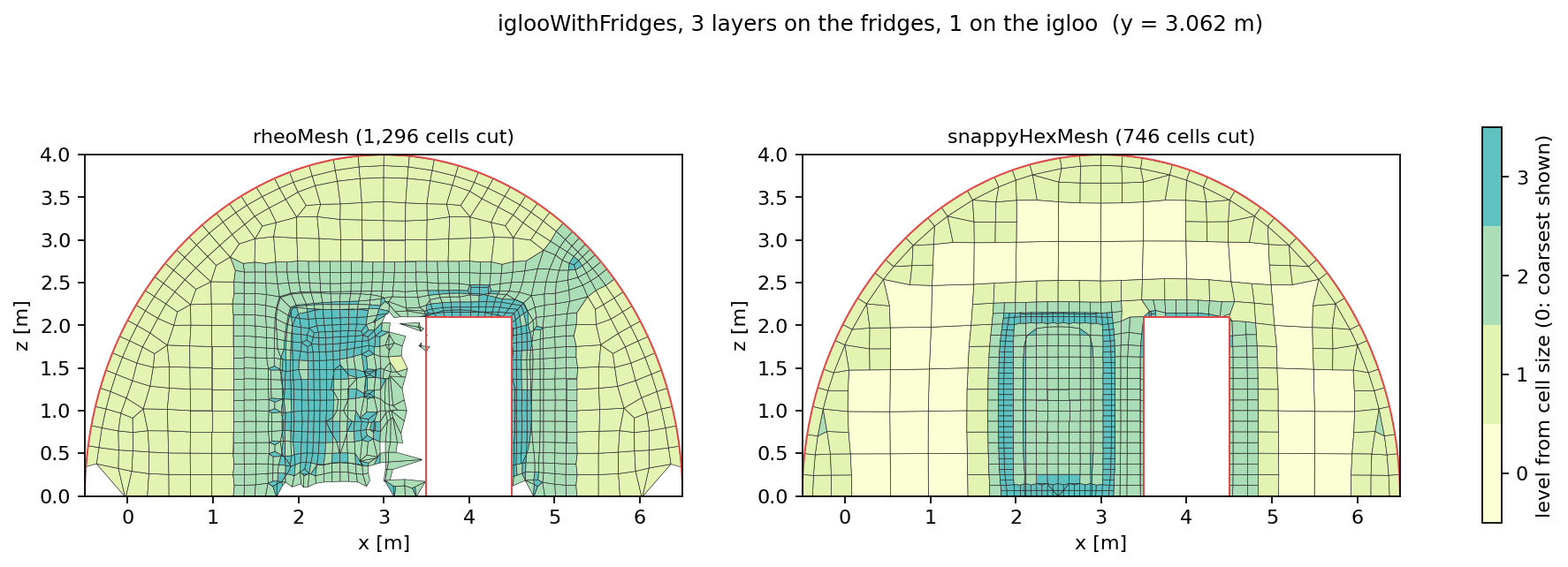
iglooWithFridges (3 layers on the fridges, 1 on the igloo), with layers, section y = 3.0625 m
| rheoMesh | snappyHexMesh | |
|---|---|---|
| check | Mesh OK | Mesh OK |
| time | 2.0 s (pass 1: 0.74 s, pass 2: 1.26 s) | 1.71 s (snappyHexMesh step, 28 processes) |
| cells | 28,035 | 10,528 |
| max non-orth | 64.98° | 64.08° |
| max skewness | 2.85 | 2.90 |
| layers (mean) | fridges 2.53, igloo 0.95 | fridges 2.1, igloo 1.0 |
Close-up 1: the fridge top corner (3 layers)
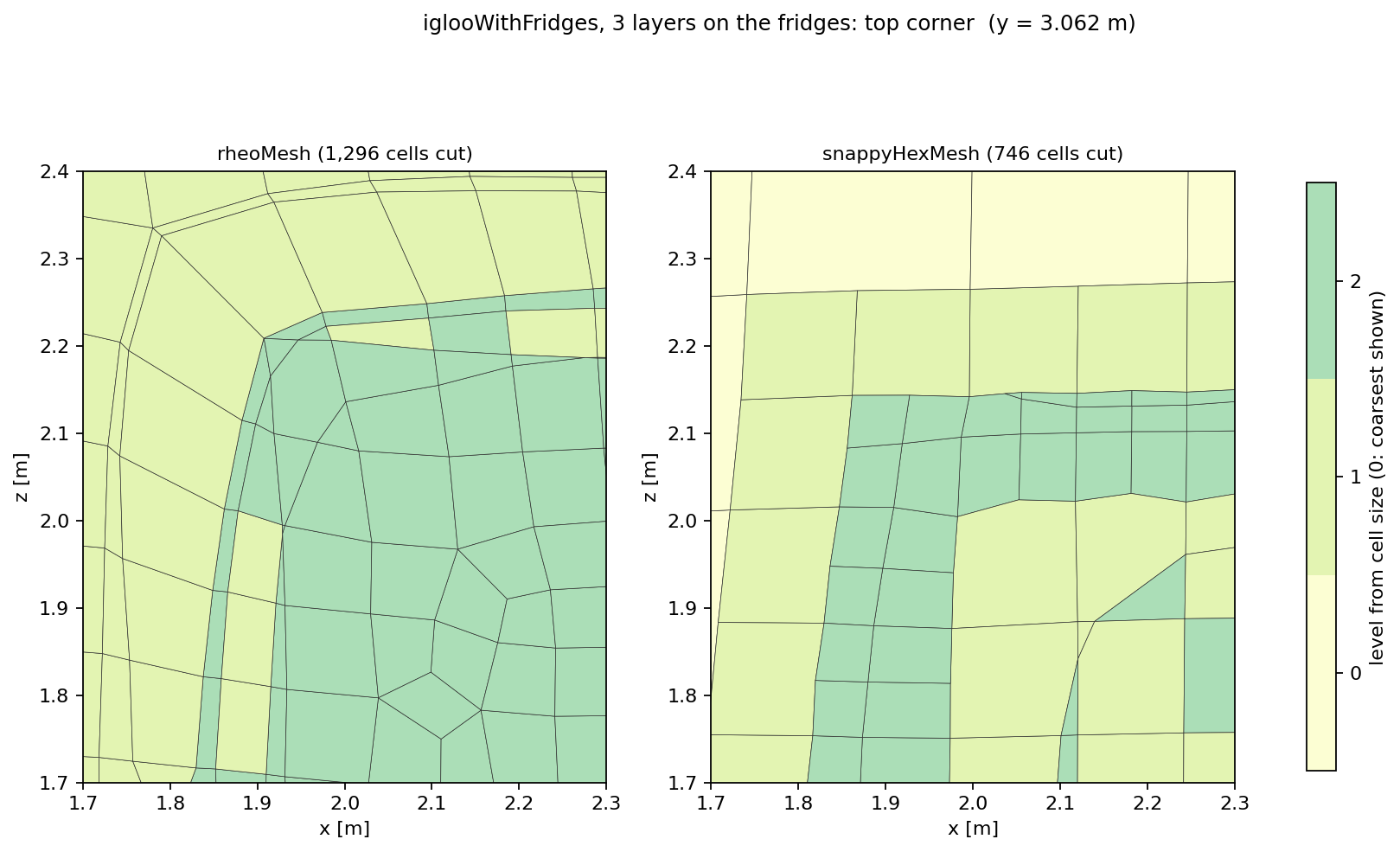
iglooWithFridges (3 layers on the fridges, 1 on the igloo), close-up 1, section y = 3.0625 m
Close-up 2: the top of the igloo (1 layer)
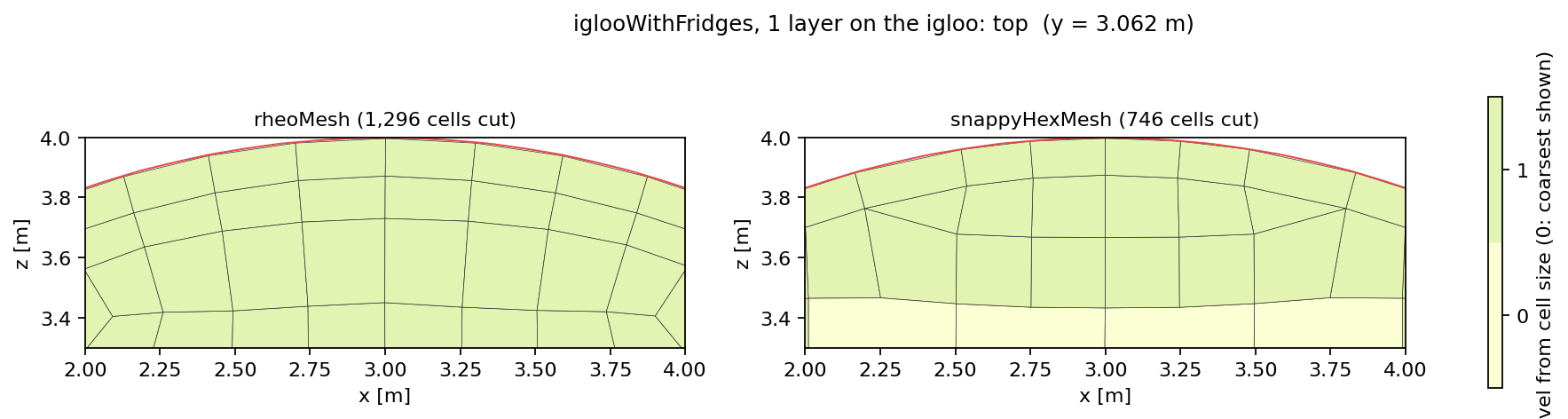
iglooWithFridges (3 layers on the fridges, 1 on the igloo), close-up 2, section y = 3.0625 m
motorBike (1 layer)
Section (y ≈ 0, no layers)
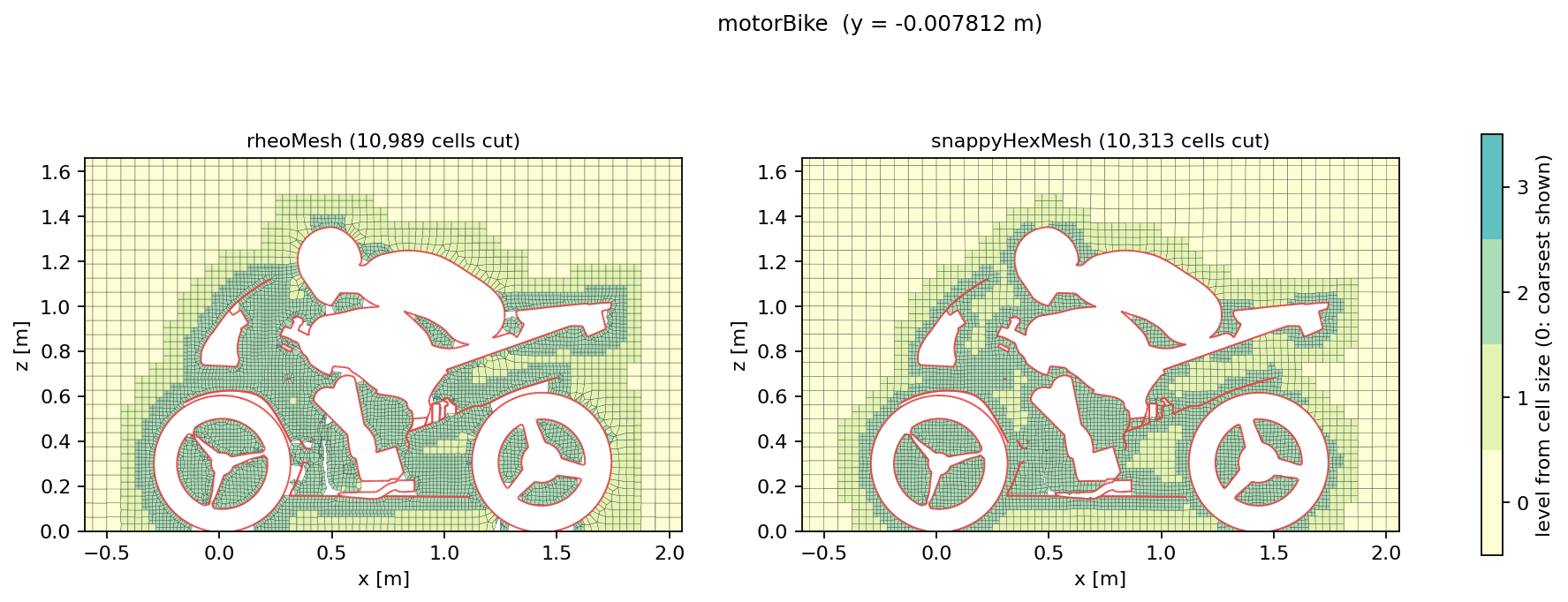
motorBike, no layers, section y = -0.0078 m
| rheoMesh | snappyHexMesh | |
|---|---|---|
| check | Mesh OK | 1 failed check (no layers) |
| time | 7.3 s | 28.4 s (whole process, 112 processes) |
| cells | 413,115 | 326,816 |
| max non-orth | 60.37° | 64.63° |
| max skewness | 4.00 | 10.43 |
Section (y = 0, with layers)
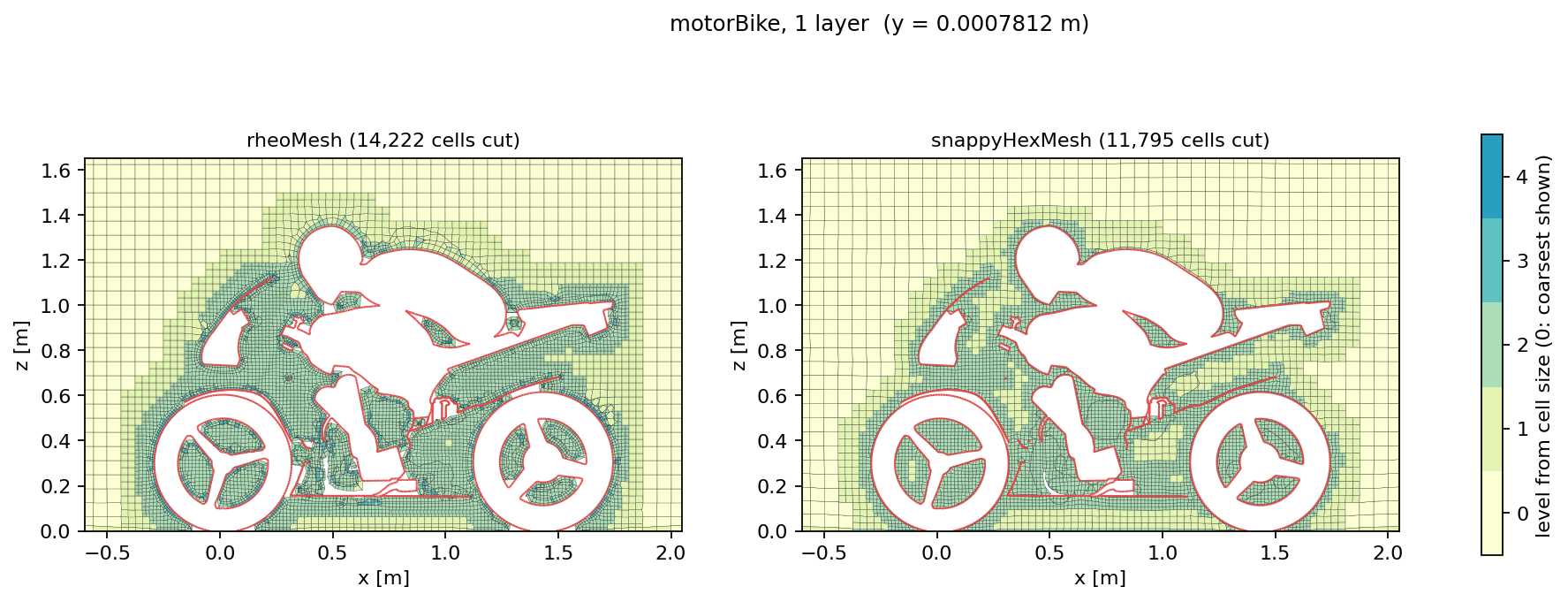
motorBike (1 layer), with layers, section y = 0.00078 m
| rheoMesh | snappyHexMesh | |
|---|---|---|
| check | 5 failed checks | 1 failed check |
| time | about 26 s (pass 1: 8.6 s, pass 2: 17.1 s) | 26.9 s (snappyHexMesh step, 28 processes) |
| cells | 529,312 | 355,442 |
| max non-orth | 91.84° | 65.00° |
| max skewness | 17.63 | 12.65 |
| layers (mean) | motorBike 0.47, lowerWall 0.96 | motorBike 0.54, lowerWall 0.99 |
Close-up 1: the top of the helmet
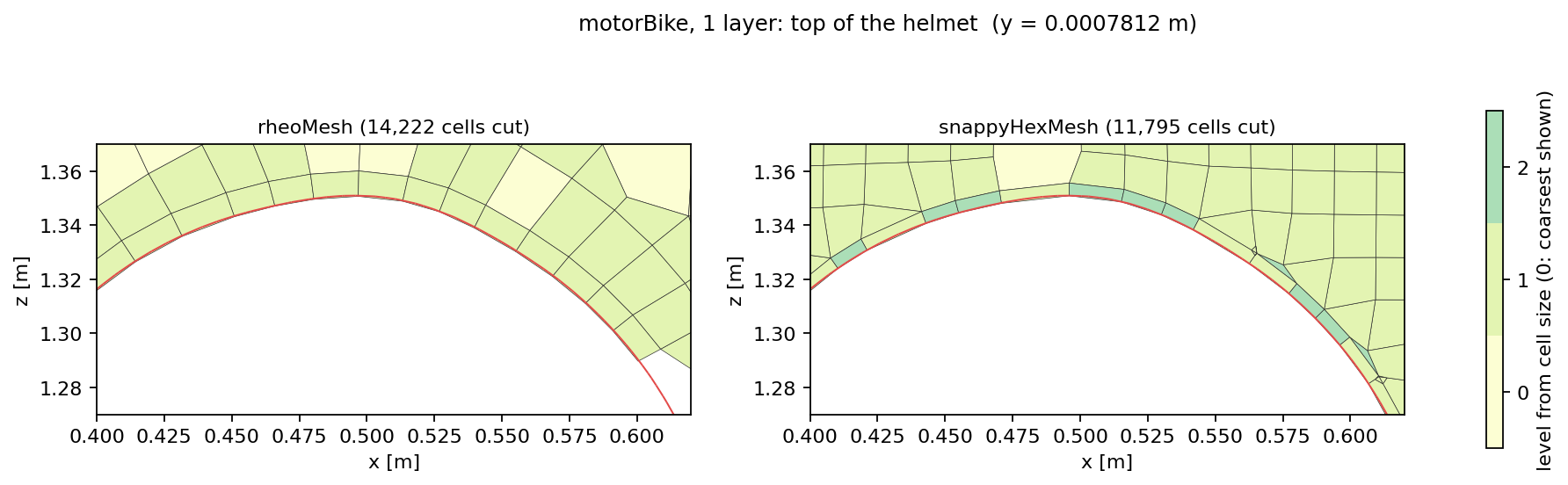
motorBike (1 layer), close-up 1, section y = 0.00078 m
Close-up 2: the floor (lowerWall) under the engine
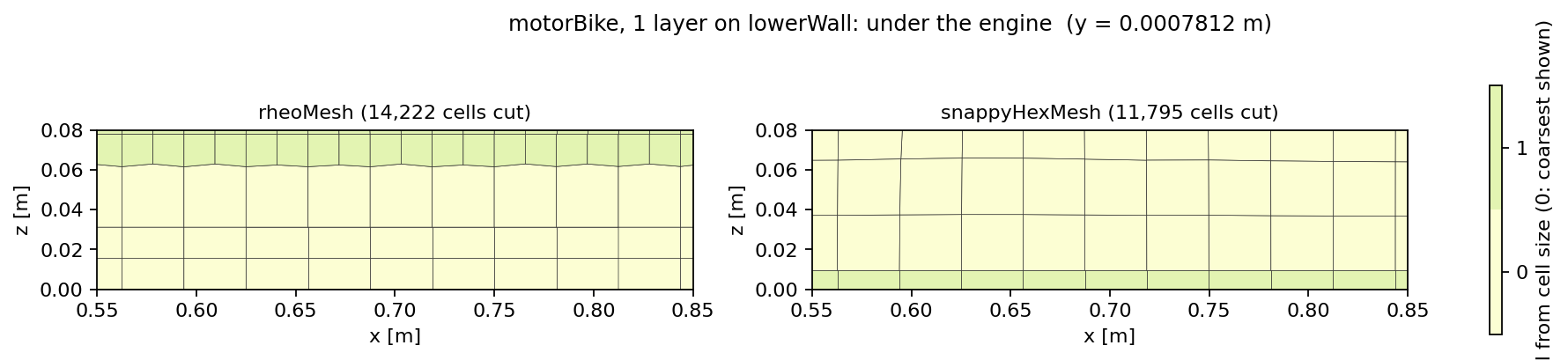
motorBike (1 layer), close-up 2, section y = 0.00078 m
Comparison with snappyHexMesh and cfMesh (2026-10-21 to 26)
Measured on the same DrivAer surface (Cranfield) and the same machines (2026-10-21 to 26). snappyHexMesh and cfMesh were used as black boxes; their sources were not read. The numbers are those of the versions at the time; the settings differ from the main-line est3cgN4vGrW30S2.
Parallelism and reproducibility
| rheoMesh | snappyHexMesh | cfMesh (v2512) | |
|---|---|---|---|
| Parallel model | threads in one process (ISO C++ parallel algorithms) | MPI domain decomposition (needs decomposePar) | OpenMP in one process |
| Decomposition / reconstruction | not needed | needed | not needed |
| Mesh vs thread / rank count | the same: 28 / 56 / 112 / 384 threads give byte-identical polyMesh files, also between Miyabi-C and Flow2 | identical on Miyabi-C and Flow2 at the same rank count (112); other rank counts not compared | differs: 151 cells change with the thread count |
Meshing time (about 3.4 M cells, 6 layers on the body)
Values of the October 2026 versions, not the current rheoMesh times. The latest comparison is "snappyHexMesh and snappyHexMeshLike compared (DrivAer, 2026-11-10)" on the rheoMesh page.
| machine and parallelism | time | mesh | |
|---|---|---|---|
| rheoMesh (l3f, body layers) | Flow2 Type I, 384 threads | 51.6 s (pass 1 9.1 s, pass 2 42.5 s) | 3.41 M cells, checkMesh OK (non-orth 65.0°, skew 3.92) |
| rheoMesh (l3wg3, body + tyre + ground layers) | Flow2 Type I, 384 / 112 threads | 54.7 s / 71.1 s | 3.53 M cells, OK (72.4°, 3.98) |
| snappyHexMesh (6 layers on body, wheels, ground) | Flow2 Type I, 112 ranks | 83.9 s ("Finished meshing"; whole process 107 s): refine 45.8, snap 13.4, layers 22.9 s | 3.43 M cells, 1 failed check (2 faces skew > 4, max 4.91), non-orth 64.6° |
| rheoMesh (l3f) | Miyabi-C, one node, 112 threads | 111.8 s | as above |
| snappyHexMesh | Miyabi-C, one node, 112 ranks | 113.7 s (whole process 147 s) | as above |
- Castellation alone: rheoMesh 1.6 s, snappyHexMesh 70.5 s on one Miyabi-C node (112 cores; N = 5, 2.86 M cells).
- Layers: snappyHexMesh 4.96 of 6 on the body on average (86.5 %, 1.29 cm), wheels 0.95 / 0.85. The rheoMesh main line (est3cgN4vGrW30S2): coverage 90.9 % without the gaps, no layer gaps.
cfMesh (another case, M, Flow2 Type I)
| parallelism | time | mesh |
|---|---|---|
| 384 OpenMP threads | 137.3 s (wall 292 s with start-up): octree 19.3, templates 11.8, layers 63.7 (+ volume optimisation 36.1) s | 4.08 M cells, 6 failed checks (1 185 faces > 70°, max 131.7°; 44 skew > 4, max 45.3; 18 negative volumes) |
| 48 threads | 173.9 s | 4.09 M cells, 6 failed checks |
- Eight times the threads give only 1.3 times the speed, and the layer optimiser is slower at 384 threads. Two layers at 46 % of the snappyHexMesh target thickness; the first-layer height cannot be set.
- The negative volumes and the 139° faces sit where the tyre nearly touches the ground (a µm gap) and at one underbody spot.
Memory
- cfMesh about 1 KiB per cell (M, 5.8 GiB); snappyHexMesh about 4.7 KiB per cell (L, 22.5 M cells, 106 GiB on 384 ranks).
- rheoMesh, a 20.75 M-cell mesh without layers: 455 B per cell at the extraction peak, 283 B per cell at the write (the layer stage not measured).