tgv3d-d3q19
英語 | 日本語
D3Q19 Taylor-Green vortex at Re=1600 -- the canonical 3D transition/decay benchmark (OpenLB turbulence/tgv3d menu). Fully periodic box [0,2pi]^3, BGK + Smagorinsky LES (explicit Hou et al. 1996 closure), GPU via stdpar. Clean-room: implemented from the standard TGV initial condition and the reference dissipation curve of Brachet et al. (1983) J. Fluid Mech. 130, and van Rees, Leonard, Pullin & Koumoutsakos (2011) J. Comput. Phys. 230 -- NOT from any GPL solver source.
概要: 3次元テイラー・グリーン渦 Re=1600。層流から乱流への遷移を経て散逸率がピークを打つ古典問題で、DNS のピーク散逸率と 0.80% 一致。単一の時系列全体を比べられるため、単発の数値照合より情報量が多い。
Geometry
Animation
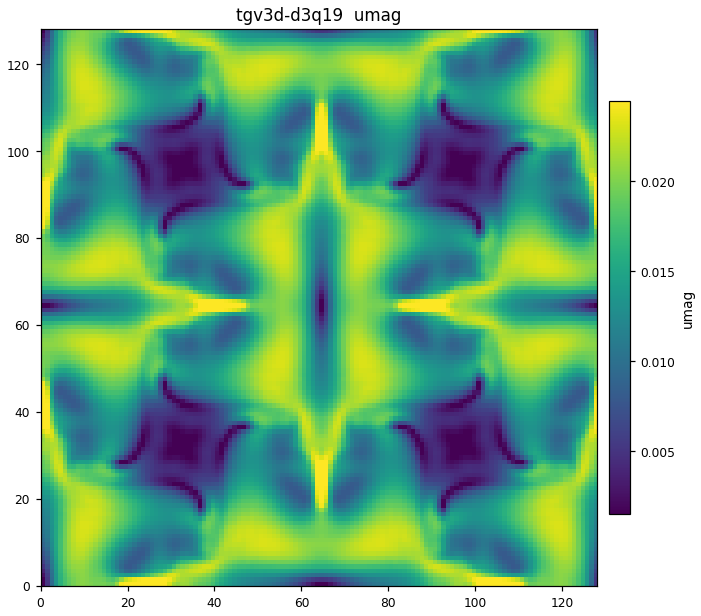
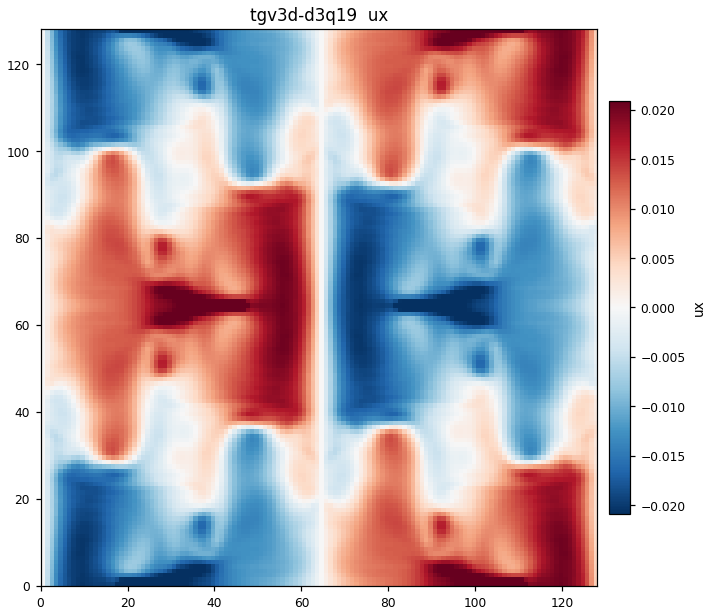
Fields
この計算が最後の出力ステップで書き出した場をそのまま描いたもの。3D ケースは中央断面。
Build & run
tgv3d_d3q19 N Re U0 t_end_star [Cs]
このページの図を作った計算のコスト(Miyabi-G Grace CPU (72 cores, -stdpar=multicore)): 170.6 s wall。
Validation
| Tier | T2 — 単点比較 |
| QoI | dissipation_rate |
| Reference | Brachet et al. (1983); van Rees et al. (2011) DNS Re=1600 dissipation |
| Gate | — ゲートなし |
| Measured | 0.0124 (rel. err +0.80%) — cross-code run (tgv3d) |
Source & run details
| Item | Value |
|---|---|
| Target | orheo-tgv3d-d3q19 |
| Source | native/benchmarks/tgv3d_d3q19.cpp |
| Lattice | D3Q19 |
| GPU twin | yes (orheo-tgv3d-d3q19-gpu) |
| Modules | lbm_d3q19.hpp |
| Gallery run | 2026-07-27 @ 7628c0cf |
| Args | `` |
| Wall time | 170.64 s |
| CPU time | 7231.07 s |
| Device | Miyabi-G Grace CPU (72 cores, -stdpar=multicore) |
Computation log
この計算の実際の出力(先頭と末尾)。
tgv3d N=128 Re=1600 U0=0.050 L=20.372 nu0=6.366e-04 tau0=0.50191 Cs=0.10  8148 steps (t*<=20)
  t*=0.00  E_k=0.12500  eps=0.00000
  t*=1.96  E_k=0.12368  eps=0.00087
  t*=3.93  E_k=0.12100  eps=0.00342
  t*=5.89  E_k=0.11228  eps=0.00647
  t*=7.85  E_k=0.09602  eps=0.01006
  t*=9.82  E_k=0.07378  eps=0.01058
  t*=11.78  E_k=0.05527  eps=0.00771
  t*=13.74  E_k=0.04326  eps=0.00558
  t*=15.71  E_k=0.03478  eps=0.00361
  t*=17.67  E_k=0.02830  eps=0.00262
  t*=19.63  E_k=0.02384  eps=0.00201
peak dissipation eps_max=0.01240 at t*=8.84  (ref ~0.0125 at t*~9)