GPU liquid cold-plate three-level multi-objective optimization (1D → FVM → LBM)
English | Japanese
« Optimization, inverse problems and uncertainty · « Home
Simultaneous three-level multi-objective optimization of a staggered cylindrical pin-fin liquid cold plate cooling a 700 W-class GPU module, running 1D screening, Grace CPU steady FVM optimization, and Hopper H100 unsteady 3D thermal LBM Pareto verification concurrently on a single Miyabi-G (GH200) node in 13.7 minutes.
Problem setup
- Domain: Periodic channel slice \(L = 36\text{ mm} \times W = 12\text{ mm} \times H = 3.0\text{ mm}\), heated die zone \(x \in [6, 30]\text{ mm}\) at \(q'' = 437.5\text{ kW/m}^2\) (equivalent to 700 W over a 40 mm × 40 mm die; \(Q_{\text{slice}} = 126.0\text{ W}\)).
- Fluid & solid: Water at \(T_{\text{in}} = 25\,^\circ\text{C}\) (\(\rho = 994\text{ kg/m}^3\), \(\nu = 7.2\times 10^{-7}\text{ m}^2/\text{s}\), \(\text{Pr} = 4.82\)), copper pin fins (\(k_{\text{Cu}} = 385\text{ W/(m}\cdot\text{K)}\)).
- Design variables (4): Pin diameter \(D \in [1.0, 2.4]\text{ mm}\), streamwise pitch ratio \(S_L/D \in [1.6, 3.2]\), transverse pitch ratio \(S_T/D \in [1.6, 3.2]\), inlet velocity \(U_{\text{in}} \in [0.18, 0.65]\text{ m/s}\).
- Objectives (both minimized): Pressure drop \(\Delta P\) [Pa] and chip peak temperature \(T_{\max}\) [°C].
Simultaneous resource allocation on 1 Miyabi-G (GH200) node
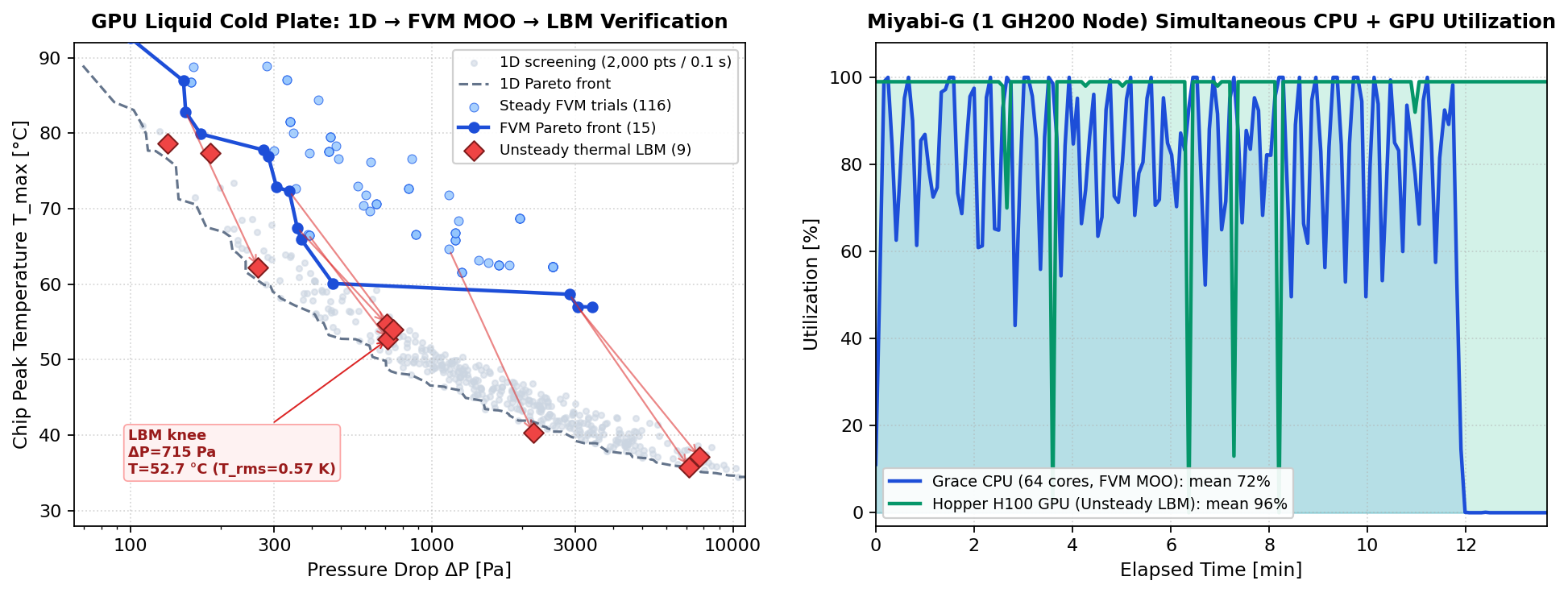
| Level | Method & grid | Hardware | Throughput | Mean utilization |
|---|---|---|---|---|
| 1D model | Zhukauskas / Short staggered pin-fin correlations + fin efficiency \(\eta_f\) | Grace CPU (1 core) | 2,000 candidates / 0.1 s (8 Pareto seeds) | — |
| Steady FVM | blockMesh + snappyHexMesh (140k–190k cells) + buoyantBoussinesqSimpleFoam (\(k\)-\(\omega\) SST) + Optuna NSGA-II |
Grace CPU 64 cores (4 workers × 16 MPI) | 116 trials (~20–26 s/trial), 15 Pareto designs | 71.9% (82.9% active) |
| Unsteady thermal LBM | D3Q19 TRT+Smagorinsky LES + D3Q7 thermal LBM (nvc++ -stdpar=gpu), 480×160×40 = 3.07 M cells × 70,000 steps |
Hopper H100 GPU + 8 Grace cores | 15 Pareto verifications (55 s each, 3,933 MLUPS mean) | 96.4% (~390 W) |
Multi-fidelity comparison across Pareto designs
Design (D / S_L/D / S_T/D / U_in) |
1D \(\Delta P\) [Pa] | FVM \(\Delta P\) [Pa] | LBM \(\Delta P\) [Pa] | 1D \(T_{\max}\) [°C] | FVM \(T_{\text{avg}}\) [°C] | LBM \(T_{\max}\) [°C] | LBM \(T_{\text{rms}}\) [K] |
|---|---|---|---|---|---|---|---|
Low-ΔP (1.84 mm / 3.12 / 2.77 / 0.32 m/s) |
168 | 191 | 184 | 71.1 | 79.8 | 77.4 | 1.92 |
Knee (1.02 mm / 2.42 / 1.99 / 0.25 m/s) |
988 | 464 | 715 | 46.6 | 60.0 | 52.7 | 0.57 |
High-cooling (1.10 mm / 1.77 / 2.90 / 0.54 m/s) |
5,318 | 1,148 | 2,173 | 36.8 | 64.6 | 40.3 | 0.23 |
Min-T (1.08 mm / 2.01 / 1.89 / 0.63 m/s) |
14,277 | 2,863 | 7,141 | 33.8 | 58.6 | 35.8 | 0.19 |
- Steady RANS (FVM) retains stationary recirculation wakes behind pins and overpredicts wall temperature, whereas unsteady 3D thermal LBM resolves Kármán vortex-shedding mixing—lowering predicted temperatures closer to empirical correlations while quantifying unsteady hotspot fluctuations \(T_{\text{rms}}\) (0.19–1.92 K).